
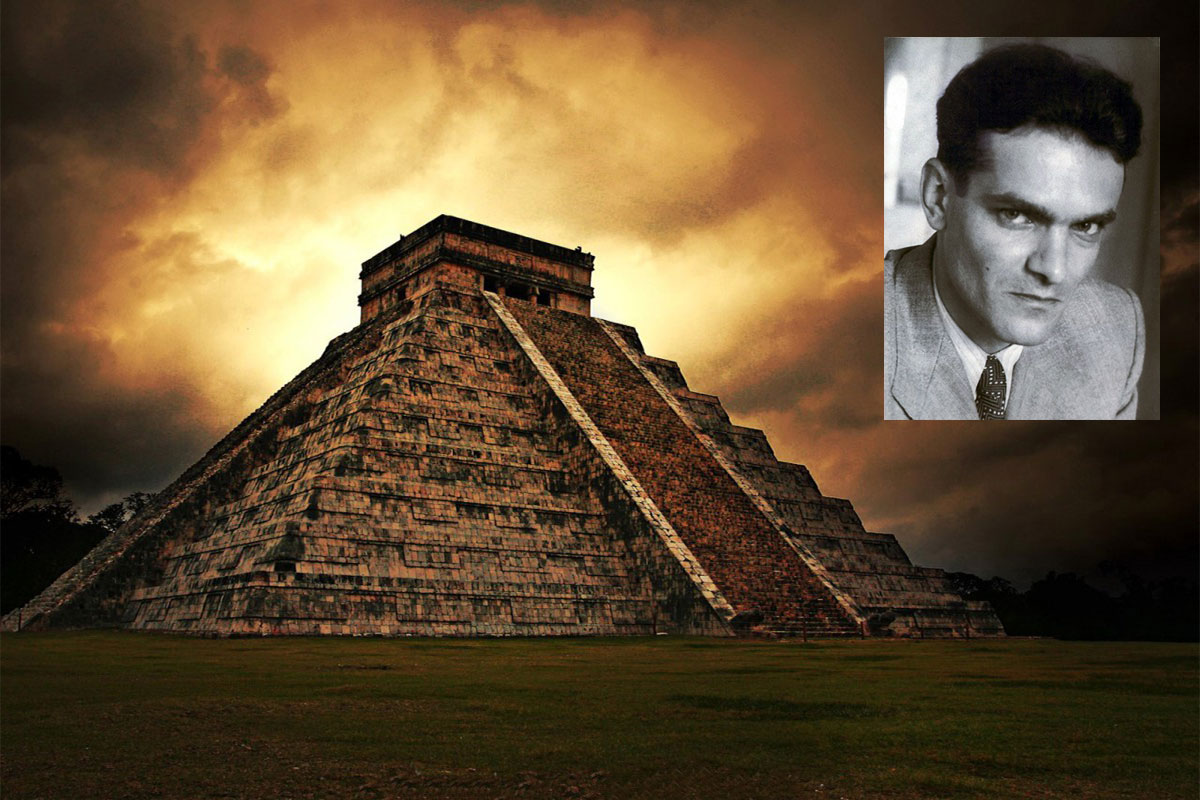
Who deciphered Maya writing?
It was one of those scientific stories that seems almost impossible. A Soviet researcher who had never set foot in Mexico managed to do what the world’s leading Mayanists had failed to achieve for decades: he proved the phonetic character of Maya writing and opened the way to reading it. Not through a jungle expedition, not through a sensational archaeological discovery, not through a new bilingual inscription like the Rosetta Stone, but through work at a desk, with books, tables, manuscripts and iron logic. Later, Yuri Valentinovich Knorozov would say, almost defiantly: “I am an armchair scholar. To work with texts, there is no need to climb pyramids.” In that sentence there was defence, irony and the pain of a man who for too long was not allowed to visit the cultural world of his greatest discovery.
On March 29, 1955, Knorozov went to defend his dissertation without knowing how it would end. In the atmosphere of Soviet science at the time, the discovery that Maya writing had a phonetic component carried not only scientific, but also ideological risk. According to rigid dogmas, pre-Columbian America had long been viewed through outdated schemes, and the existence of developed writing among the Maya challenged overly simple ideas about civilization, the state and cultural development. The 33-year-old researcher spoke for only a few minutes, but the result was almost unbelievable: he was awarded not a Candidate degree, but a Doctor of Historical Sciences degree. In the humanities, such a decision was extraordinarily rare.
From that moment, the history of deciphering ancient scripts increasingly came to be spoken through two names: Champollion and Knorozov. Jean-François Champollion opened the way to reading Egyptian hieroglyphs. Yuri Knorozov proved that Maya writing was not a collection of mystical symbols or purely ideographic signs, but a complex system in which phonetic and syllabic elements played a crucial role.
The path to the Maya began far from Mexico
Yuri Valentinovich Knorozov was born in 1922 near Kharkov, into a family of Russian intelligentsia. His father was an engineer, and the family valued education, music and books. As a young man, Knorozov played the violin, drew, wrote poetry and from the beginning did not fit comfortably into conventional school expectations. His character irritated many people: too independent, too sharp, too unlike the proper student.
In 1939 he entered the history department of Kharkov State University, and in 1940 continued his studies at Moscow State University, where he specialized in ethnography. He was interested in ancient cultures, shamanic practices, mechanisms of thought and methods of transmitting information. Even in that choice, the future Knorozov was already visible: a scholar interested not in one narrow subject, but in the very nature of signs, ritual, text and human communication.
The war sharply changed his biography. Knorozov was drafted into the army and served in communications units, including as a telephone operator in an artillery regiment. Later, a famous legend grew around his wartime biography: that in Berlin, from a burning library, he had carried out the books that later helped him decipher Maya writing. This version was repeated for years, but in his later life Knorozov called it absurd. According to him, there had been no burning library: the books were in boxes prepared for shipment and later ended up in Moscow.
Still, the mystery remains part of his myth. Knorozov really did obtain two publications of decisive importance: “An Account of the Things of Yucatan” by the sixteenth-century Franciscan Diego de Landa, and a publication reproducing the three surviving Maya codices — the Dresden, Madrid and Paris codices. Without these books, his work would have been impossible.
“An unsolvable problem”
After the war, Knorozov graduated from the history department of Moscow State University. His thesis and early publications were connected with ethnography and shamanic practices, but soon his attention was captured by Maya writing. An important trigger was an article by German researcher Paul Schellhas titled “The Decipherment of Maya Writing — an Unsolvable Problem.” For Knorozov, that phrase sounded almost like a challenge. He answered it with a sentence that became his scientific creed: “What has been created by one human mind cannot fail to be understood by another.”
He was denied admission to postgraduate study at Moscow State University. One reason was biographical “unreliability”: during the war, his mother had remained in occupied territory. In the late 1940s, Knorozov moved to Leningrad and began working at the Museum of Ethnography of the Peoples of the USSR, sorting collections damaged during the war. He lived there as well, in a narrow room filled with books and drawings of Maya signs. The setting was almost ascetic: a writing desk, an army cot and walls covered with materials for his work.
It was there, in this museum isolation in Leningrad, that the work began which would change the field of Maya studies.
Why his discovery was harder than it seems
Knorozov was often compared to Champollion. But in scientific terms, his task was even more difficult. Champollion had the Rosetta Stone — the same text in several languages, including understandable Greek. Knorozov had no full bilingual text. He had codices, fragments of manuscripts, Diego de Landa’s information, comparisons with Mayan languages and a method that required strict logic.
Before attempting to read the texts, Knorozov built a theoretical foundation. He distinguished the decipherment of an ancient writing system from the solving of a secret cipher. In a cipher, a known language is hidden by substituting signs. In an ancient script, the problem is different: the order of signs is not hidden, but their reading has been forgotten, and the language may be poorly known or substantially changed. Such work therefore requires not only cryptographic skill, but linguistics, history, ethnography, semiotics and knowledge of cultural context.
Knorozov developed a method generally associated with positional statistics: analysis of the number of signs, their frequency, their positions in the text, their repetitions, grammatical functions and possible correspondences with language. This approach made it possible to determine the type of writing system and gradually identify readings for individual signs.
The key of de Landa
The main key was Diego de Landa’s “An Account of the Things of Yucatan.” In the sixteenth century, the Spanish friar recorded a so-called Maya “alphabet.” For a long time, this material was considered mistaken or useless because it did not work like an alphabet in the European sense. Knorozov understood the essential point: de Landa had recorded not an alphabet, but a clue to syllabic reading.
When the Spaniard asked a Maya informant to write a letter, the informant was in fact not recording an abstract sound, but a syllable corresponding to the name of the Spanish letter. This was the decisive shift. What had once seemed confusion became the key. Maya writing turned out to be neither purely ideographic nor alphabetic, but logosyllabic: it combined word signs and syllabic signs.
Working with the Dresden, Madrid and Paris codices, Knorozov showed that the system had a phonetic basis and could be read. This did not mean that all texts immediately became clear. But the door had been opened. After him, the decipherment of Maya writing gained the methodological foundation without which modern readings of inscriptions, royal names, dates, dynasties and historical events would have been impossible.
Three and a half minutes that changed science
The first publication of his results appeared in 1952 in the journal Soviet Ethnography under the modest title “Ancient Writing of Central America.” In Soviet academic circles, the work was received as a sensation. The dissertation defence took place in Moscow on March 29, 1955. The topic sounded formally restrained — de Landa’s work as an ethnohistorical source — but in essence it involved proving the existence of developed writing and a complex Maya civilization.
The result became legendary: Knorozov was awarded the degree of Doctor of Historical Sciences. A young scholar who had never visited Mexico and worked from a museum room in Leningrad had become the person who moved one of the great mysteries of world scholarship forward.
In 1963, his monograph “The Writing of the Maya Indians” was published, laying out the principles of decipherment. In 1975, “Maya Hieroglyphic Manuscripts” appeared with translations of texts. These works secured the foundation of his method.
Recognition and resistance
Abroad, the reaction was mixed. Some scholars quickly understood the scale of the discovery. American archaeologist and Mayanist Michael Coe would later write that everyone working on the Maya was now, in a sense, a “Knorozovist.” But the influential British Mayanist Eric Thompson, who had long denied the phonetic character of Maya writing, met Knorozov’s work with sharp hostility.
The dispute was not only scientific, but also personal. To admit that the young Soviet researcher was right meant admitting that an entire school of thought, which had kept Maya writing within ideographic interpretations for decades, was wrong. After Thompson’s death and as new readings accumulated, it became clear: Knorozov had been right. Modern Maya studies stand on the foundation he helped create.
In 1956, Knorozov was allowed to attend the International Congress of Americanists in Copenhagen. But after that, almost until 1990, he could not travel abroad freely. Invitations from other countries often simply never reached him. He bitterly joked about the commissions responsible for “sending him” to Mexico, whose members had all already been there themselves. This inability to see the Maya world was one of the most painful and absurd features of his fate.
A scholar larger than one decipherment
Knorozov’s range of interests was enormous: ancient writing systems, linguistics, semiotics, shamanism, the peopling of the Americas, archaeoastronomy, the theory of the collective, brain development and mechanisms of communication. He was not a scholar of only one topic, even though the decipherment of Maya writing made him world-famous.
For him, writing was not merely a set of signs. It was a way to understand how a collective stores and transmits information, how civilizations arise, how symbolic thought develops, and how human beings transform experience into text, ritual, image and social memory. In this sense, Knorozov went far beyond the narrow boundaries of his specialty. He thought interdisciplinarily long before the word became fashionable in universities.
His method and approach were applied not only to Maya writing. He was interested in the writing of Easter Island, Proto-Indian texts and other forgotten systems. He generously shared ideas with students and colleagues, joking: “I am not an octopus.”
Mexico, Guatemala and late recognition
In 1975, Knorozov received the USSR State Prize. In 1990, after diplomatic relations between the Soviet Union and Guatemala were restored, he finally visited the land of the Maya at the invitation of President Vinicio Cerezo. There he received a high state honour and visited major archaeological sites, including Tikal. Having climbed a pyramid, he stood there silently for a long time. It is hard not to imagine this as one of the most powerful scenes of his life: a man who had read Maya texts for decades from thousands of kilometres away finally stood among the cities of the civilization whose writing he had returned to the world.
Mexico also recognized his achievements. In 1994, he was awarded the Order of the Aztec Eagle, Mexico’s highest honour for foreign citizens who have rendered exceptional service to the country. For Knorozov, this had special meaning. Accepting the award, he said in Spanish: “My heart always remains Mexican.”
In his final years, he was able to visit Mexico, live near the Maya world he loved, enjoy tropical nature, Mexican food and the night sky of Yucatán. Fate, which had kept him away from the place of his greatest discovery for so long, finally gave him that meeting — late, but real.
The end of a great life
Yuri Valentinovich Knorozov died on March 30, 1999. His death was bitter and unjust in its ordinariness: after a stroke and complications, he died in a hospital in Saint Petersburg. The man who had changed world scholarship and restored the voice of an ancient civilization left almost without the level of public attention he deserved.
But Knorozov’s scientific fate proved stronger than everyday injustice. His name is known today in Mexico, Guatemala, Russia and throughout the world wherever the Maya civilization is studied. Monuments to him have been erected in Mexico, his works continue to be read, and his phrase that what was created by one human mind can be understood by another has become almost a universal motto of science.
Knorozov proved not only that Maya writing could be read. He proved something larger: a breakthrough of genius can sometimes be born not at the centre of global expeditions, but in a cramped room, among books, stubbornness, solitude and absolute faith in the power of the human mind.
P.S. The scholarly legacy of Y.V. Knorozov is carefully preserved and developed. At the Russian State University for the Humanities, with support from the Mexican side, the Centre for Mesoamerican Studies was created during the scholar’s lifetime; today it bears his name.