
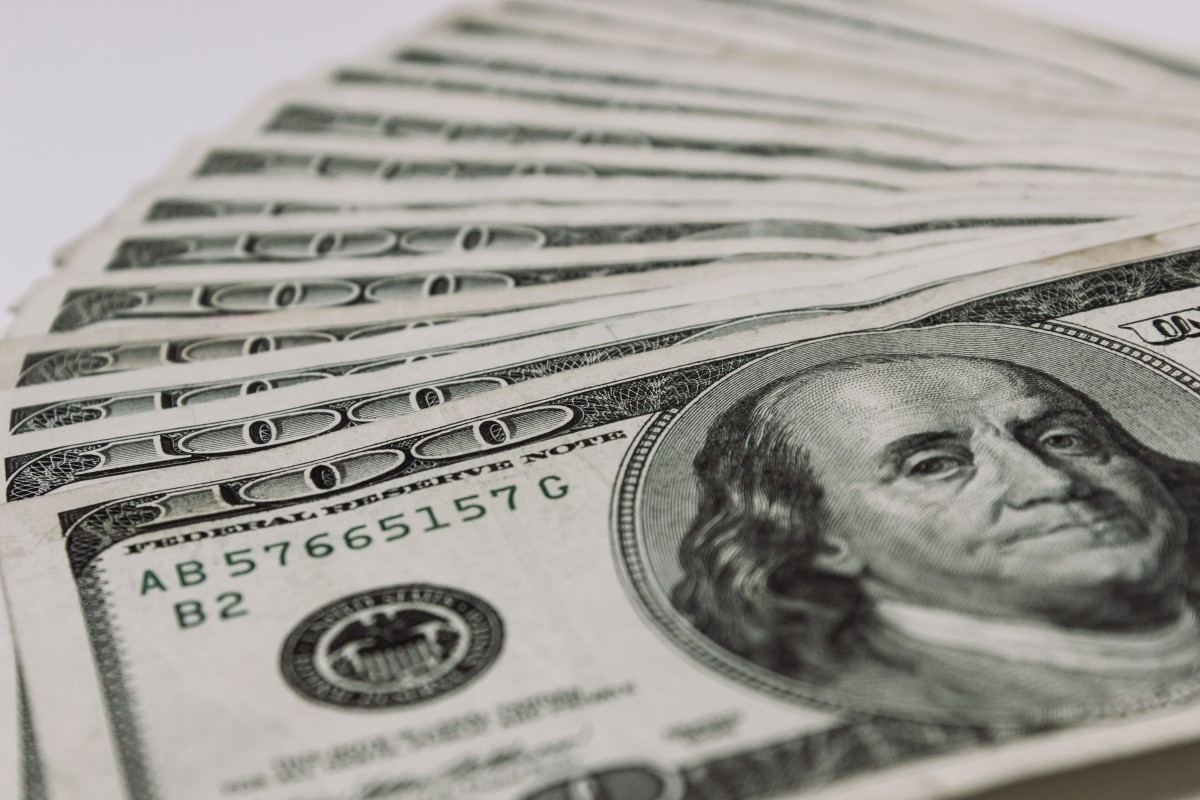
Why exactly is $ - dollar
Most people instantly recognize the letter S, crossed by one or two vertical strokes, as the dollar sign. The dollar is the main monetary unit not only of the United States, but also of many other countries. That is why the dollar symbol $ is used to denote not only the American dollar, but also the currencies of other nations, often with additional letters indicating a specific country: for example, Trinidad and Tobago — TT$, Barbados — BDS$, Australia — A$ or AU$, and so on. But why did the letter S become the basis for the symbol of the American currency, when the word dollar does not even contain that letter?
The history of the word dollar began in the 16th century in Bohemia, in what is now the Czech Republic. At that time, Europe became rich in silver for the first time in many centuries. For generations, Europeans had spent gold and silver buying silk, spices, and other exotic luxuries, and as a result, the precious-metal reserves of the Old World had been significantly depleted. In the early 16th century, large deposits of silver ore were discovered in Tyrol and Saxony, now regions of Austria and Germany, as well as in Bohemia. Silver coins soon began actively replacing gold coins in circulation. The Joachimsthaler was the name of a 16th-century coin minted near the silver mine in the Bohemian town of Joachimsthal.
The Bohemian Joachimsthalers became a standard in the minting of silver coins, and before long the shortened word “thaler” was being used to refer to almost any silver currency. Each nation adapted the Czech term in its own way: the Dutch pronounced it as “daalder,” in Slovenia “thaler” became “tolar,” and in Denmark, because of local pronunciation, the coin came to be called “daler.”
In Great Britain, somewhat later, the name transformed into the more familiar and modern-sounding “dollar.” In England during the 17th and 18th centuries, any silver coins resembling the thaler were called “dollars” — and one can already find a reference to them in Shakespeare’s Macbeth:
The King of Norway, craving composition,
Nor would we deign him burial of his men
Till he disbursed at Saint Colme’s Inch
Ten thousand dollars to our general use…
When Spain began actively exploiting the riches of the New World, Europe’s own deposits of precious metals lost their former importance. For the next several centuries, the world’s “silver centre” shifted to Bolivia, Peru, and Mexico. Reales, also known as “Spanish dollars” or “peso de ocho” — in English, “piece of eight,” because each real was worth one-eighth of an English pound — were minted from “Indian” silver, flooded Europe, and gradually pushed thalers out of the market, becoming the main international currency. To understand how deeply Spanish money influenced the culture and economy of that era, one only needs to look at the names of several modern national currencies.
Peso de ocho
In eight countries — Argentina, Chile, Colombia, Cuba, the Dominican Republic, Mexico, the Philippines, and Uruguay — the national currencies are called pesos. The Chinese yuan and the Japanese yen received their names from the shape of Spanish coins: in Chinese, “yuan” means round. Japan and China used those coins as a model when creating their own money. The riyals used in Saudi Arabia and the Qatari riyal also owe their names to Spanish reales. And finally, most importantly, when the young United States of America began minting its own money, it called its currency the “dollar,” since Spanish money was then widely used in domestic transactions.
We are used to seeing the dollar represented by the Latin letter S, usually crossed by two vertical lines, though sometimes by one. The single-stroke version is commonly used in print, because two thin strokes reproduce much less clearly at the small type sizes used in newspapers.
But where did this symbol actually come from? The origin and meaning of the dollar sign remain obscure and mysterious. The dollar has existed for more than two centuries — the American currency appeared in 1785 — and over that time it has accumulated many legends and theories, some of them quite convincing. Yet no version has been conclusively proven. We can only examine the main theories proposed by historians and decide which seems most plausible.
Possible Origins of the Dollar Sign
One of the most likely explanations traces the dollar sign to the Spanish abbreviation “Ps,” once used to denote the monetary units of Spain — pesos or piastres. According to this version, only the vertical stroke remained from the letter “P,” allowing the symbol to be written more quickly, while the letter “S” remained unchanged as the background. On the other hand, in this case the “S” is merely a secondary ending, indicating the plural form of pesos. For that reason, it does not seem entirely logical that accountants would have simplified the letter “P,” which identified the actual monetary unit, while preserving the plural ending.
It is often written that in 1778, the New Orleans businessman Oliver Pollock invented the dollar sign. According to this theory, the original meaning of the $ symbol was connected with Spanish piastres, which were widely used in America at the time. In business papers, piastres were traditionally abbreviated as the Latin letters PS, and when those letters were written one over the other, they produced the symbol used today.
Another theory claims that the letter “S” stands for the first letter of “Spain.” This view is supported by the fact that the letter S was allegedly stamped on gold bars exported from Spain’s New World colonies. When the bars were shipped to Spain, a vertical line was supposedly added to them, and after arrival another line was added to confirm the origin of the gold.
Some American experts believe that the “$” sign may have originated from the abbreviation “PTSI,” which was used to mark silver from the Bolivian mines of Potosí, the largest industrial mining centre in the world during the 16th and 17th centuries. This silver was used to mint peso coins from 1573 to 1825, and those coins circulated widely in Britain’s North American colonies.
The crossed “$” could just as easily be the remnant of a crossed-out figure eight. Spanish reales were once widely used in North America for monetary transactions. They weighed, and therefore were worth, one-eighth of an English pound sterling. In writing, they were marked as “1/8,” which is why they were called “pieces of eight.” The second stroke may therefore have come from the European scribal tradition of marking abbreviations in this way.
The “royal” version argues that the dollar sign is nothing other than a stylized version of the coat of arms of the Spanish royal family. In 1492, King Ferdinand II of Aragon chose the Pillars of Hercules, or Columnae Herculis, as a royal symbol. In antiquity, this was the name given to the rocks framing the entrance to the Strait of Gibraltar: the Rock of Gibraltar, the North Rock, Mount Jebel Musa in Morocco, and Mount Abila near Ceuta. A ribbon winding around the symbolic Pillars of Hercules bore the motto “Non plus ultra” — “nothing further beyond,” meaning beyond the limits of the known world. But after Columbus discovered new lands beyond Gibraltar, the motto was changed to “Plus ultra,” or “further beyond.” Emperor Charles V adopted this motto, and when the great silver mines of Mexico and Peru were discovered, the “$” symbol began appearing on New World coins, which circulated widely in Europe.
Another popular theory claims that the dollar symbol appeared thanks to the United States of America itself — a theory that, one suspects, may have been invented by Americans. In English, the country’s name is United States of America, abbreviated as USA. According to this version, the symbol derives from the English name of the American state. The first two letters, U and S, were supposedly superimposed, with the lower part of the U disappearing and only two vertical strokes remaining. Combined with the letter S, they created the symbol of the country’s national currency. This version smells rather strongly of patriotic invention. It was promoted by the American writer Ayn Rand.
The “silver” version resembles the previous one in that it also simplifies the letter “U,” but according to this theory the letters “U” and “S” stand for “Silver Unit.”
Nor can we completely rule out the theory that the symbol originated from the sign for the ancient Roman monetary unit known as the sestertius. The word sestertius comes from semis plus tertius — “half of the third,” or two and a half. It was a silver coin worth two and a half pounds of copper. The sestertius was represented by the letters “LLS” or “IIS,” and sometimes “HS.” This abbreviation can be read as “Libra-Libra-Semis,” meaning “Pound-Pound-Half.” In shortened writing, the two letters “L,” with their lower crossbars cut off, were placed over the letter “S,” producing something resembling a dollar sign. This was how the sestertius was written in ancient Rome. Roman themes were very fashionable during the Enlightenment. For example, the seat of the United States Congress is called the Capitol, after the Capitoline Hill in Rome, and the upper chamber of the U.S. Congress is called the Senate, just as it was in ancient Rome.
The religious version explains the symbol as a modified reverse of the Austrian thaler, which depicted the crucified Jesus and a serpent winding around the cross. The Masonic version, favoured by admirers of conspiracy theories and secret societies, claims that the “$” symbol represents the Temple of King Solomon: the initial letter of “Solomon” and two columns.
But the truth may be far more ordinary and may have been right under our noses all along: the dollar sign may simply have derived from the shilling, which is denoted by the letter “S,” sometimes “reinforced” by a vertical stroke.
As for the international custom of placing the dollar sign before the amount, this is a tradition Americans inherited from the English, who always placed the pound sign directly before the number.