
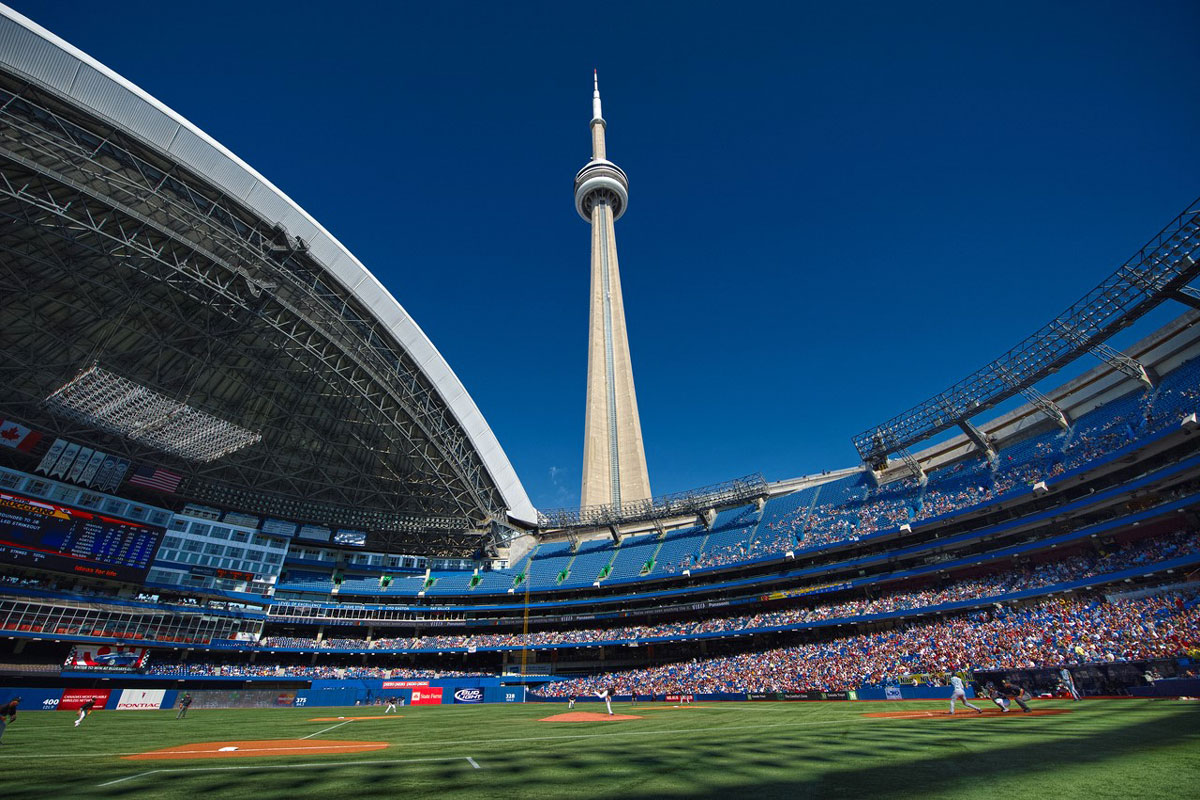
How the CN Tower was built in Toronto
The CN Tower is not simply Torontos most recognizable tower. It is the structure that changed the city’s silhouette, became a symbol of Canadian engineering ambition and turned the former railway lands by Lake Ontario into one of the most famous locations in North America. Today, it feels like a natural part of the Toronto skyline, but in the 1970s the idea of building a tower more than half a kilometre high seemed almost audacious. It had to solve a practical communications problem, become an architectural sign of the future and prove that Toronto was no longer just a business city on the lake, but a rising metropolis with an image of its own.
The CN Tower stands 553.33 meters, or 1,815 feet, tall including its antenna. For more than three decades, it remained the tallest freestanding structure in the world and still ranks among the most impressive engineering achievements of the twentieth century. But its story did not begin with tourist observation decks or a glass floor. It began with a far more practical problem: in the 1960s, Toronto’s rapidly rising skyscrapers began interfering with radio and television signals.
The city was growing upward, and the old communications infrastructure could no longer keep up. A tower was needed to lift antennas above the dense urban core and solve the signal problem for years to come. But as the project developed, it became something larger. The CN Tower would be not only a technical structure, but a symbol of a new urban confidence.
An idea born from a city of the future
Construction of the CN Tower began in February 1973. Before work started, engineers and architects studied other tall towers around the world, trying to understand what the new Canadian tower should be. The challenge was complex: the structure had to be record-breaking in height, stable, functional, visually distinctive and capable of welcoming enormous numbers of visitors.
Early ideas were quite different from what we see today. One initial concept included three separate towers connected by bridges. Eventually, the project became cleaner, more unified and more elegant: a single slender concrete tower with a strong base, observation levels and an antenna at the top. It was this clarity of form that made the CN Tower not just a tall object, but an architectural sign.
The name CN originally stood for Canadian National, because the tower was built by Canadian National Railway. In 1995, the tower was sold to Canada Lands Company, a federal Crown corporation, while the short and familiar name remained part of the city’s memory. Over time, CN came to be understood as Canada’s National, which reflects its current status well: it is no longer only a communications structure, but a national landmark.
A construction project that demanded precision
The work began with an enormous excavation about 15 metres deep. Tens of thousands of tonnes of earth and rock were removed from the site before builders could create the powerful foundation of the future tower. Around 40,500 cubic metres of concrete and thousands of tonnes of steel were used in the structure. The total mass of the tower is approximately 118,000 tonnes.
The main shaft of the tower was built using the slipform method. This meant that the concrete form slowly climbed upward as the concrete below it set. The work required almost surgical precision: at a height of more than half a kilometre, even a small error in vertical alignment could have become a serious problem. Engineers constantly checked the position of the structure, achieving remarkable accuracy for something of this scale.
By February 1974, the concrete shaft had already become the tallest structure in Canada. Construction then began on the main pod - the level where the observation decks, restaurant and public spaces are located today. This part of the tower had to be not only strong, but comfortable for the thousands of visitors who would one day rise to it every day.
Olga the helicopter and the final climb to the record
One of the most dramatic stages of construction was the installation of the antenna. It was originally expected to be lifted by more traditional methods, but a giant Sikorsky S-64 Skycrane helicopter named Olga was brought in. It carried antenna sections to the top, where they were installed one by one.
For Toronto, this became a spectacle in itself. People followed the helicopter flights, newspapers published the work schedule, and the construction site turned into a kind of civic performance. Using the helicopter reduced the installation time from several months to just a few weeks. On April 2, 1975, the CN Tower was completed and officially became the tallest freestanding structure in the world.
The tower opened to the public on June 26, 1976. From that moment, it became not only part of Canada’s telecommunications infrastructure, but Toronto’s defining tourist symbol.
Observation decks, a glass floor and the city below
The main visitor experience begins more than 340 metres above the ground. This is where the principal observation levels are located, including the famous Glass Floor, installed in 1994. For many guests, it becomes the most emotional part of the visit: not everyone is ready to step onto a transparent surface and see the city directly beneath their feet, even though the structure is engineered for enormous loads.
Higher still is The Top, an observation level at 446.5 metres. On a clear day, the horizon can stretch approximately 160 kilometres away. The city, Lake Ontario, the islands, suburbs and distant landscape come together in a panorama that no ordinary rooftop can offer. In especially good visibility, the Niagara region can even be seen.
The CN Tower is also known for its 360 Restaurant, which slowly revolves, allowing guests to see the city without leaving their table. Over time, the tower has become more than a place to visit for the view. It is a complete experience: dinner, observation decks, the glass floor, night lighting and the sudden feeling that Toronto can be understood all at once.
Elevators that feel like takeoff
The ride up the tower is part of the experience. High-speed elevators travel quickly and deliver visitors to the main levels in under a minute. The cabins include glass elements, offering views of the city and of the tower’s structure during the ascent.
When the elevators were designed, the planners thought not only about speed, but also about psychology. Height, enclosed space and rapid vertical movement can make people uncomfortable, so the cabins were designed to feel safe and visually open. The view outward helps reduce the sense of confinement, while the ride itself feels like a short vertical takeoff above the city.
Inside the tower there is also a staircase with 1,776 steps to the main level. It is not normally used by visitors for general access, but it has become part of well-known charity climb events, where participants ascend on foot to raise funds.
A tower that knows how to move
For someone standing high above the city, a slight movement in the tower can feel unsettling. In reality, it is normal. Tall structures should not be completely rigid: a certain flexibility allows them to work with wind and loads. Excessive stiffness would be more dangerous, because the energy of wind could not be safely distributed through the structure.
The CN Tower was engineered with a significant margin of safety. It is designed to withstand strong winds, extreme weather loads and seismic forces. Lightning is also a regular part of its life. The tower is struck many times in a typical year, but its protection system safely channels the electrical discharge. To the city, it looks dramatic; to the structure, it is an expected working condition.
Night lighting and a new image for the city
In 2007, the CN Tower received a modern LED lighting system. A network of 1,330 LED fixtures allowed the tower to become an active part of the night city. It can now change colours for national holidays, charitable campaigns, cultural events and important dates.
Most often, residents see the tower lit in colours connected with Canada, Toronto or a specific occasion, but technically the system can create millions of colour combinations. This changed the city’s evening image: the CN Tower no longer disappears after dark, but becomes a vertical beacon that unites the skyline and sets the emotional tone of nighttime Toronto.
Why the CN Tower still matters
Today, the CN Tower is no longer the tallest freestanding structure in the world. Its record has been surpassed, and the global race for height has moved far upward. But the tower’s significance has not diminished. Height was only part of its power. What matters more is that the CN Tower became the architectural symbol of a city that, in the 1970s, was only beginning to understand its own scale.
It was born from a technical necessity, but became a cultural sign. It was built for communication, yet it connected the city to a new image of itself. It rose among former railway lands, and today it stands at the centre of one of Toronto’s most dynamic areas, beside the stadium, museums, offices, hotels, restaurants and a constant stream of visitors from around the world.
The CN Tower reminds us that true urban symbols are rarely created for beauty alone. They appear when an engineering challenge, the ambition of an era and a sense of place come together. That is why this tower continues to function not only as a communications structure and attraction, but as Toronto’s vertical signature - visible from far away, instantly recognizable and still capable of producing that feeling: here is a city that once decided to rise higher.