
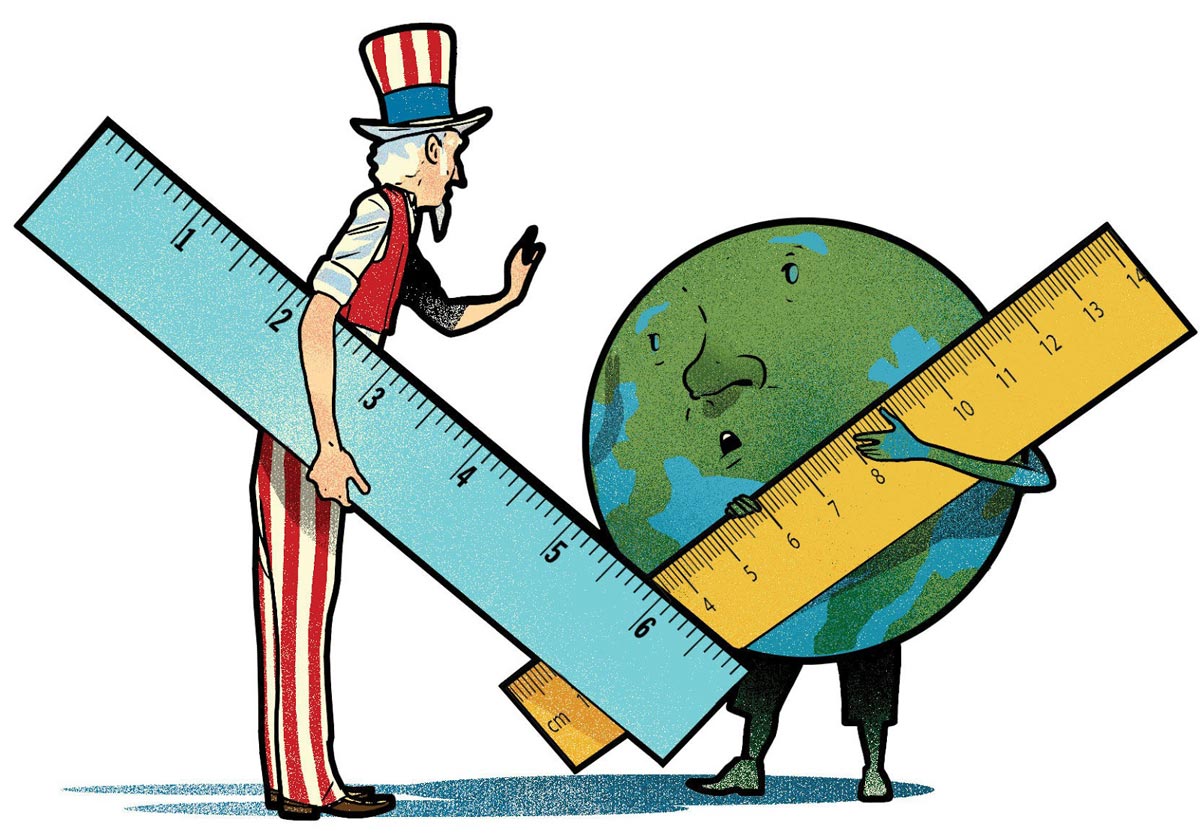
Why the United States did not switch to the metric system
You have probably wondered more than once why the screen sizes of digital devices are measured in inches. It has become such an accepted convention that almost no one stops to ask why we do not simply use centimetres instead — especially since inches would seem to belong firmly and permanently in the history books. The reason is that the United States and a few other countries, unlike most of the world, never fully switched to the metric system, preferring their traditional units of measurement to international metres and kilograms. And because many of the world’s largest technology corporations are based in the United States, the inch has remained firmly embedded in many related industries.
Together with high technology, these old-fashioned inches continue to reach the widest possible audience. At the very beginning of this story, however, one point needs to be clarified. There is a common belief that the SI system was never officially adopted in the United States. It is so little visible in everyday American life that a person who does not look too closely could easily get that impression. But it is completely wrong.
A whole series of acts has been adopted confirming the metric system as an official system of weights and measures in the United States. So how did it happen that Americans still use old units of measurement? The answer is that all these acts are advisory rather than mandatory for private business and ordinary citizens. This means that every American still has the right to measure in familiar inches and weigh in pounds known since childhood. And this right is used not only by individuals, but also by giant corporations. The United States, Liberia, and Myanmar remain the most famous holdouts.
Three Strongholds of Ancient Units of Measurement
There are only three countries in the world that have still not fully switched to the SI system: the United States, Liberia, and Myanmar, which was known as Burma until 1989. The rest of the world has either fully adopted the metric system or, at least, officially accepted it as the standard. What happens in everyday speech is another matter. In Russia, for example, someone may still jokingly call a kilometre a “versta,” but everyone clearly understands that they mean an ordinary metric kilometre, not the old Russian unit of distance. In the United States, however, the traditional system of weights and measures is used not only in casual conversation. Football fields are measured in yards. The work produced by automobile engines may be expressed in the unusual-sounding foot-pounds. Air pressure is measured in pounds per square inch. Instead of the international SI system, the United States uses the U.S. Customary System.
It includes more than three hundred units for measuring different physical quantities. The difficulty is that many of these units have the same names while meaning entirely different things. Let us take the simplest and most understandable example, even for someone far removed from engineering: the ton. What could be complicated about a ton? Surely it is one thousand kilograms, and nothing else. But in the United States there are at least nine definitions of the word “ton”: the short ton, displacement ton, refrigeration ton, nuclear ton, freight ton, register ton, metric ton, assay ton, and ton of coal equivalent. And despite all these obvious complications, neither American business nor everyday life has fully embraced the simple, clear, and unambiguous metric system. The reasons, as is often the case, lie in the country’s history. In the early years, America’s attitude toward the metric system was shaped by its relationship with France. In the British colonies, the British Imperial System was used. At the end of the 18th century, France developed the metric system, which, of course, was not adopted by Britain or its colonies. After the United States gained independence, attempts were made to bring order to the country’s measurement system. But these efforts, as so often happens, ran into the question of money.
Thomas Jefferson, who served as U.S. Secretary of State under George Washington, was sympathetic to the decimal system. But it turned out that defining metric units of length would require sending a delegation to France, and that was an expensive undertaking. Relations with France, which had supported the United States in its struggle for independence, began to cool after 1795. When France invited representatives of various countries in 1798 to familiarize themselves with the metric system, the Americans encountered a dismissive attitude. Nevertheless, representatives of the United States visited Paris and were deeply impressed by the metric system. But the chances of convincing the country’s leaders to switch to a new system of weights and measures coming from France were very slim. In 1821, U.S. Secretary of State John Quincy Adams studied the units of measurement used in 22 states and concluded that the U.S. Customary System was sufficiently unified and did not require change. Napoleon ruled France, and Americans began to doubt whether the French themselves would remain faithful to the system of weights and measures they had created. As a result, consideration of the metric system in the United States came to a halt at that historical stage. But that does not mean the issue was not raised again and again as the SI system gained wider recognition in many different parts of the world.
The United States Decides to Adopt the Metric System
In 1865, the American Civil War came to an end. Americans looked around and discovered that most European countries had switched to the decimal metric system. This obvious fact could no longer be ignored in the United States. In 1866, Congress passed an act making the metric system official for use in all contracts, transactions, and court proceedings. Nine years later, France gathered representatives of the world’s leading countries to discuss the details of a new international version of the metric system. The United States received an invitation and sent a delegation. Representatives of these countries signed an international convention establishing the International Bureau of Weights and Measures and the International Committee for Weights and Measures, whose role was to review and adopt changes. The agreement provided for the creation of a special hall in the French town of Sèvres, near Paris, where metric standards were to be kept, including the standard metre. This made it possible to avoid confusion among different nations about what exactly was meant by a particular unit of measurement. In 1890, the United States received copies of the international prototype metre and the international prototype kilogram.
Under the Mendenhall Order, named after the superintendent of weights and measures, metric units were adopted as the fundamental standards of length and mass in the United States. The yard was defined as 3600/3937 of a metre, and the pound as 0.4535924277 of a kilogram. In 1959, English-speaking countries made several refinements: one yard was defined as 0.9144 metres, and one pound as 0.4535923 kilograms. In other words, formally, the United States adopted the metric system as its standard of weights and measures 145 years ago, and for roughly 120 years everything in the country could have been measured in metres and kilograms. But as practice shows, making a decision does not mean bringing it into real life. The metric system in today’s United States has had many prominent supporters among scientists and politicians who believed it should become mandatory nationwide. In 1971, it began to look as though the United States would finally join the countries that had adopted the metric system. The National Bureau of Standards released a report titled “A Metric America,” recommending that the country switch to the metric system within ten years. In 1975, Congress passed the Metric Conversion Act, which had the same general purpose as the recommendations of standards experts, but with two important differences: no strict deadline was set, and the transition to the metric system was to remain voluntary. As a result, American schoolchildren began studying the SI system, and some companies attempted “metrication,” but it largely turned into ineffective promotion, since no real steps were taken to make metric units the standard in everyday use. The result is that the United States still uses units of measurement that most of the rest of the world has long since left behind. An increasing number of consumers of American products began demanding that supplied goods include specifications in the metric system. As American companies opened more and more production facilities in Europe and Asia, they had to decide which units to use: metric or traditional American. Recognizing these difficulties, Congress amended the Metric Conversion Act in 1988, declaring the metric system to be the “preferred system of weights and measures for United States trade and commerce.”
By the end of 1992, federal agencies were required to use metric units when measuring quantities related to procurement, grants, and other matters connected with business activity. But these requirements applied only to government structures. Private business remained free to use the familiar system of measurement. Attempts were made to interest small businesses in the metric system, but little progress was achieved. Today, only about 30 percent of products made in the United States are considered “metricated.” The American pharmaceutical industry is often described as strictly metric, because all specifications for pharmaceutical products are given exclusively in metric units. Beverages, meanwhile, carry labels in both metric and traditional U.S. units. This industry is considered “soft metric.” The metric system is also used in the United States by manufacturers of film, tools, and bicycles. In most other areas, however, Americans still prefer to measure the old-fashioned way.
In ancient inches and pounds. And this applies even to such a young industry as high technology. So what prevents a highly developed industrial country from switching to the system of weights and measures accepted across most of the planet? There are several reasons. Conservatism and cost are among the biggest obstacles to the transition to the metric system. One reason is the expense the national economy would have to bear if it fully switched to SI units. Technical drawings and manuals for highly complex equipment would have to be revised. This would require a great deal of work by highly paid specialists — and therefore a great deal of money.
For example, NASA engineers have reported that converting space shuttle drawings, software, and documentation into metric units would have cost 370 million U.S. dollars — roughly half the cost of a typical space shuttle launch. But high conversion costs alone cannot fully explain the cool American attitude toward the metric system. Psychological factors also play an important, and by no means secondary, role in slowing the country’s transition to an international system of weights and measures. The persistent conservatism of Americans makes them resist many innovations, especially those that come from abroad. Americans like to do things their own way. Individualism is one of the defining traits of this nation. The descendants of those who conquered the vast spaces of the Wild West stubbornly reject attempts to force them to abandon the inches and pounds familiar from childhood. No advanced technology can easily make a person revise deeply conservative habits. Commercial mobile communication, for instance, has existed since 1947, but it became truly interesting to the wider public only in the early 1980s. Change happens only when the consciousness of the average person is ready to accept it. And that, in turn, becomes possible only when a person sees a clear purpose in the change. The average American simply does not see much personal meaning in the metric system.
That is why all efforts to introduce the metric system in the United States run up against the seemingly unbreakable fortress of everyday life, where ordinary citizens have no desire to let metres and kilograms in. There is also another important reason, which we have already touched upon. A significant share of the world’s largest corporations are located in the United States. Their products remain competitive on the global market despite the unfamiliar inches and pounds. In fact, “despite” may not even be the right word. The whole world would be surprised if, one day, the screen size of the next smartphone were suddenly listed in centimetres instead of inches. And that means Americans have little practical reason to give up their traditional system of weights and measures.