
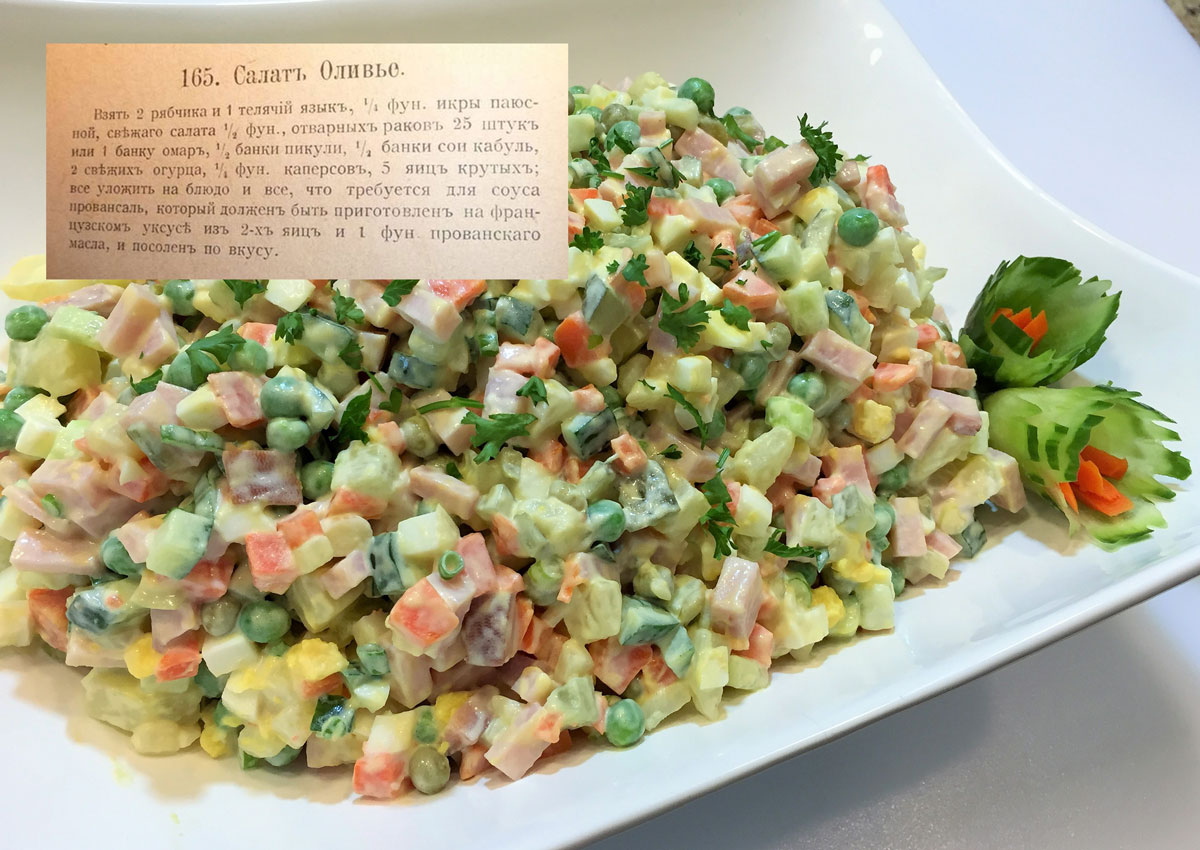
The real Olivier Salad and its history
The famous Olivier salad was created by a French chef in Russia in the second half of the 19th century, and the chef’s name often misleads people. Yet the fact remains: Lucien Olivier was the founder of the celebrated Hermitage restaurant and the creator of the magnificent salad that has survived to this day.
The elite Hermitage restaurant was built by Lucien Olivier after he had spent many years living in Moscow and understood exactly what the Russian capital was missing. It was missing French elegance. Joining forces with the wealthy merchant Yakov Pegov, Olivier purchased a plot of land in central Moscow and set out to build a first-class restaurant modelled on the finest French establishments. By the mid-1860s, on the site of a small booth that had once sold snuff, there stood a splendid building with white columns, crystal chandeliers, private dining rooms, and luxurious interiors. For Moscow at the time, this was something new, and the emerging bourgeoisie rushed to the restaurant. At first, Olivier’s establishment was called a tavern in the Russian style, and the waiters were dressed accordingly. The importance and popularity of the restaurant can be judged by several facts: in 1879, the Hermitage hosted a ceremonial dinner in honour of Ivan Turgenev; in 1880, one in honour of Fyodor Dostoevsky; and in 1899, the famous celebration of the centenary of Pushkin’s birth, attended by all the most prominent writers and poets of the era. University professors celebrated jubilees at the Hermitage, students marked Tatiana Day there, the intelligentsia gathered there, and wealthy merchants feasted there. In short, Olivier’s restaurant, like its superb cuisine, attracted the finest people of the time.
Lucien Olivier, the youngest of the three Olivier brothers, came to Moscow as a very young man to make a living. Like many Frenchmen, he hoped to apply his culinary talents in a country that had always held French cuisine in high esteem. While his brothers cooked for French gourmets, Lucien was opening his Hermitage restaurant. At first, the business brought in considerable income, and the young Frenchman prepared dishes he had known since childhood. A major part of this success was the family’s refined version of Mayon sauce, or mayonnaise. As early as the beginning of the 19th century, the Olivier family had begun adding mustard and several secret spices to the sauce, giving the familiar flavour a slightly piquant edge. The popularity of the Olivier family mayonnaise was so great that it allowed the elder brothers to maintain their business in France, while Lucien opened a Moscow “branch” on Trubnaya Square. The building where the restaurant was located still stands today: it is No. 14 on Petrovsky Boulevard, at the corner of Neglinnaya Street. Perhaps one day a commemorative plaque — or even an entire monument to Olivier salad — will appear there.
But everything in this world is fleeting, and gradually sauce alone was no longer enough to ensure the success of the establishment. Its taste quickly became familiar, and fickle fashion shifted toward thin, pale young ladies, whose beauty, naturally, was not helped by Olivier’s rich and high-calorie sauces. Something new had to be invented urgently. And so Lucien Olivier created a new salad — a genuine work of culinary art. Its flavour was so refined that it instantly brought the Frenchman fame as a great chef, while the popularity of his restaurant, which had begun to fade, flared up again with renewed force. Visitors named the new dish Olivier Salad, perfectly in keeping with the Russian habit of naming dishes after their creators. From that moment on, the name Olivier became a household word. Countless cooks tried to reproduce the salad, eventually simplifying the recipe so dramatically that the modern version is almost the complete opposite of the original. Many chefs attempted to recreate Olivier’s recipe, but without knowing all the ingredients, they inevitably failed. The taste of the true Olivier Salad could be experienced only at the Hermitage restaurant.
The flavour of the famous dish was due in no small part to Monsieur Olivier’s own mayonnaise recipe. It was said that the Frenchman guarded the recipe jealously and prepared the sauce in a special small room behind a closed door. The path to the salad was not straightforward. Originally, Olivier created a dish called “Mayonnaise of Game.” It consisted of cooked fillets of hazel grouse and partridge layered with jelly made from broth. Around the edges of the dish lay boiled crayfish tails and small pieces of tongue. All of this was dressed with a small amount of his own Provençal sauce. In the centre, the composition was decorated with a small mound of potatoes, gherkins, and slices of boiled eggs. According to the author’s idea, the central potato element was intended more for beauty than for eating. One day, Lucien Olivier noticed that some Russian diners, after ordering the dish, immediately destroyed the entire concept by mixing the whole composition together with a spoon and eating the resulting delicious mass with great appetite. The next day, the enterprising Frenchman mixed all the components himself and poured the sauce generously over them. Thus the famous salad was born — transformed from an exquisite but inconvenient “mayonnaise of game” into an equally refined dish, yet one far closer to the Russian soul: Olivier Salad.
Here is the recipe for the classic Olivier Salad as prepared during the Hermitage restaurant’s finest years, reconstructed in 1904 from the descriptions of one of the restaurant’s regular patrons:
Fillets of two boiled hazel grouse,
One boiled veal tongue,
About 100 grams of pressed black caviar,
200 grams of fresh lettuce leaves,
25 boiled crayfish or one large lobster,
200–250 grams of small gherkins,
Half a can of soy cabul, a soybean paste,
2 finely chopped fresh cucumbers,
100 grams of capers,
5 finely chopped hard-boiled eggs,
Dressing with Provençal sauce: 400 grams of olive oil beaten with two fresh egg yolks, with the addition of French vinegar and mustard.
One of the secrets of the classic taste of Olivier Salad lay in the Frenchman’s addition of certain spices. Unfortunately, the composition of these seasonings is unknown, so the true flavour of the salad can only be imagined from the descriptions of contemporaries.
The preparation itself was no less fascinating:
Fry the hazel grouse in a 1–2 centimetre layer of oil over a strong flame for 5–10 minutes. Then place them in boiling water or broth, either beef or chicken. Add 150 ml of Madeira to 850 ml of broth, along with 10–20 pitted olives and 10–20 small mushrooms, and cook for 20–30 minutes over low heat under a lid. When the meat begins to separate slightly from the bones, add salt, allow it to cook for another couple of minutes, and turn off the flame. Place the pot with the hazel grouse, without draining the broth, into a large container of cold water and let it cool. The purpose is to allow the meat to cool gradually. If the meat is separated while still hot, it begins to dry out and loses its tenderness. However, one must not overdo it: the meat should be removed while still warm. Do not let the hazel grouse become completely cold, or the meat will no longer come away from the bones properly. Wrap the removed meat in foil and place it in a cold place. Do not discard the broth after cooking the mushrooms — it will make an excellent soup. If you cannot find hazel grouse and decide to replace them with chicken, remember that the chicken should be cut into two or three pieces and cooked a little longer, about 30–40 minutes.
The tongue should be free of fat, lymph nodes, sublingual muscle tissue, and mucus. Half a tongue may be enough. Rinse it very thoroughly in cold water, place it in cold water, bring it to a boil, and cook over low heat with the lid tightly closed for 2–4 hours. The time depends on the age of the owner of the tongue: for a young calf, two hours will be sufficient. Half an hour before the tongue is ready, add chopped carrot, parsley root, onion, and a small piece of bay leaf to the same pot. Add salt 5–10 minutes before the end of cooking. As soon as the tongue is cooked, immediately place it in a container of cold water for 20–30 seconds, then transfer it to a plate and remove the skin. If the tongue still burns your fingers, dip it in the water once more. Once cleaned, return the tongue to the broth and quickly bring it back to a boil, then turn off the flame and place the pot to cool in a larger container filled with ice water. Wrap the cooled tongue in foil as well and place it in a cold place.
Cut the pressed caviar into small cubes.
Rinse the lettuce leaves thoroughly, dry them, and cut them immediately before preparation.
Place live crayfish, washed in cold water, headfirst into a boiling cooking liquid. To prepare the liquid for boiling crayfish, take 25 grams each of parsley, onion, and carrot, 10 grams of tarragon, 30–40 grams of dill, one bay leaf, several allspice berries, and 50 grams of salt. After placing the crayfish in the boiling water, allow the water to return to a boil and cook for another 10 minutes. After turning off the heat, do not remove the crayfish immediately. Let them steep, and then cool the pot with the cooked crayfish using the method described above.
Finely chop the pickles just before mixing.
Mash the soy cabul before adding it to the salad.
Peel the fresh cucumbers and chop them finely. They do not have to be perfectly even; they may simply be crumbled. Finely chop the capers as well, after drying them first.
The eggs must be large and fresh. Do not overcook them under any circumstances. Treat this part carefully. The eggs should taste fresh, and the whites should be tender, not rubbery. Boil them for 7–8 minutes, certainly not 15.
Cut and combine all the ingredients, trying to do so carefully with lifting motions from the bottom upward. Add homemade mayonnaise and serve immediately. It is also important to consider how much alcohol the guests have consumed. The more they have drunk, the sharper the sauce should be. If the guests are sober, it is more logical to dress the salad with classic mayonnaise in order to appreciate the delicate flavour of all the ingredients.
Such was the recipe at the time it was reproduced by one of the restaurant’s regular customers. It is possible that something was overlooked, but the main components — those that would have been difficult to conceal from a sophisticated public — are present in the recipe. The secret of the spices that gave the dish its signature and unique flavour has, unfortunately, been lost. After Lucien Olivier’s death in 1883, the Hermitage restaurant passed to the “Olivier Partnership.” For a long time, the restaurant changed hands, while the famous recipe travelled into the wealthy homes of the capital — or, more precisely, into their kitchens. The personal chefs of many of Moscow’s richest people tried to recreate the French master’s recipe and served the celebrated salad at formal dinners. This situation might have continued indefinitely had it not been for the First World War and then the Revolution of 1917. The sudden disappearance of many products struck Olivier Salad hard. At that time, there was no room for delicacies: for many years the country sank into a dark period of upheaval, and in terms of food, into severe hunger and a ration-card system. But in 1924, the NEP era began, and products that had seemed gone forever once again appeared in the country.
Even so, much could no longer be restored. Hazel grouse and crayfish tails, branded as “bourgeois,” became unavailable and, quite simply, irrelevant to the city dwellers of that time. The NEP period gave rise to several versions of the salad. One of the restaurants where such a version appeared — and it must be said, one of the central restaurants of the period, since high-ranking Party officials dined there — was the Moscow restaurant. It was headed by Ivan Mikhailovich Ivanov. He preserved the famous dish in a modified form, but one still close to the original. The realities of the time, however, introduced their own changes into the recipe.
Recipe for Olivier Salad according to the Moscow restaurant version of the mid-1920s:
Ingredients:
6 potatoes,
2 onions,
3 medium carrots,
2 pickled cucumbers,
1 apple,
200 grams of boiled poultry,
1 cup of green peas,
3 boiled eggs,
Half a cup of olive-oil mayonnaise,
Salt and pepper to taste.
Preparation: Use fresh, medium-sized vegetables. Cut all ingredients finely and very evenly into equal pieces. Boil the potatoes and carrots, peel them, cut everything, mix, and dress with mayonnaise. Garnish the top with parsley and apple slices.