
How passenger railways were destroyed in the United States
What happened to passenger rail travel in the United States? A country that calls itself a global superpower — and that was once a true kingdom of busy steel highways — effectively and deliberately dismantled mass passenger transportation by rail after the Second World War. Grand stations built during the golden age of rail were ruthlessly demolished, remodelled beyond recognition, or simply abandoned. Legendary, often almost fantastical transcontinental trains that had been part of Americana, part of the country’s material culture, for decades were simply thrown onto the scrap heap of history. How did this happen?
It would not be an exaggeration to say that the United States owes much of its present role as a superpower to rail transport. Passenger service on the country’s oldest railroad, the Baltimore and Ohio Railroad, began in May 1830, and it was an event that forever changed how Americans saw their country — and themselves.
The development of steel highways advanced at an avalanche pace. Thanks to the railroads, the products of factories, mills, and farms could be delivered quickly to ocean ports for export, bringing the United States money and prosperity for both industry and agriculture. People soon forgot the Spartan conditions of stagecoach travel and began to journey in comfort. Railroads dramatically shortened distances across a vast country, giving its population unprecedented mobility — and with it, access to the very American dream. The rails, and the fortune-seekers who arrived along them, truly conquered the Wild West. They were what made the States genuinely United.
The Golden Age
By 1916, the last peaceful year for America before the First World War, the total length of the country’s railroads had reached a staggering 409,000 kilometres. For comparison, that same year the total length of all similar lines in the Russian Empire barely exceeded 70,000 kilometres. In the USSR — a true railway empire — the network, at the peak of its development and including industrial sidings, amounted to 220,000 kilometres. In China, which has launched enormous railway construction projects, the rail network has only recently exceeded 120,000 kilometres and is expected to “only” double by 2050.
A hundred years ago, the United States, especially its eastern half, was covered by a dense railway web. Of course, it was far from perfectly rational. The country had many competing private operators whose railroads often duplicated one another. Moreover, the rail boom also produced phenomenal speculation. Cornelius Vanderbilt, J. P. Morgan, and Jay Gould made their millions — today’s billions — on railroads, and, naturally, such a path to wealth could not fail to attract swindlers and adventurers of every scale.
From time to time, the boom turned into a bubble, and the bubble burst. Uncontrolled construction for the sake of construction, the bankruptcy of banks that had financed it, and speculation in railway-company shares became direct causes of the stock market crashes of 1873 and 1893. Yet despite all this, America’s rail network continued to expand, reaching its peak just before the First World War.
The railroads effectively made the United States a powerful industrial nation. Thanks to them, hundreds of millions of acres of valuable land in the centre of the country were brought into agricultural use, which in turn helped lower the price of food and other goods and encouraged the flow of destitute immigrants from the Old World to America. Railroads stood at the forefront of progress. They were not merely a symbol of the country, but also a major driver of science, technology, and modern business practices, many of which were born in their office buildings. Railroads made America America.
At the turn of the 19th and 20th centuries, railway operators built grand stations in major cities across the country — real palaces, the American equivalents of European castles, temples of transportation. For an ordinary citizen, entering one of them became an event in itself. Inside these colossal buildings, the worker and the farmer, the newsboy and the laundress, the official and the clerk, the writer and the gangster all felt that they were part of a genuine ritual: the beginning, or the end, of a Journey. The future of American railroads seemed cloudless. But that was only a mirage. Clouds were already gathering on the horizon, and each of them had the shape of a Ford Model T rolling off Henry Ford’s assembly lines.
For about 70 years, roughly until 1920, railroads remained almost the only means of intercity travel in the United States. With the start of mass automobile production, the appearance of buses, and the construction of the first highways, the popularity of train travel began to decline gradually. At first the process was slow and not especially noticeable, particularly because in the 1930s American railroad companies began introducing entirely new kinds of rolling stock and new formats of travel. Streamline came into fashion — an artistic style, a branch of Art Deco, characterized by smooth silhouettes and a swift, aerodynamic image associated with something ultra-modern, even futuristic.
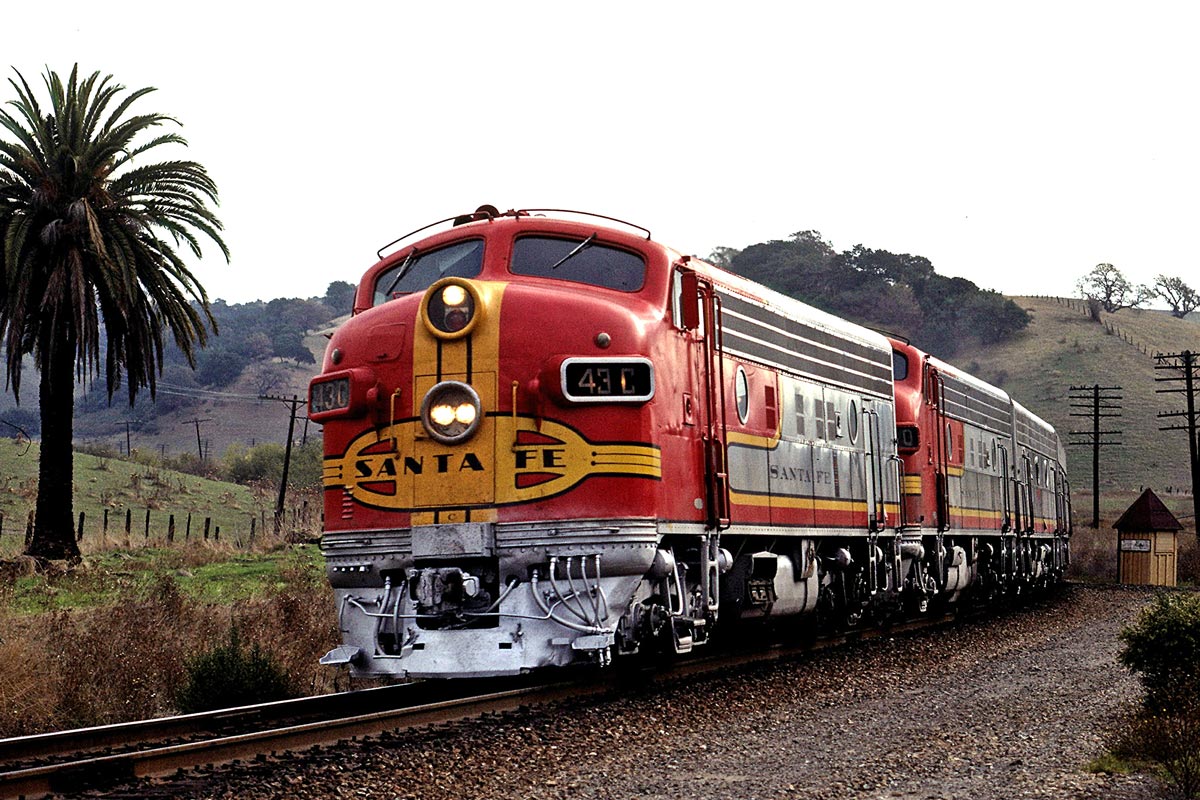
The archaic forms of steam locomotives gave way to futuristic engines finished in gleaming polished metal and resembling early rockets more than traditional trains. Across the country, the famous California Zephyr, Texas Zephyr, Super Chief, Flying Yankee, and Rock Island Rocket raced ever faster along the rails — their very names encoding, in every possible way, their main advantage: speed. Speed and comfort. In these luxurious trains, in addition to sleeping cars that offered an unprecedented level of comfort, there were restaurants, lounge cars, and even special observation cars with panoramic glazing that allowed passengers to enjoy the passing landscape without interrupting a cocktail conversation. It was a triumph of industrial design — probably the highest point in the development of American railroads, and also their swan song.
The End of an Era
During the Second World War, the steel highways received their final push. Gasoline became a strategic commodity, its distribution was rationed, and people once again returned to trains. But with the end of the war and the beginning of rapid economic growth in the United States, railroads increasingly moved into the background. Streamlined trains still retained a certain popularity by inertia for about another decade, especially on long-distance routes, but mass passenger travel steadily declined. By 1946, the United States was already running 45% fewer trains than in 1929, and the exodus of passengers only intensified from there. As passenger numbers fell, so did the revenues of private railroad operators. Their debts grew, the first bankruptcies began, and the state removed itself from subsidizing rail transportation. It had found new favourites.
Traditionally, railroads in the United States had been a private business. Their successful development had been interrupted more than once by crises, but the rail magnates, losing one colleague after another, always managed to climb out and continue making money on their own. The rail network was already highly developed — perhaps even overdeveloped — and the federal government concentrated its efforts on other infrastructure projects. In 1956, the United States began large-scale construction of the Interstate Highway System, a project that stretched over 35 years and cost taxpayers hundreds of billions of dollars. President Eisenhower, who had commanded Allied armies in Europe during the Second World War, had been deeply impressed by Nazi Germany’s autobahns and became determined to create a similar network of high-speed roads in his own country. In addition to their defensive importance, they were meant to give ordinary Americans — increasingly motorized Americans — the opportunity to travel across the United States quickly, safely, and independently.
This was a heavy blow, but it was far from the only one that began the complete rout of passenger rail service in America. At the same time, civil aviation was entering its new jet age. The federal government subsidized its development and the fundamental lowering of domestic airfares, including through the construction of airports — not only in large cities, but also in medium-sized and even small towns and communities. That last point was crucial. After a while, it turned out that one could fly to literally any town in the vast country — or at least to its nearest surroundings.
The private railroad companies, born of the free market and having earned billions of dollars within it, suddenly faced that same market’s bared teeth. Deprived of government support and preoccupied with competing against one another, they could not keep fares competitive with automobile and air travel. For a hypothetical farmer in Nebraska who had earned some money and wanted to vacation somewhere in Florida, it simply became more convenient and cheaper either to drive there in his own car along the highway, or to drive to the nearest airport and, within a few hours — even with connections — find himself by the warm blue sea.
The railroad companies found themselves trapped: burdened with enormous infrastructure, main lines that often duplicated one another, rapidly falling passenger traffic and revenues, and equally rapidly rising debts. Faced with complete indifference from the state, they were forced to begin cutting costs. The enormous palace-like stations in city centres, with customers disappearing, became an unbearable burden, and companies began getting rid of them. In New York, the monumental Pennsylvania Station, which occupied several city blocks, was ruthlessly demolished in the 1960s, shocking contemporaries. The famous Grand Central, also in New York, was saved only by a miracle.
Their counterparts in other major cities met different fates. Some, such as Union Station in Washington or Los Angeles, retained more or less active long-distance and commuter train service and continued to function as intended. Others, such as the stations in Cincinnati or St. Louis, were eventually repurposed for other uses — museums, shops, or entertainment complexes. The gigantic complexes in Detroit and Buffalo were far less fortunate: they were simply abandoned.
Trains were cancelled en masse. Because of the infrastructure crisis, many of the remaining trains ran with ever longer delays, often from inconvenient stations on the outskirts of cities. Routes were closed, and with them thousands of stations. Passengers simply stopped seeing the railroad as a reliable means of reaching the destination they needed. Rail transport was no longer associated with progress, modernity, or the spirit of the space age.
Its place was taken by jet aviation and the private automobile, which gave Americans — traditionally individualistic in spirit — the desired sense of independence. The infrastructure created according to Eisenhower’s vision, with interstates literally lined with motels and diners, provided the space needed to turn that independence into reality.
The final blow to private passenger railroad companies came in September 1967, when the U.S. Postal Service refused to continue using their services. Payment for carrying mail had allowed carriers to keep many remaining routes on the edge of profitability, and the loss of such an important customer triggered yet another wave of mass eliminations of familiar routes.
In 1968, in a desperate attempt to survive, two of the country’s largest remaining railroad companies — the Pennsylvania Railroad and the New York Central — merged. But it turned out that what they had really merged were their problems. Bankruptcy followed in 1970. By that point, however, the American federal government had finally awakened. The aviation and automobile lobbies, of course, retained their influence, but even with their interests fully taken into account, the Nixon administration understood that the near future threatened the complete collapse of the country’s railroad system, with unpredictable consequences. In May 1971, with the creation of Amtrak, what remained of passenger rail service was effectively nationalized.
That was the end of the American railway dream. In a decade and a half, what had been built over the previous 120 years was effectively dismantled. Of the 409,000 kilometres of track that existed in 1916, only about 220,000 remain today. The U.S. rail network is still the largest in the world, but 80% of it has no passenger service. Amtrak now carries more than 30 million passengers a year — twice as many as in 1972, its first full year of operation. At first glance, this looks like progress. Yet one third of that traffic is concentrated in the small but extremely busy Northeast Corridor, the high-speed line between Boston and Washington via New York and Philadelphia. Another 5.6 million people travel short distances within California.
The long-distance trains that miraculously survived account for less than half of all Amtrak passenger traffic. They are very expensive and not especially convenient. Over the past 60 years, American railroads have made a remarkable reverse journey: from a means of transportation to a luxury, popular mainly with tourists.
America has lost the habit of travelling by rail, and teaching the country to embrace it again will be very difficult. The average American will never understand a multi-day journey across the country in a sleeping compartment — still less in an open-plan sleeper — complete with the obligatory foil-wrapped chicken, boiled eggs, and a small bottle of whiskey. The future of local rail transport lies only in the revival of commuter service and the possible development of high-speed rail lines. California’s high-speed rail project, intended to connect San Francisco and Silicon Valley with Los Angeles and Anaheim, is already under construction, but so far its experience demonstrates only one thing: a new China, with thousands of kilometres of high-speed rail being built every year, is impossible in the United States. Railway romance may return there — but it will take a long time, and it will be very, very expensive.