
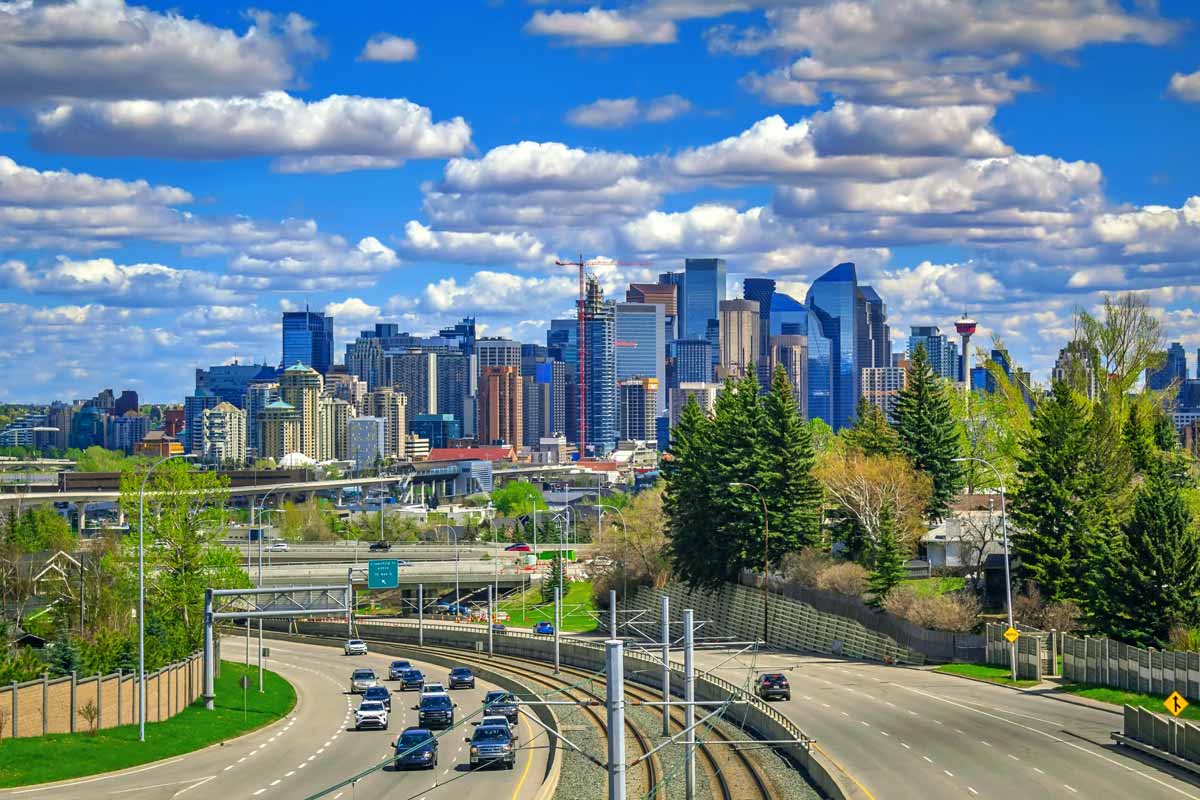
Alberta is breaking all records!
Real Estate Investments
Today, I would like to talk about Albertas economic news and the current state of Calgarys real estate market. High inflation, combined with the Bank of Canadas decision to raise its key interest rate to 5%, has significantly reduced consumer spending across Canada. Simply put, everything has become more expensive, and people are buying much less. This trend is expected to continue nationwide throughout 2024. Experts believe that the Bank of Canada will begin lowering rates in the very near future, but the decrease will not happen quickly, and it will take at least a year to bring the economy back to its pre-pandemic trajectory.
In Alberta, however, the situation is completely different. The province’s current economic model has allowed it to continue developing quite successfully, even with such high borrowing costs. While Canada as a whole recorded a budget deficit of roughly $25 billion in 2023, Alberta, by contrast, posted a budget surplus of $2.4 billion — despite the fact that, in 2023, enormous funds were allocated from the provincial budget to infrastructure construction, health care, wildfire response, and other areas necessary for improving quality of life. Alberta’s GDP is just under half of Ontario’s GDP, while its population is 4.8 million compared with Ontario’s 15.6 million. What makes these economic results even more impressive is that they were achieved against a backdrop of relatively low energy prices, while several major energy infrastructure projects are still under construction. In 2024, the province’s budget surplus is expected to reach $5.5 billion.
Over the past five years, thanks to the actions of Alberta’s government — which, it should be noted, is supported today by almost the entire population of the province — industries such as high technology and aerospace manufacturing have begun to develop here. Boeing is currently building a plant in the province, the hydrogen and carbon sectors are expanding, and major work is under way in renewable energy. In this field, Alberta is a global leader.
Unemployment in the province is falling rapidly, while the number of jobs is growing strongly. By comparison, in Ontario, the number of unemployed people increased by more than 30% in 2023 alone. In 2023, Alberta’s population grew by 202,000 people, representing an increase of nearly 4.5%. And this trend is only accelerating. Less than a year ago, statistics showed population growth of 4%; today, that figure is already half a percentage point higher. Alberta as a whole — and, of course, Calgary, the province’s largest city and home to 35% of Alberta’s population — has faced unprecedented population growth. By comparison, Ontario’s population growth in 2023, which was the largest in that province’s history, was just over 3%. If in 2022 Alberta’s population increase was driven primarily by interprovincial migration, then in the second half of 2023 the picture changed significantly. Provincial immigration programs began to work, and in addition to migration from other Canadian provinces, a stream of immigrants from other countries began arriving. This trend continues to strengthen, and already today international immigration to Alberta has exceeded interprovincial migration. There is little doubt that 2024 will be a record year for the province.
Calgary’s new-construction market is trying to keep pace with population growth, but so far it is struggling to do so. Real estate prices in Calgary continue to rise at an extraordinary speed. Here are the latest figures from the Calgary Real Estate Board: detached homes have increased in price by 14% over the year, townhouses by 20.4%, and apartments by 17%. At the same time, the number of sales rose by 9.9%, while the number of new listings fell by 4.3%. As a result, we have reached a new all-time record: in Greater Calgary today, only 2,532 properties are available for purchase, which is 21.7% fewer than at the same time last year. For the first time in Calgary, the “months of supply” indicator has fallen below one — more precisely, to 0.95. This means that if no new properties came onto the market, everything currently listed for sale would be sold in less than one month.
Canada has never seen numbers like this in any province. Naturally, prices are rising extremely quickly. Experts expected a very hot spring market in Calgary, but today’s statistics have exceeded every expectation. And this is still before the beginning of any decrease in borrowing rates, which will unquestionably add fuel to the fire. The fastest-appreciating areas in March and early April were in east Calgary, where prices rose by 24.9% year over year. In second place was the northeast, where average price growth reached 17.3%. Considering that in Calgary only a 10% down payment is required to purchase new construction, the deposit money of investors who bought property in these areas generated close to a 200% return over the year. These are precisely the areas where most of our projects were located last year. Once again, we hit the mark. Moreover, the potential of these areas remains very significant. They are new, comfortable neighbourhoods, and in my opinion, they are likely to see the strongest price growth in the coming years.
As for rentals, the Calgary Real Estate Board shows the following result: overall, across all property types, rents increased by 14.3% over the year, and experts predict that rents will rise by roughly the same amount in 2024. I have no doubt about this. Calgary has no rent control, and with such a shortage of housing, rents simply cannot help but continue rising.
And, of course, an important indicator when evaluating the investment potential of any region is the amount of new housing currently under construction. Although a record number of new construction projects was started in 2023 — 25,000 — experts estimate that in order to bring Calgary’s housing market back into balance, the city would need to build twice as much, and by many estimates, even three times as much. In 2023, about 120,000 people moved to Calgary, and simply to provide housing for them, at least 50,000 residential units would need to be built. In addition, the older housing stock must also be renewed. So, in my opinion, Calgary currently needs around 70,000 new housing units per year. Yet only 25,000 are being built. That is why Calgary’s investment market today is practically bottomless, and those who take advantage of this opportunity will see excellent returns in the future. I believe that within just five years, we will see Calgary prices reach the same level as Toronto. This already happened during the oil boom of 2005–2008. After that, Toronto real estate tripled in price, while Calgary remained frozen in place for ten years. Today, Calgary’s time has come to take its revenge, and all the factors suggest that this is exactly what will happen.
Our company has been working in Calgary real estate investments for more than three years. We identified this market at the right time, just as we did with the Caribbean real estate market, and have already helped more than five hundred of our clients purchase investment properties here. If you are interested in this type of investment, you can book an online appointment, schedule a meeting at our Richmond Hill office, or call us by phone.