
A Caribbean club for those in the know: Eden Rock Saint Barthélemy
Some hotels simply stand in a beautiful place. Others make the place itself sound different afterwards. Eden Rock Saint Barthélemy belongs to the second category. It did not merely benefit from the fame of St Barths - it helped create it. Before the island became shorthand for a private Caribbean club, secluded villas, white beaches, yachts, French charm and multimillionaires without visible security, there was a rock above St Jean Bay, a short runway, mountains, sea, a nearly mythical pirate aura and a man with the temperament of an adventurer.
Today, St Barths can seem almost like a ready-made set for beautiful living. A small French island in the Caribbean, where luxury does not look like display, but like perfected nonchalance: linen shirts, barefoot dinners, designer villas, beach clubs, champagne without unnecessary noise and people so accustomed to privacy that they have no need to demonstrate status. But this code did not appear by itself. At some point, someone had to invent it.
For St Barths, that point of origin was Eden Rock.
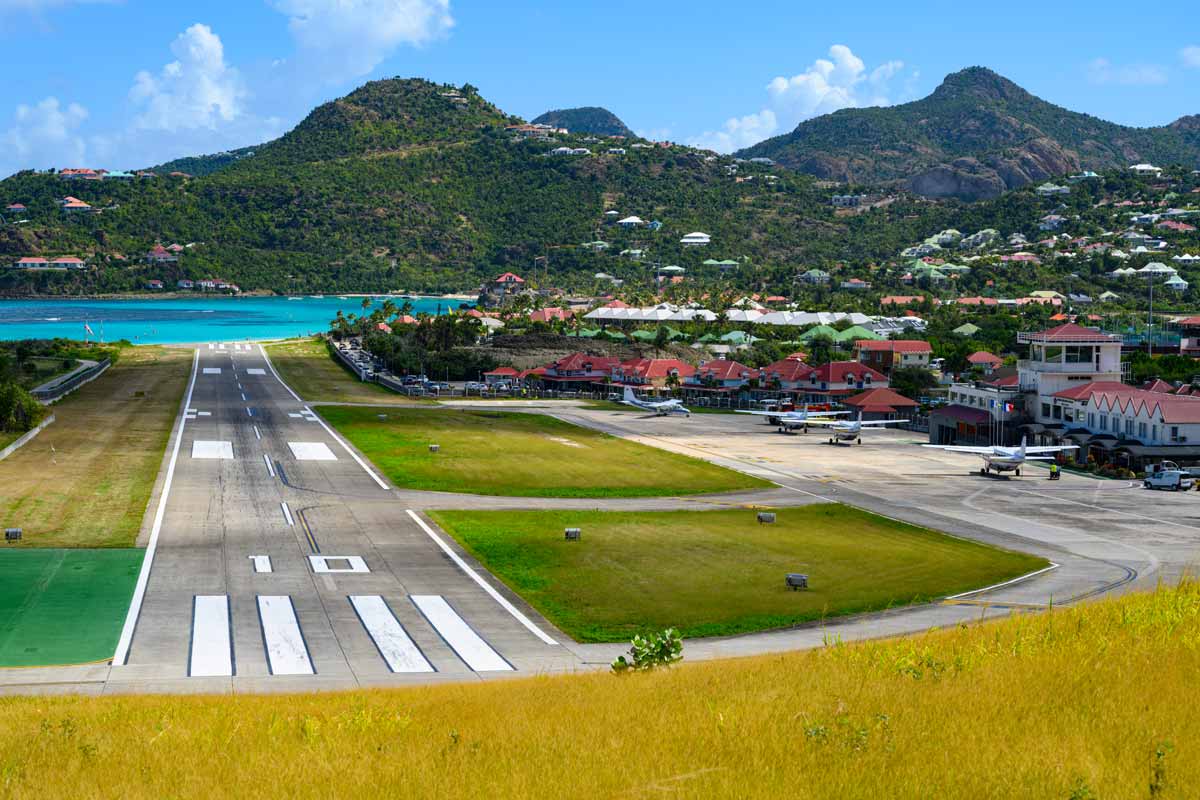
The story begins with Rémy de Haenen - aviator, adventurer, entrepreneur and one of those figures without whom island legends do not hold together. In the 1940s, he landed a plane on a pasture near St Jean, effectively opening a new era of access to the island. For St Barths, this was almost what the railway was for Palm Beach: not merely transportation, but an invitation from the outside world. As long as a place remains difficult to reach, it can be beautiful, but it does not become a resort. Once one can fly there, it begins to turn into a dream.
In the 1950s, Rémy built a house on the rocky promontory above St Jean Bay. It was nothing like a classic hotel with a grand entrance, columns and ceremonial hierarchy. It was more like the home of a man whose life was too interesting not to receive guests. At first, there were only a few rooms. But that was exactly the magic: Eden Rock was born not as a hotel project, but as an extension of its owner’s personality.
There are two paths in luxury. The first is to build a palace and invite the public to admire its grandeur. The second is to create the feeling that you have been admitted into a private world where people are not usually invited. Eden Rock chose the second path long before the word boutique became a hotel cliché.
The rock was the perfect symbol. It separated guests from ordinary life without turning the hotel into a fortress. On one side were St Jean Bay, pale water, sand and planes descending so low that the island kept reminding everyone of its cinematic quality. On the other was the feeling of a house above the sea, where guests did not dissolve into a crowd, but became members of a small seasonal society.
It was precisely this tone that made Eden Rock a magnet for those who did not want to vacation where everyone else vacationed. Over the years, the hotel has been associated with Hollywood stars, industrialists, artists and heirs to great fortunes. But the important thing is not the list of famous names. It is why they came. St Barths did not offer them grandeur. It offered freedom from grandeur.
This is a subtle but essential difference. On the Riviera, one had to be seen. In Palm Beach, one had to belong to the right circle. On St Barths, one could afford to disappear while remaining among one’s own. Eden Rock became the physical embodiment of that promise: small, stylish, close to the ocean, well known enough for the initiated and informal enough not to feel official.
That is how a true luxury legend is born: not from the amount of marble, but from the right degree of inaccessibility.
In 1995, the hotel passed to the Matthews family. This was an important stage. Eden Rock could have remained a beautiful old story, a romantic relic from the age of aviators and the first Caribbean travellers. Instead, it began to evolve into a contemporary property of the highest category while preserving what mattered most: the feeling of a home, an art-filled world, a private collection rather than an anonymous resort machine.
There was strategic precision in this. St Barths never needed to compete with mass Caribbean destinations. It did not need enormous all-inclusive complexes, giant lobbies or endless beachfront blocks. Its power lies in scale. A small island, a small airport, small coves, small restaurants, short distances - but an enormous concentration of money, taste and social capital.
Eden Rock fit this formula perfectly. It did not impress through size. It worked through atmosphere.
The rooms and villas here have always felt less like standard accommodation categories and more like different versions of a fantasy about private Caribbean life. Some have more art, some more beach, some more theatre, some an almost domestic intimacy. For the modern ultra-luxury guest, this matters deeply. Such a guest is tired of interchangeable expensiveness. Fine sheets, a beautiful pool and a good breakfast are no longer enough. What they want is a place with a biography.
This sense of biography also has an almost physical proof. Inside Villa Rockstar, one of Eden Rock’s most famous villas, there is a recording console associated with John Lennon’s Imagine. It is not merely a striking detail for music lovers, and not just another decorative object placed in a luxury interior. In this one piece, the logic of Eden Rock becomes especially clear: luxury here is built not only on views, service and price, but on cultural traces. On objects touched by history. On the feeling that you are not staying inside a flawlessly expensive set, but in a place where beneath the beautiful surface there is memory.
Eden Rock’s history is not only about beauty, but about survival. In 2017, Hurricane Irma caused enormous damage to St Barths. For an island whose economy depends heavily on tourism, this was a blow not only to buildings, but to the myth of serenity. Caribbean luxury always lives next to a natural force that can never be fully domesticated. The ocean that makes a place paradise can, in a single night, remind everyone who is really in charge.
Eden Rock was badly damaged. But such moments test a legend. An ordinary hotel after a catastrophe is simply repaired. A legendary one is reassembled so that it returns not as a copy of the past, but as a stronger version of itself.
After an extensive reconstruction, Eden Rock reopened for the 2019 season. The renewed hotel introduced new spaces, including the Rémy Bar, named after its founder, a redesigned Sand Bar and a spa concept. It was a smart gesture: not erasing the old story in favour of new design, but writing the renovation into the continuity of the myth. In the luxury segment, memory is part of the product. Remove the past, and what remains is simply expensive real estate by the water.
Today, Eden Rock is part of Oetker Collection - a group that knows how to treat hotels as cultural objects, not merely hospitality assets. It is the right environment for such a place. Some hotels can be scaled. Others can only be protected. Eden Rock belongs to the second group.
Its value is not that it is the largest, the newest or the most luxurious by obvious measures. In a market where new villas and resorts constantly try to outdo one another with square footage, pools, wine cellars and personal teams, Eden Rock holds on to another currency: character.
Character is becoming the great scarcity in luxury travel. Money can buy an ocean view. It can buy a private beach. It can buy a villa, a chef, a yacht, a plane, security and total invisibility. But money cannot always buy the feeling that a place has a soul. Eden Rock sells exactly that feeling - and this is why it remains relevant.
It contains a rare mixture of French lightness and Caribbean ease. Not Parisian severity, not American display, not resort carelessness in the vulgar sense. Rather, the ability to be expensive without heaviness. This is the kind of luxury that does not say its own name out loud. It simply assumes you know how to read the code.
St Barths itself is built on codes. Here, it is not considered elegant to look as though you are trying too hard. Excessively loud luxury feels almost provincial. True status reveals itself in knowing where to dine, which beach to choose, when to arrive, which villa to rent, where not to ask unnecessary questions and why the island’s main value is not spectacle, but privacy.
Eden Rock has been, and remains, one of the centres of this language. It does not merely receive guests. It teaches them the rules of the island: less pomp, more precision; less formality, more quality; fewer grand gestures, more mood.
In this sense, Eden Rock can be compared to a great piece of clothing that does not shout its brand but immediately reveals its level. It needs no explanation for those who understand. And for those who do not, an explanation would not help anyway.
There is another reason the story of Eden Rock matters. It shows that modern luxury destinations are often born not from marketing strategies, but from personality. Rémy de Haenen was not building a brand concept in the contemporary sense. He lived in a particular way - flying, risking, receiving guests, choosing a place not according to a return-on-investment table, but according to instinct. Owners, designers, managers, investment and an international hotel group came later. But the first impulse was human.
And it can still be felt. In an era when many resorts look like flawless but interchangeable sets for Instagram, Eden Rock preserves the advantage of origin. It did not appear because analysts identified a promising market. It appeared because one adventurer saw a rock above the bay and decided that life could be beautiful there.
For a North American reader, this story has another layer. We understand seasonality. We know the value of sun in February. We know how powerfully climate changes not only mood, but social habits. A Caribbean vacation for a northerner is not simply rest. It is a brief relocation into a version of life where the body relaxes, colours intensify, conversations become lighter and time stops looking like a list of tasks.
Eden Rock has refined that dream into a high form. It made escape from winter feel not mass-market, but selected. Not simply going to the sea, but arriving at a place where sea, history, service and social aura merge into one sensation: you are not being served, you are being received.
That is the highest form of hotel art.
Of course, St Barths today is no longer the wild island it was in the days of Rémy de Haenen’s first landings. It has become expensive, structured, developed, discussed and seasonally crowded with private jets and yachts. Any legend, once successful, risks becoming its own postcard. But Eden Rock maintains an important balance: it continues to be a symbol without becoming only a museum of its own fame.
Its story is a reminder that true luxury does not begin with price. Price comes later. First, there must be a place that cannot be repeated. Then a person who saw it before others. Then guests who understood the hint. Then decades in which all of it survived time, weather, fashion, catastrophe and new competition.
Eden Rock stands on a rock not only physically. It stands on a rare combination of adventure, memory, taste and the ability to remain itself.
And perhaps that is why its central secret is not that famous people have stayed there. The secret is that even famous people came there not to become more visible, but to disappear from the radar.