
1976: год, когда мир перезагрузился
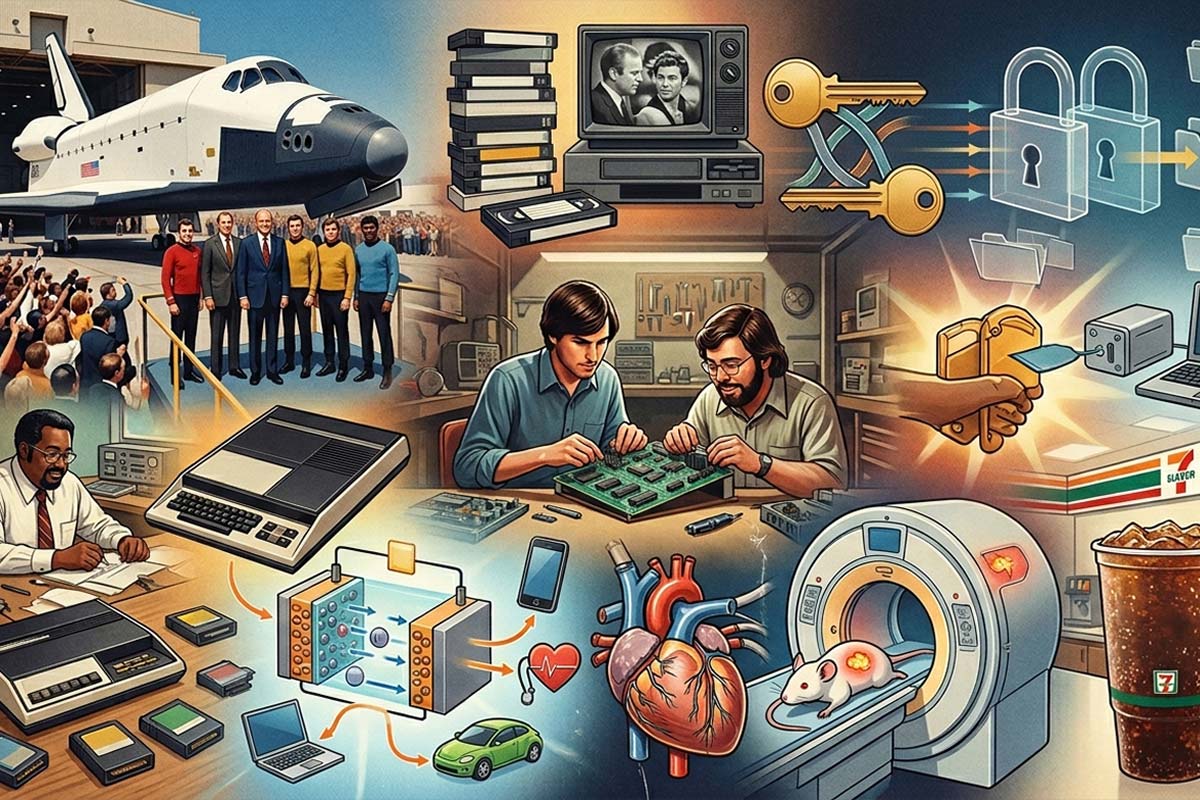
While Steve Jobs and Steve Wozniak were building their first computer in California, the world — without fully realizing it — was living through one of the most concentrated years in the history of technology. Apple, founded on April 1, 1976, is marking its fiftieth anniversary, and that milestone is a useful reminder that the Apple-1 was far from the only breakthrough of its era. In 1976, the future was taking shape on several fronts at once — in energy storage, cryptography, medicine, home entertainment, video games, and aerospace engineering. Many of those ideas still operate quietly inside our everyday lives.
The batteries that power the modern world
British chemist Stanley Whittingham, then working at Exxon, created one of the first functional rechargeable lithium batteries. It was not yet the modern, safe lithium-ion battery as we know it today: the early designs used metallic lithium and remained dangerously reactive. Scientists would spend decades improving safety and making the technology practical for mass use. But Whittingham’s work opened the path toward the batteries that now power smartphones, laptops, electric vehicles, medical implants, hearing aids, and, of course, nearly every form of modern mobile electronics.
The cassette that won the format war
In September 1976, the Japanese company JVC introduced VHS — and made a decision that was as strategic as it was technological. Unlike Sony, which closely guarded its Betamax format, JVC allowed other manufacturers to produce compatible devices. That choice helped determine the outcome of one of the most famous format wars in consumer electronics. Early VHS tapes could hold about two hours of recording time — enough for a full-length movie. The format remained on the market for nearly three decades and finally gave way to DVD only in the mid-2000s.
The key that protects the internet
Of all the technological ideas of 1976, this one may be the least visible to the average person — and the most universal. Whitfield Diffie, Martin Hellman, and Ralph Merkle laid the foundations of public-key cryptography: a system that made secure communication possible without first sharing a secret key. Before that, encrypted communication always faced the same problem: how do you deliver the key without someone intercepting it? The new concept changed the logic of digital security itself. Today, these principles support banking transactions, secure websites, e-mail, cloud services, messaging apps, and almost everything we do online. Including what you are doing right now.
The magnet that learned to see inside the body
Strictly speaking, the first full human body scan using MRI would be achieved a year later, in 1977. But in the mid-1970s, nuclear magnetic resonance was already beginning its transformation from a laboratory technique into a future tool of medical diagnosis. Raymond Damadian, Larry Minkoff, and Michael Goldsmith were working toward a way to use magnetic fields and radio waves to create images of internal body structures without X-rays. The principle was revolutionary: a powerful magnetic field aligns hydrogen atoms in the body, a radio-frequency pulse changes their state, and then a computer reconstructs a detailed image from the signal produced as they return to alignment. Today, MRI is one of the most important diagnostic tools for detecting cancer, brain disorders, spinal conditions, joint injuries, and diseases of the soft tissues.
The cartridge changes everything
Before the mid-1970s, home video game consoles were largely tied to built-in games. If you wanted a new set of games, you often needed a new system. Jerry Lawson, one of the first Black engineers in Silicon Valley, helped change that model. The Fairchild Channel F, released in 1976, became the first home video game console to use interchangeable ROM cartridges. The idea seemed obvious only after someone made it work: one console, many games, each on its own cartridge. From that slot grew much of the modern video game industry — from Atari and Nintendo to Sega, PlayStation, and every later generation of home gaming systems.
Space learns how to land
In 1976, the world saw the rollout of the Space Shuttle Enterprise — and its name owed something to science-fiction fans. The shuttle had originally been expected to carry the name Constitution, but Star Trek fans launched a major letter-writing campaign, and President Gerald Ford supported the name Enterprise. Members of the original television cast attended the rollout ceremony in California. The prototype had no engines for reaching orbit and no full thermal protection system: it was built primarily to test aerodynamics, approach, landing, and handling. But Enterprise proved that a new kind of spacecraft could return to Earth and land like an aircraft. Today, it is displayed at the Intrepid Museum in New York City.
The big gulp
And, as a counterpoint to all this high technology, 1976 also brought the Big Gulp. That year, 7-Eleven introduced a 32-ounce fountain drink — almost a litre. By the standards of the time, it was an almost absurdly large cup: before that, a 20-ounce drink was already considered big. A test batch at an Orange County store sold out quickly, and the new format began spreading across the country. Later, 7-Eleven would introduce even larger sizes. Progress, as it turns out, is not always digital, medical, or cosmic. Sometimes it is very everyday — and very large.
Fifty years ago, a few dozen people — in garages, laboratories, universities, engineering offices, and corporate research centres — were quietly rewriting the rules. They did not necessarily know one another. They did not always understand the scale of what they were creating. They were simply working on specific problems: how to store energy, how to protect information, how to see disease, how to record a movie, how to separate a game from a console, how to land a spacecraft. But that is how the future is built. And that is why the world we live in today looks the way it does, and not otherwise.