
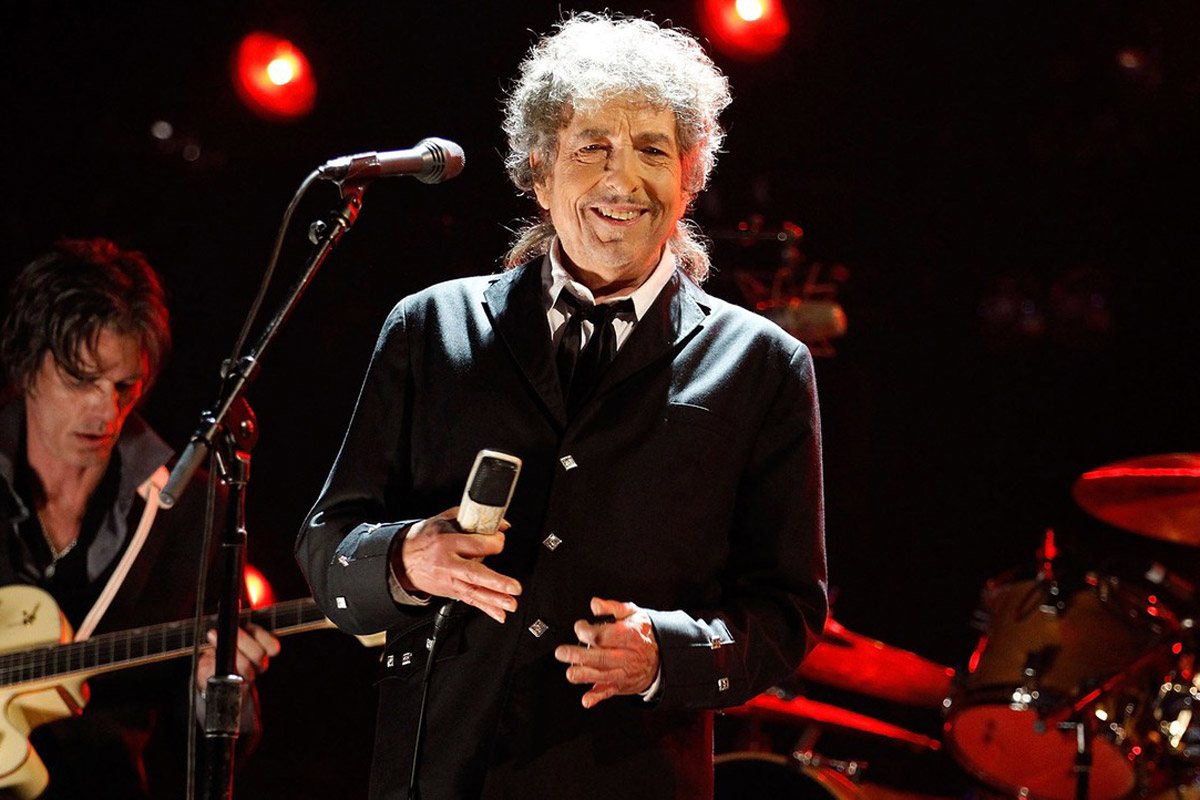
Bob Dylan: rock history
Bob Dylan is one of the rare artists whose name has long since moved beyond music. He has been the voice of a generation, a destroyer of genre boundaries, a poet of the American road, a chronicler of an anxious century and the man who proved that a song could be not only entertainment, but literature. His work changed folk, rock, country, blues and the very language of popular culture. He could irritate fans, disappear, return, change his voice, religious beliefs, sound and stage persona, but again and again he ended up at the centre of the conversation about what a modern song can be.
Robert Allen Zimmerman, the future Bob Dylan, was born on May 24, 1941, in Duluth, Minnesota, into the family of a small businessman. His parents were active in the local Jewish community. Dylan’s family roots led back to Eastern Europe, with ancestors connected to regions of today’s Ukraine and Lithuania. In 1947, after his father became ill, the family moved to Hibbing, a small mining town in northern Minnesota, where Dylan spent his childhood and youth.
As a child, he listened intensely to the radio: blues, country, gospel, early rock and roll and folk. Hank Williams and Woody Guthrie made an especially deep impression on him. Guthrie became almost a mythological figure for the young Dylan: after moving to New York, he visited the ailing Guthrie in hospital and regarded him as a spiritual predecessor. Dylan learned guitar, increasingly took up the harmonica, wrote poetry and gradually began creating himself as an artist.
In high school, he performed in various groups playing rock and roll and folk music. After entering the University of Minnesota in 1959, Dylan became more deeply involved in the Minneapolis folk scene. Around this time, he began using the stage name Bob Dylan. The name has often been linked to the Welsh poet Dylan Thomas, although Dylan himself later complicated and revised the story of its origin more than once. Like so much else about him, the name became part of the legend.
New York, folk and the first anthems of an era
In January 1961, Dylan arrived in New York. He was not yet twenty, but he already behaved like someone with a mission. Very quickly, he became a noticeable figure in Greenwich Village — the neighbourhood where folk clubs, cafés, political conversations and poetic ambition merged into a unique cultural atmosphere.
His debut album Bob Dylan was released in March 1962. It consisted mostly of reworkings of traditional folk and blues material, but even there one could already hear an unusual performer: the voice was rough, conversational, almost deliberately anti-showbiz. Dylan was not trying to sound beautiful in the conventional sense. He sounded as if a song were an urgent message, not an evening’s ornament.
The real breakthrough came with The Freewheelin’ Bob Dylan, released in 1963. Here Dylan was no longer merely an interpreter of traditional songs, but an author formulating the mood of his time. Blowin’ in the Wind, A Hard Rain’s a-Gonna Fall, Masters of War and other songs made him the central voice of the new American folk scene.
These songs arrived at the same moment as the civil rights movement, the fear of nuclear war and a growing distrust of the official language of politics. Blowin’ in the Wind, performed by Peter, Paul and Mary, became an international anthem, and Dylan found himself in the unexpected role of prophet. His songs were performed by Marlene Dietrich, Elvis Presley, Etta James, Stevie Wonder, Dolly Parton and dozens of other artists. Under the influence of this new seriousness in songwriting, Sam Cooke wrote A Change Is Gonna Come, one of the central anthems of the civil rights era.
Joan Baez played a special role in Dylan’s early career. She was already a recognized star of the folk scene and often performed his songs, helping bring them to a wider audience. Their creative and personal alliance became one of the important stories of American music in the early 1960s.
Song becomes literature
The Freewheelin’ Bob Dylan impressed not only American listeners. The Beatles, according to George Harrison, listened to the album over and over. For the Liverpool four, it was a revelation: a popular song could speak not only about love, dancing and youthful energy, but also about fear, politics, time, loneliness, history and conscience.
In 1964, Dylan released The Times They Are A-Changin’, an album that firmly established his reputation as a writer of protest anthems. But almost immediately, he began moving away from the role the public tried to impose on him. Another Side of Bob Dylan, released that same year, was more personal, ironic and literary. His lyrics began to feature complex images, interior monologues and the influence of modernist poetry, the Beats, Rimbaud, Keats and American conversational speech.
Dylan increasingly did not want to be merely a political bard. He was interested not in direct statement, but in language that could be clear and mysterious at the same time. In his songs, meaning was increasingly born not from one slogan-like phrase, but from the collision of images. Sometimes word followed word almost like a stream of consciousness, and that changed the idea of what could happen inside a popular song.
The electric turn
By the mid-1960s, the world around Dylan was changing at tremendous speed. The Animals recorded a powerful rock version of the traditional song House of the Rising Sun, which Dylan had also performed on his debut album. The Byrds turned his Mr. Tambourine Man into a shimmering folk-rock hit. These successes showed that Dylan’s songs could live in electric sound just as convincingly as under an acoustic guitar.
In 1965, Bringing It All Back Home appeared, an album where acoustic folk and electric rock collided in the same space. For part of the old folk audience, this was betrayal. The conflict became especially loud at the Newport Folk Festival, where Dylan walked onstage with an electric band. The audience, expecting new protest anthems, heard something entirely different — sharp, urban, nervous and free from the old rules.
In the summer of 1965, Dylan released Highway 61 Revisited. The album became one of the key works in the history of rock music. It opened with Like a Rolling Stone, a six-minute song that broke conventional ideas about radio format, single length and the boundaries of popular poetry. It was not simply a hit, but a cultural explosion: biting, powerful, literary and absolutely rock and roll at the same time.
In 1966, the double album Blonde on Blonde was released. Dylan later described its sound as “thin wild mercury sound.” Together with Bringing It All Back Home and Highway 61 Revisited, the album forms the famous trilogy often regarded as the peak of his electric period and one of the major achievements of twentieth-century American culture.
Judas in Manchester
From the autumn of 1965 to the spring of 1966, Dylan toured with the musicians who would soon become known as The Band. The concerts were tense: the first acoustic half still reassured old fans, but the second, electric half enraged those who believed Dylan had betrayed folk ideals.
The most famous episode took place in Manchester in 1966. Someone in the audience shouted: “Judas!” It was an accusation of betrayal. In response, Dylan told the musicians to play louder, and the band crashed into a furious version of Like a Rolling Stone. A recording of this concert circulated for decades as a legendary bootleg and was officially released only in 1998.
On July 29, 1966, Dylan had a motorcycle accident near Woodstock and withdrew from touring life for a long period. The true severity of his injuries is still debated by biographers, but the consequences were clear: he stopped the exhausting public pace, retreated into a more private life and began rethinking his sound.
The basement, country and another turn
During this period of retreat, Dylan often played with The Band. In a house in Woodstock, they recorded new songs, old ballads, blues, country and strange hybrids of American musical memory. These recordings later became known as The Basement Tapes. At first, they circulated unofficially and became one of the most famous bootlegs in rock history; in 1975, they were finally released officially.
In 1967, John Wesley Harding appeared — a quiet, restrained, almost austere album. After the wild electric trilogy, it sounded like a sharp turn toward simplicity, biblical tones and American tradition. It included All Along the Watchtower, which Jimi Hendrix transformed into one of the most famous rock versions of all time. Dylan himself recognized Hendrix’s interpretation as so powerful that he later performed the song with that version in mind.
Dylan then went to Nashville. The 1969 album Nashville Skyline surprised fans with its softer voice, country sound and unexpected simplicity. Lay Lady Lay became a major hit and reached the American Top 10. But after that, the direction of Dylan’s work again became less obvious.
Crisis, return and Blood on the Tracks
In 1970, the double album Self Portrait shocked critics. Its mixture of covers, live recordings and scattered material seemed to many like a sign of creative exhaustion. Only a few months later, Dylan released New Morning, a more focused and warmer album that partly restored listeners’ confidence.
In 1971, he performed at the Concert for Bangladesh, organized by George Harrison. In 1973, Dylan appeared in the film Pat Garrett and Billy the Kid and wrote Knockin’ on Heaven’s Door for it — a song that became one of the most famous of his career and was later performed by dozens of artists, including Guns N’ Roses, Eric Clapton and many others.
In 1974, Dylan released Planet Waves, recorded with The Band. It became his first album to reach number one on the Billboard 200. The tour with The Band that followed was a major commercial event and was documented on the live album Before the Flood.
The true artistic return came in 1975 with Blood on the Tracks. For the first time in years, Dylan’s songs sounded so piercingly personal and confessional. Tangled Up in Blue, Simple Twist of Fate, Shelter from the Storm — this was no longer the voice of a political prophet and not the mercury poetry of the 1960s, but a mature, wounded and attentive storyteller examining love, memory, separation and time. Many consider Blood on the Tracks Dylan’s most complete album.
It was followed by Desire and then the famous Rolling Thunder Revue tour with Joan Baez, Joni Mitchell, Mick Ronson, Allen Ginsberg and others. In 1976, Dylan appeared at The Band’s farewell concert, The Last Waltz, which Martin Scorsese turned into one of the most famous concert films in music history.
The religious period, endless touring and new alliances
In the late 1970s, Dylan underwent a Christian conversion that sharply changed the content of his songs. Slow Train Coming, released in 1979 and recorded with Mark Knopfler, opened the religious period in his work. Gotta Serve Somebody won Dylan a Grammy, but the change itself provoked mixed reactions. Many fans were not ready for the direct preaching tone, and John Lennon responded with his song Serve Yourself.
In the 1980s, Dylan toured heavily and collaborated with different artists. In 1985, he performed in the Soviet Union at a poetry festival in Moscow — a symbolic event in a country where his songs had long been known through translations, tape recordings and his influence on Russian-language rock culture. His work had a noticeable impact on musicians such as Boris Grebenshchikov and Mike Naumenko.
In 1986, Dylan toured with Tom Petty and the Heartbreakers, in 1987 with the Grateful Dead, and in 1988 he became a member of the supergroup Traveling Wilburys alongside George Harrison, Roy Orbison, Tom Petty and Jeff Lynne. That same year saw the beginning of the so-called Never Ending Tour, a long-running concert series that became one of the most unusual stories in modern music.
Late revival
After the uneven Under the Red Sky in 1990, Dylan went several years without releasing new original songs, but continued to perform and devoted more time to painting. In 1997, he was hospitalized with a serious inflammatory heart condition. He later joked that he was ready to see Elvis, but recovered and soon returned to work.
At the end of 1997, Time Out of Mind was released — his first album of new songs in many years, produced by Daniel Lanois. It was a powerful late-career rebirth. Dylan’s voice had become raspy, dark and almost ghostly, but that quality perfectly matched songs about time, death, loneliness and the road. The album won three Grammy Awards, including Album of the Year.
In 2000, Dylan won an Oscar and a Golden Globe for Things Have Changed, written for the film Wonder Boys. In 2001, Love and Theft appeared, an album in which blues, jazz, swing, country and the American song tradition intertwined in a free and witty form. Dylan produced it himself under the pseudonym Jack Frost.
In 2004, the first part of his autobiography, Chronicles: Volume One, was published. In 2005, Martin Scorsese released No Direction Home, a documentary about Dylan’s early period. In 2007, the unconventional biographical film I’m Not There appeared, with different aspects of Dylan played by Cate Blanchett, Christian Bale, Heath Ledger, Richard Gere and other actors.
In 2006, Modern Times debuted at number one on the Billboard 200. At the time, the 65-year-old Dylan became the oldest living artist to top the American album chart. His voice had grown even rougher, but critics were again on his side. Rolling Stone named Modern Times one of the major albums of the year, and the Grammys recognized his work with another award.
The Nobel Prize
On October 13, 2016, Bob Dylan was awarded the Nobel Prize in Literature. It was the first time the award had gone to an artist known primarily as a musician and songwriter. The official citation from the Swedish Academy honoured him for creating new poetic expressions within the great American song tradition.
The decision provoked intense debate. Some saw it as a historic expansion of the boundaries of literature, while others considered it too bold a departure from the traditional idea of a writer. But the debate itself revealed Dylan’s scale. His lyrics had long lived not only in music, but also on the page, in memory, in political language, in university courses, in the culture of quotation and in the very idea of American poetry.
Sara Danius, the permanent secretary of the Swedish Academy, explained the choice by pointing out that Dylan creates poetry for the ear, continuing an ancient tradition in which poetry and song were not separate. Dylan became the first American since Toni Morrison to receive the Nobel Prize in Literature.
Rough and Rowdy Ways: history, death and the American myth
In 2020, Dylan released Rough and Rowdy Ways, his first album of original material in eight years. Before that, he had recorded several albums of songs from the Great American Songbook, connected with the repertoire of Frank Sinatra and American popular standards. The new album was a return not merely to original songwriting, but to a vast conversation with history.
The great surprise was Murder Most Foul, an almost 17-minute composition about the assassination of John F. Kennedy and the cultural memory of America. It is not a song in the usual radio format, but rather a meditation, elegy, lecture, prayer and list of musical incantations all at once. It became the first Dylan song to top any Billboard chart: Rock Digital Song Sales.
Rough and Rowdy Ways asks the listener for more than attention; it asks for cultural memory. Already in I Contain Multitudes, Dylan brings together Walt Whitman, Edgar Allan Poe, Anne Frank, The Rolling Stones, Indiana Jones, Wes Anderson, William Blake, old rockabilly and ancient stories. He has long lived inside history, but here history becomes almost a physical space through which he wanders like an old philosopher, jester, preacher and witness.
False Prophet brings blues tension and bitter self-irony. In My Own Version of You, the narrator, like Frankenstein, assembles an imaginary creature from Richard III, Marlon Brando, Julius Caesar, Liberace, Leon Russell and Saint Peter. Dylan does not divide culture into high and low: Karl Marx, Sigmund Freud, Elvis, Shakespeare, bluesmen, movie characters and saints all exist in one enormous memory.
I’ve Made Up My Mind to Give Myself to You restores lyricism, Black Rider returns to the inevitability of death, Goodbye Jimmy Reed pays tribute to the blues tradition, and Mother of Muses summons historical and cultural spirits, including military leaders and heroes of peaceful resistance. Crossing the Rubicon sounds like a dark, hypnotic blues about a border that can no longer be avoided. Key West (Philosopher Pirate) turns the Florida Keys into a metaphysical destination.
Only after all this does Murder Most Foul cease to seem like a strange long song. It sounds like the conclusion of a journey through the American twentieth century — from the Kennedy assassination to rock and roll, from radio waves to national trauma, from myth to memory. At 79, Dylan is not trying to compete with young artists and is not trying to look modern in the usual sense. He is doing what he has always done: turning the song into a space where history, voice, language and mystery meet as equals.
Bob Dylan long ago stopped being simply a singer. He became part of the cultural landscape, a figure through whom America has tried more than once to hear itself. Perhaps that is why his late songs sound so convincing: they have no desire to prove relevance. They have something more important — time, memory, stubbornness and a voice still searching for words where most would long ago have agreed to remain silent.