
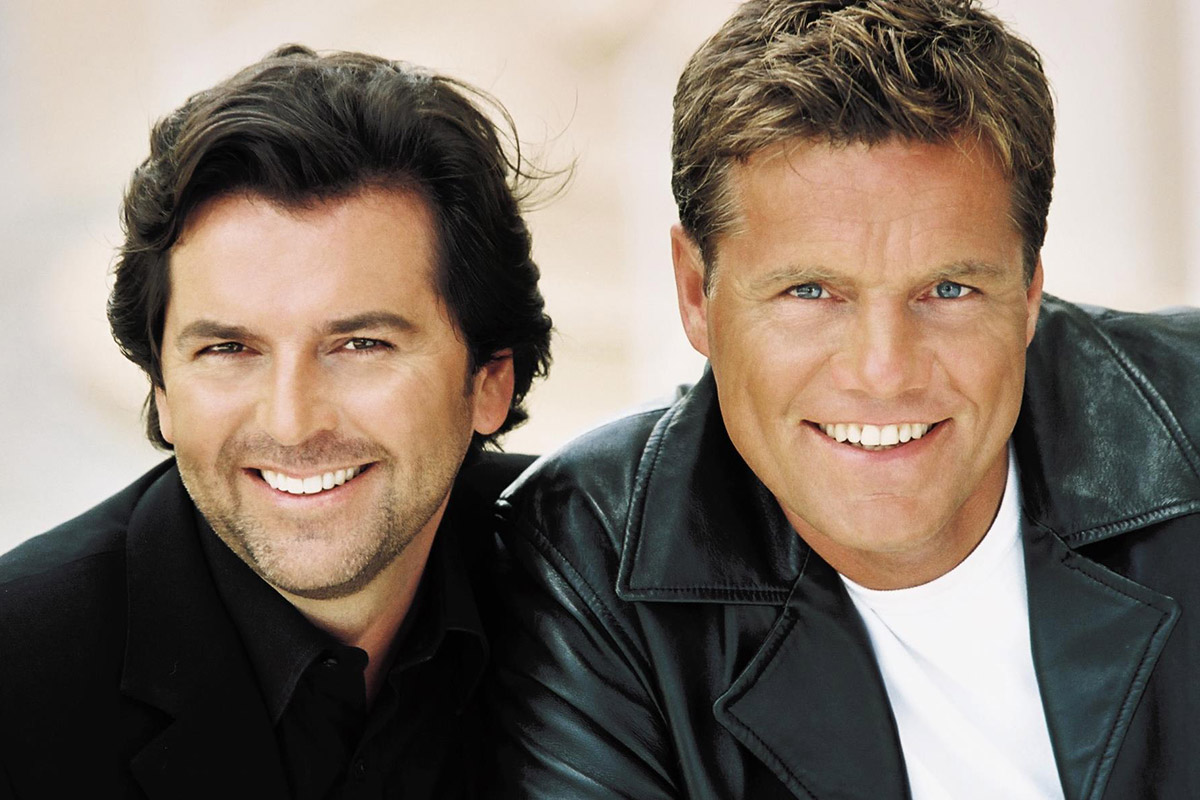
Modern Talking: The Duo That Outlived Its Own Conflict
The story of Modern Talking is not only about the glittering sound of the 1980s, millions of records sold and songs that are still instantly recognizable from the first seconds. It is also the story of a rare creative partnership in which the chemistry on stage proved stronger than human compatibility. Thomas Anders and Dieter Bohlen twice rose to the top of European pop music and twice separated in scandal. But time has rearranged the accents: both men have long since built their own lives, both remain successful, both created families, and Modern Talking has become a cultural phenomenon that outlived their personal conflict.
You're My Heart, You're My Soul — it is hard to imagine a more recognizable beginning. Modern Talking’s debut hit was released in 1984 and quickly turned the duo into a European sensation. It was followed by Cheri, Cheri Lady, Brother Louie, Atlantis Is Calling and dozens of other songs that became the soundtrack of a generation. Thomas’s high voice, the signature choruses, the synth-pop romance and Dieter Bohlen’s production formula made the group one of the most successful acts in the history of German pop music.
The story began in the early 1980s, when young composer and producer Dieter Bohlen was looking for the right performer for his songs and met emerging vocalist Thomas Anders. Visually, they complemented each other perfectly: Bohlen was the ambitious producer, songwriter and engine of the project; Anders was the soft, romantic frontman with a recognizable voice and image. On stage, it worked flawlessly. Behind the scenes, everything was more complicated.
Fame, money and the first split
The first period of Modern Talking lasted only a few years, but it was extraordinarily intense. The duo filled large halls, toured extensively, released album after album, and their songs went gold and platinum in different countries. But the greater the success became, the more tension accumulated.
In 1987, Modern Talking split for the first time. Official and unofficial explanations varied: exhaustion, conflict, touring pressure, disputes over creative control, finances and personal circles. There were always many rumours around the group, and separating hard fact from emotional versions told by the participants is not easy. But one thing is clear: a partnership that worked perfectly as a musical machine did not withstand personal and business contradictions well.
After the split, Thomas Anders began a solo career, while Dieter Bohlen created Blue System, which also achieved considerable popularity. Both continued to work successfully, but the media war between them did not stop. Through the press, they exchanged sharp remarks, accusations and mutual grievances. Their conflict increasingly resembled not just a professional breakup, but a painful divorce between two people bound too tightly by shared success.
Nora: the woman fans turned into a symbol of the conflict
Nora Balling, Thomas Anders’s first wife, played a special role in the mythology of Modern Talking. For fans of the group, she became almost a legendary figure — not so much a person as a symbol of the tension between Anders and Bohlen. It was Nora whom many fans associated with the first major drama around the duo.
For years, Thomas wore a gold chain with the name Nora around his neck, a gift from his wife. For some, it was a romantic gesture; for others, it was an overly visible sign of her influence. Bohlen did not hide his irritation and later repeatedly mocked the necklace and Nora’s role in Thomas’s life. In his version, her interference made the group’s normal work difficult.
Nora accompanied Thomas to concerts, tours and shoots, and took an interest in interviews, photo sessions and working processes. Around her, a reputation quickly formed as a strong-willed woman who wanted to influence her husband’s career. How much of that reputation reflected reality and how much became a convenient explanation for the group’s internal crisis is difficult to say. But in the public history of Modern Talking, Nora firmly occupied the role of the “third participant” in the conflict.
Thomas and Nora later separated. She withdrew from public life, rarely appears in the media and almost never comments on the story of Modern Talking. But in fan memory, her image remains one of the most controversial elements of the group’s legend.
The comeback millions had been waiting for
The pause lasted more than ten years. In the late 1990s, Dieter Bohlen and Thomas Anders began communicating again, and in 1998 Modern Talking unexpectedly returned. Their television appearance, new versions of old hits and the album Back for Good became a major event for fans. The comeback proved commercially powerful: the duo once again attracted large audiences, released albums, toured and showed that nostalgia for the 1980s could be a tremendous force.
In public, the musicians spoke of reconciliation, a new chapter and a desire to leave old grievances behind. For fans, it looked almost like a miracle: the beloved group was together again, the songs were playing again, and two people who had long been enemies seemed to have found a way to work side by side.
But the second life of Modern Talking was also limited in time. In 2003, the duo broke up permanently. This time, the ending was especially painful: Dieter Bohlen announced the end of the group from the stage during a concert, and according to Thomas, it came as a surprise to him. One of the reasons cited was Anders’s solo performances under the Modern Talking brand without Bohlen’s consent, but behind that stood a deeper collapse of trust.
After the stage: courts and books
After the second breakup, communication continued not in the studio or on stage, but through lawyers and courts. Dieter Bohlen published an autobiography in which he spoke harshly about his former partner and raised financial questions from the Modern Talking years. Thomas Anders sued over disputed claims and succeeded in having a number of passages removed from the book. The story of the blacked-out sections became a separate fan legend: rare uncorrected copies began to be treated as collectors’ artifacts.
Later, Thomas Anders published his own autobiography. After that, Nora went to court, claiming that certain statements were defamatory. In the end, the story of Modern Talking became fixed not only in music history, but also in legal history. The duo that once sang about love in the almost naïve language of disco-pop turned out to be far less romantic in real life.
Asked over the years about the possibility of another reunion, Thomas Anders has answered firmly: Modern Talking will not return. And it appears to be one of those cases in which public nostalgia is stronger than the participants’ desire to find themselves in the same boat again.
Dieter Bohlen: producer, television and a new family
Dieter Bohlen remained one of the most visible figures in German show business. After Modern Talking and Blue System, he continued to write and produce, worked with various artists including C.C. Catch and Chris Norman, created music for television and for many years was the face of popular German talent shows, including Deutschland sucht den Superstar.
In his personal life, Bohlen has always remained a vivid and much-discussed figure. He has six children from different relationships. His long-time partner Carina Walz, with whom he has been together for around two decades, is more than 30 years younger than him. The couple have two children — daughter Amelie and son Maximilian. At the end of 2025, Dieter and Carina officially married in the Maldives and later registered the marriage in Germany.
Bohlen is now in his seventies, but he continues to appear actively in public, keeps himself in shape, does sports and preserves the direct, sometimes abrasive style for which he is both loved and criticized. There has always been little diplomacy in him, but a great deal of energy, ambition and self-confidence.
Thomas Anders: elegance, a solo career and a calm family life
After Modern Talking, Thomas Anders built a softer and more elegant public image. He continued his solo career, toured widely, performed in different countries, recorded albums in English and German, and managed to keep an audience that values not only nostalgia, but also his own artistic style.
In 2000, Thomas married Claudia Hess, and in 2002 their son Alexander was born. Unlike the turbulent public story of his first marriage, his current family life appears much calmer and more stable. Thomas often emphasizes that he is happy with his family, and his image today is more that of a mature, well-groomed, intelligent artist than a figure from scandalous headlines.
One interesting detail: in 2026, Thomas officially changed his surname and legally adopted Anders as his family name. His wife and son also took the surname. For an artist whose stage name has long been stronger than his passport name, the step feels symbolic: Bernd Weidung finally became Thomas Anders not only on stage, but also in official documents.
Why Modern Talking is still remembered
Modern Talking has often been reduced to a formula: simple lyrics, a high voice, a dance rhythm, romantic choruses and Dieter Bohlen’s recognizable studio style. But that was exactly the project’s strength. It did not pretend to be more complicated than it was. It offered pure pop emotion, an instantly memorable sound and the image of a European 1980s dream — slightly glossy, slightly naïve, but incredibly infectious.
Their songs outlived the era, radio formats, cassette tapes, discos and even the personal conflict between the two men. Today, Modern Talking is no longer merely the duo of Anders and Bohlen. It is a cultural code that for millions of people is connected with youth, dancing, early music videos, cassette players, European pop romance and a time when a chorus could be simple — and still go straight into memory.
Thomas and Dieter may never share a stage again. Perhaps that is even right: some legends are better left without endless attempts at revival. But Modern Talking has long since taken on a life of its own, separate from their relationship. The group remains where every true pop legend belongs — in songs that continue to play, despite all the quarrels, lawsuits and years.