
Hamilton - один из лучших городов для инвестиций
Hamilton is increasingly being called one of the most interesting real estate markets in the Greater Toronto and Hamilton Area — and not simply because it is located roughly an hour from downtown Toronto. The deeper reason is that the city is undergoing a structural transformation. Infrastructure, transit, the waterfront, education, healthcare, logistics, the film industry and new residential development are gradually changing its economic profile. For an investor, this matters: strong real estate does not grow in isolation. It grows with neighborhoods, jobs, transportation and the quality of the urban environment.
Today, many property owners and investors are asking the same question: what is happening in the market, and how should one act in order to avoid an expensive mistake? Similar periods of uncertainty have happened before — in 2017, at the beginning of the pandemic, and during the rapid rise in interest rates. But in moments like these, it becomes especially important to separate short-term noise from long-term fundamentals. If a city is receiving major investment, new transportation links, jobs and population growth, its real estate can remain interesting even when the broader market behaves unevenly.
Why Hamilton attracts investors
Hamilton is located about 60 kilometres from downtown Toronto and is connected to it by major highways and GO Transit. According to the 2021 Census, the city had a population of about 570,000 people, while the broader Hamilton Census Metropolitan Area approached 785,000. This is no longer a small satellite of Toronto, but a major urban centre with its own economy, employment base, universities, medical cluster, port, airport and active construction.
Hamilton’s main advantage is diversification. The city has long since stopped being only a steel town. Steel and manufacturing remain part of its identity, but healthcare, life sciences, education, logistics, film production, technology, professional services and small business now play an increasingly important role. This type of economy is usually more resilient than a market dependent on a single industry.
Hamilton is home to McMaster University, one of Canada’s strong research universities, as well as Mohawk College. Together, they form a large student and research environment, support rental demand and create a base for medical, engineering, technology and research jobs. McMaster Innovation Park and the city’s healthcare ecosystem add another layer of long-term potential.
Hamilton is also an important transportation and logistics hub. John C. Munro Hamilton International Airport is one of Canada’s key cargo airports, while the Hamilton-Oshawa Port Authority plays a significant role in freight movement on the Great Lakes. For business, this means access to highways, rail, air cargo, port infrastructure and the markets of the Golden Horseshoe.
Infrastructure that is changing the city
The most visible future factor is the Hamilton LRT. The project calls for approximately 14 kilometres of light rail transit and 17 stops from McMaster University through downtown Hamilton toward Eastgate. It is one of the region’s key infrastructure projects, expected to reshape the city’s transportation logic, strengthen development corridors and increase the appeal of areas along the line.
For investors, the LRT matters not only as convenient transit. In most cities, new rapid transit corridors change the behaviour of developers, renters, buyers and businesses. New mixed-use projects appear, density increases, station-area neighbourhoods gain additional liquidity, and real estate near strong transit becomes easier for future tenants and buyers to understand.
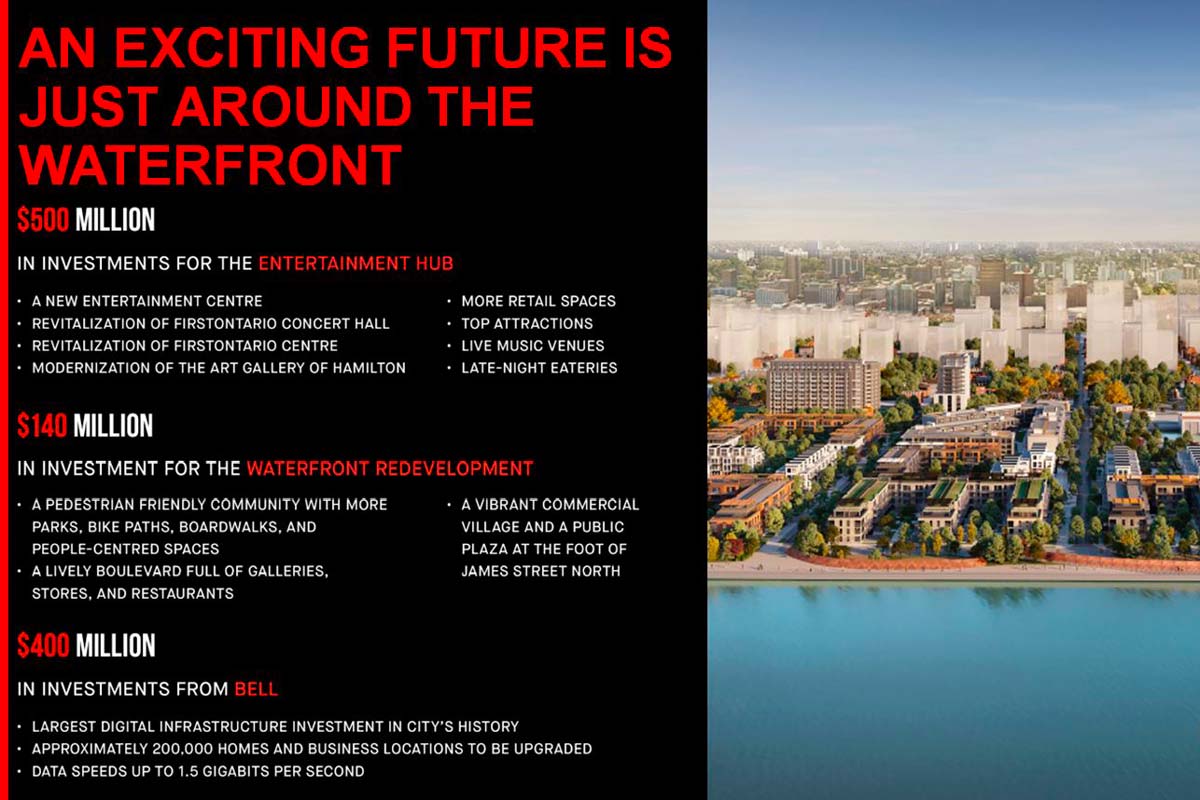
Beyond the LRT, Hamilton is redeveloping its waterfront. The city is gradually rethinking industrial and underused lands near the water, transforming them into more accessible, walkable and mixed-use urban spaces. This is a long-term process, but it is fundamental to how the city is perceived: the waterfront can change not only tourist appeal, but also quality of life, the value of nearby neighbourhoods and Hamilton’s broader image.
Investment also continues in entertainment districts, public spaces, digital infrastructure and commercial development. The city offers free public Wi-Fi in a number of public spaces, and the growth of digital and urban infrastructure reflects a broader trend: Hamilton is working to become not just a more affordable alternative to Toronto, but a modern centre for living and working in its own right.
Why housing demand remains strong
In fast-developing areas, housing almost always lags behind demand. Commercial growth, jobs, universities, healthcare institutions, transit and infrastructure can move faster than approvals and residential construction. The result is a familiar problem across the GTA: more people, more renters and still not enough quality housing.
Hamilton receives demand from several sources at once. First, local residents who want to stay in the city. Second, students, young professionals, healthcare workers and employees of new businesses. Third, buyers from Toronto and the GTA who still see Hamilton prices as more accessible. Fourth, investors looking for markets with growth potential without entering projects at downtown Toronto prices.
It is also important that Hamilton is no longer viewed only as a compromise — farther away, but cheaper. The city now has restaurants, creative spaces, new residential projects, cultural activity, film production, medical and educational centres. All of this is gradually changing the profile of both renters and buyers.
What investors need to understand
Buying real estate in an area undergoing transformation can be very profitable. But only if approached soberly. It is not enough to buy “anything in Hamilton” and expect the same result. It is essential to look at the specific location, distance to the future LRT, developer quality, floor plan, condo fees, rental demand, parking, amenities, construction timeline, entry price and real competition at completion.
Hamilton is large and diverse. Some areas have strong potential; others require caution. In some locations, transit and infrastructure growth support the investment. In others, the strength comes from proximity to the university or hospital network, the waterfront or lifestyle changes. But there are also places where the price already partially reflects future expectations, which means investors must enter more carefully.
In pre-construction investment, it is especially important to calculate not only an attractive growth forecast, but the entire financial scenario: deposit size, payment schedule, closing costs, development charges, HST implications, mortgage qualification at closing, possible assignment restrictions and realistic rent after completion. Mistakes here can be expensive.
Hamilton versus Toronto: where the investment logic lies
The main argument in Hamilton’s favour is the relationship between purchase price and rental potential. In a number of projects, the entry cost remains lower than in more expensive parts of the GTA, while rental rates have already moved close to levels that make the investment math more interesting. That is why Hamilton can be attractive not only to those planning to resell after construction is completed, but also to those considering long-term rental income.
At the same time, investors should not build a strategy on promises of “guaranteed growth.” Real estate depends on interest rates, credit conditions, supply, migration, employment, tax policy and the broader economy. Even a strong city can experience periods of stagnation or correction. A sound strategy must therefore consider different scenarios: fast growth, moderate growth, project delays, a weaker rental market at completion or the need to hold the property longer than originally planned.
A strong investment is not only faith in a city, but the ability to withstand time. Hamilton is interesting precisely because its story is not limited to short-term speculation. It has fundamental factors: transit, education, healthcare, logistics, the waterfront, a creative economy and relative affordability compared with Toronto.
Why the moment is still interesting
Hamilton has already changed noticeably in recent years. But the largest structural changes are still underway or only entering their active phase. That is why the city remains interesting for those looking not at one season, but at a 10- to 15-year horizon.
When major infrastructure projects are already clear, but not yet fully reflected in the everyday life of a city, a window of opportunity appears. It does not last forever. As projects are completed, the urban environment improves and demand grows, prices usually begin to reflect more and more of the future potential. Investors do not profit when everyone has already seen the result; they profit when they correctly understand the direction of change before most others do.
Our company has been actively working with Hamilton in recent years. We have already handled sales in several projects, and investors who believed in the direction early are seeing real results today. But it is important to understand that every new project must be analyzed separately. Even in a strong city, a poor entry price or weak location can ruin an investment.
In the near future, we plan to offer sales in several Hamilton projects. To avoid missing new opportunities, register on our web portal at www.newGTAcondos.com, and you will receive advance notifications about upcoming project launches by email.
Hamilton is no longer just “a city near Toronto.” It is an independent market with a strong economic base, major infrastructure changes and a clear investment logic. For anyone looking for real estate with long-term potential, it should not be ignored.