
Collins Avenue: from mangrove swamps to Michelin-era Miami
Miami Beach
Today, Collins Avenue is one of the great lines of Miami Beach glamour: palms, ocean air, Art Deco neon, legendary hotels, designer boutiques, fine dining and the silhouettes of luxury towers reflected in the water. The avenue stretches along the barrier island, connecting different eras and different versions of Miami - from historic South Beach to Bal Harbour and Sunny Isles Beach.
But Collins Avenue did not begin with parties, fashion shoots or penthouses worth tens of millions of dollars. It began with mangrove swamps, mosquitoes, avocados and the stubbornness of an elderly Quaker farmer who saw potential where most people saw only a useless strip of sand. That is the real magic of Miami Beach: a city of luxury was born from an agricultural experiment, an engineering risk and the belief that even a swamp could be turned into the future.
The man the avenue was named after
At the beginning of the twentieth century, the site of modern Miami Beach was a wild strip of mangroves, wetlands and sand between the Atlantic Ocean and Biscayne Bay. It was not a resort, but an almost impassable landscape between water and water. Into this landscape came John Stiles Collins in 1907 - a Quaker farmer from Moorestown, New Jersey. He was already about 70 years old, an age when most people think about a quiet retirement rather than risky projects on the edge of swampy Florida.
Collins bought a large tract of land and decided to grow exotic crops: avocados, mangoes and coconuts. For the time, this was a bold calculation. South Florida was only beginning to become a territory of large ambitions, and not everyone believed that these lands could produce serious value. But Collins saw more than swamp. He saw climate, soil, proximity to the ocean and the possibility of creating productive plantations.
The problem was logistics. The harvest had to be taken to the mainland and then to the railroad. Ferries and boats were too slow and unreliable. Collins then made the decision that would change not only his business, but the future of all Miami Beach: he would build a bridge across Biscayne Bay.
The bridge that changed everything
In 1912, Collins began building a wooden toll bridge. The project was extraordinarily expensive and difficult for its time. Money ran out quickly, and there was still distance left to reach the mainland - enough to threaten the entire idea. At that moment, Carl Fisher entered the story: a millionaire from Indiana, entrepreneur, developer and one of the future architects of the Miami Beach myth.
Fisher saw in the swampy sandbar not a farm, but a resort of the future. He helped Collins finish the bridge by providing financing in exchange for land. On June 12, 1913, the Collins Bridge opened to traffic. At the time, it was one of the longest wooden bridges in the world - about 2.5 miles, or roughly 4 kilometres. It connected the island to the mainland and opened the way for construction equipment, workers, investors, land buyers and a new urban dream.
After that, avocados gradually gave way to real estate. What began as an agricultural project became the foundation of a resort city. The main road running north-south along the island was named Collins Avenue, in honour of the man who first made the connection to the mainland a reality.
South Beach: Art Deco, neon and the birth of an image
The southern part of Collins Avenue developed early. In the 1920s and 1930s, the Miami Beach that would later become a visual legend began to take shape here: low-rise hotels, pastel façades, Art Deco geometry, neon signs, rounded corners, nautical motifs and the feeling of an endless holiday.
Today, the Art Deco Historic District in South Beach covers an area roughly between 5th Street and 23rd Street along Ocean Drive, Collins Avenue and Washington Avenue. It is one of the most recognizable architectural ensembles in America and an essential part of Miami Beach’s cultural identity. Its value lies not only in individual buildings, but in the complete atmosphere: an urban stage where architecture, climate, light and street life work together.
Collins Avenue is especially interesting here because it connects several layers of the city. It is closer to the ocean than Washington Avenue, but less theatrical than Ocean Drive. Along it, one can see historic hotels, more contemporary luxury addresses and traces of how South Beach evolved from a winter resort into a global symbol of nightlife, design and lifestyle culture.
Mid-Beach and Millionaires' Row: from resort hotels to new luxury
Moving north, Collins Avenue changes tone. Here begins a more spacious and less tourist-noisy Miami Beach. Mid-Beach and the famous stretch known as Millionaires' Row are tied to the history of grand oceanfront hotels, postwar modernist architecture and a new wave of luxury real estate.
This is where legendary addresses such as Fontainebleau Miami Beach helped define Miami Modern and an era when resort luxury became large-scale, cinematic and almost theatrical. On this stretch, Collins Avenue is no longer simply a street for walking. It becomes a line of hotels, condominiums, beach clubs, restaurants, wellness spaces and a new idea of expensive oceanfront leisure.
Over time, this area became a major part of Miami Beach’s transformation from seasonal resort into global luxury destination. Here, luxury is expressed not only in a room with an ocean view, but in architecture, service, gastronomy, privacy and proximity to the water.
Bal Harbour: quiet elite and cult shopping
Farther north, Collins Avenue leads to Bal Harbour, one of the most expensive and restrained enclaves in South Florida. If South Beach lives on energy, music and display, Bal Harbour chooses quiet, privacy and very expensive simplicity.
In 1965, Bal Harbour Shops opened here - America’s first all-luxury fashion shopping centre and one of the most influential retail addresses in the world. Its concept was unusual for its time: an open-air tropical garden, luxury boutiques, restaurant culture and the feeling not of a mall, but of a carefully maintained private club under the sky. Many European fashion houses chose Bal Harbour Shops as one of their first locations outside New York.
Bal Harbour matters in the history of Collins Avenue because it confirmed northern Miami Beach not merely as beach territory, but as a place of quiet ultra-luxury. There is no need to shout here. Everything speaks for itself: the address, the brands, the service, the security, the ocean and real estate whose price is understood without advertising slogans.
Sunny Isles Beach: from Motel Row to a glass canyon
Farther north still, Collins Avenue enters Sunny Isles Beach, one of the most contrasting stretches of the entire route. In the mid-twentieth century, the area was known as Motel Row. Along the ocean stood dozens of bright, eccentric, sometimes almost outrageous motels: neon signs, themed façades, fantasy architecture and the spirit of automobile America in the 1950s and 1960s.
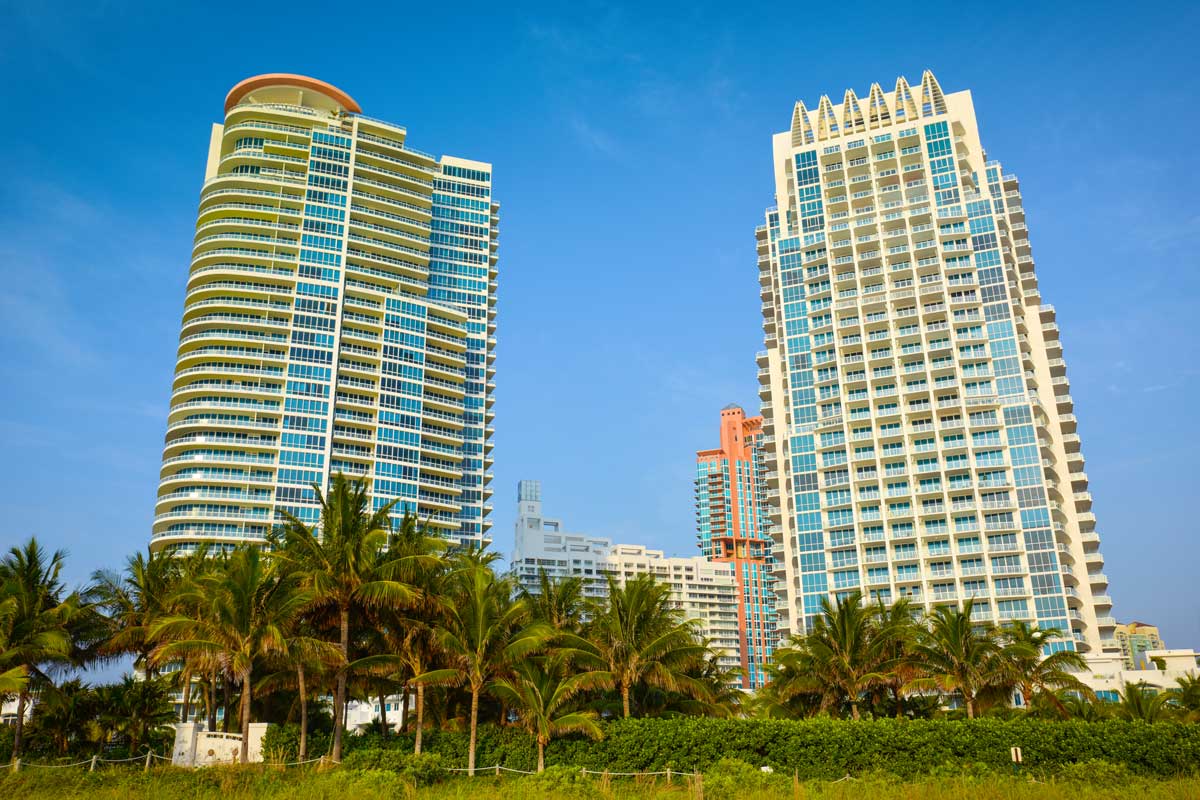
By the end of the twentieth century, that era began to disappear. Old motels gave way to high-rise condominium towers. Today, Sunny Isles Beach is a vertical city by the ocean: glass, concrete, valet parking, private elevators, branded residences and skyscrapers that create an entirely different scale. Towers such as Trump, Porsche Design Tower, Armani/Casa and other projects have changed not only the skyline, but the psychology of the area itself.
The density of high-rise buildings is so intense that after midday they cast long shadows across the beach, which is why Sunny Isles is often perceived as a kind of oceanfront canyon. This is no longer the Miami Beach of avocados and a wooden bridge, but precisely in that contrast one can see the extraordinary trajectory of Collins Avenue.
From avocados to the Michelin Guide
Today, Collins Avenue and the surrounding districts exist in a completely different economy. Luxury real estate, hospitality, fashion, wellness, nightlife and fine dining now live side by side. The Michelin Guide has brought Miami and Miami Beach into the map of serious restaurant culture, which means the modern image of the area is built not only on beaches and hotels, but also on world-level culinary ambition.
Of course, not every Michelin-recognized restaurant is located directly on Collins Avenue. But the axis of Miami Beach has become part of a broader luxury geography where dinner, hotel, gallery, boutique, beach club and penthouse view form one environment. Collins Avenue is no longer simply a road along the ocean. It is a linear history of how America’s ideas of resort life, wealth and beautiful living have changed.
Interesting facts
Avocados at the beginning of the legend. John Collins did not begin as a hotel magnate, but as a farmer. His avocado plantations played an important role in the early history of Miami Beach and became the practical reason for building the bridge.
The record-setting bridge disappeared. The original wooden Collins Bridge did not last long. In 1925, it was replaced by the Venetian Causeway, which still connects Miami and Miami Beach across a chain of artificial islands.
A street as compass. Collins Avenue helps you read the geography of Miami Beach: street numbers rise from south to north - from South Pointe and South Beach toward Mid-Beach, Bal Harbour and Sunny Isles Beach, where the numbering climbs well beyond the 190s.
An architectural timeline. Driving along Collins Avenue, you can see almost the entire history of South Florida resort architecture: Art Deco, Streamline Moderne, Miami Modern, postwar hotels, old motel culture and contemporary glass towers.
Why Collins Avenue still matters
Today, driving along Collins Avenue past hotels, boutiques, restaurants, beach clubs and penthouses, it is hard to believe that it all began with an elderly farmer trying to get his avocados to the mainland. But that is exactly what makes the story of the avenue so powerful. Collins Avenue is not simply an address of luxury. It is proof of how infrastructure, land, climate, ambition and luck can create a new geography of desire.
It contains the whole story of Miami Beach: nature transformed into a resort; agriculture giving way to real estate; Art Deco surviving the threat of demolition and becoming cultural capital; luxury retail turning the north end of the island into a world-class address; high-rise towers reshaping the skyline; gastronomy bringing Miami into an international conversation.
Collins Avenue is not just a street along the ocean. It is the spine of Miami Beach, a long glossy line between past and future. It remembers mangrove swamps, a wooden bridge, avocados, motels, neon, Hollywood-era hotels and modern towers. Perhaps that is why it remains so magnetic: behind the shine, one can still feel the story of a man who once looked at a swampy sandbar and saw not a problem, but a possibility.