
How, where and why student fraternities appeared
College fraternities are one of the most recognizable and, at the same time, most misunderstood symbols of American university life. We are used to seeing them in films as a strange mixture of private club, teenage comedy, party house, ritual society and miniature state inside a campus. Their own colours, Greek letters, secret signs, initiations, shared houses, alumni legends, internal hierarchies, loud parties, charity events, networking and, unfortunately, sometimes hazing - all of this has become part of the image of American college life. But behind the caricature lies a far more interesting story: fraternities did not appear simply for the sake of parties, but as a response to young men’s need for status, belonging, influence and social connection.
To understand why fraternities took root so deeply in the United States, one has to look not only at campuses, but at the culture of Anglo-American society: private clubs, university traditions, Masonic symbolism, elite networks and the special role of the college experience in shaping a future career. The American fraternity is not a random eccentricity. It is the product of a society in which connections, reputation, loyalty and an alumni network can work almost as powerfully as a diploma.
Where did student fraternities come from?
The origins of student fraternities are often linked to a broader European tradition of men’s clubs, secret societies, university corporations and intellectual circles. In England, Oxford and Cambridge were, from the early modern period, not only places of study, but also environments where the bonds of the future elite were formed. Young men from influential families lived together, argued, drank, competed, formed friendships and created informal networks that could remain useful for the rest of their lives.
It is important not to turn this history into a neat legend about princes automatically creating the first fraternities around themselves. The reality was broader and more interesting. The university environment itself functioned as a social laboratory: young men learned not only Latin, philosophy or law, but also how to behave inside elite society. Who could speak well? Who kept his word? Who was loyal? Who could hold his own in debate? Who became one of us? These things are rarely written on a diploma, but in closed societies they mattered enormously.
When the Anglo-Saxon model of higher education crossed into North America, it brought with it not only curricula, but also a culture of student associations. In colonial colleges, young men also formed literary, debating and secret societies. There they argued about politics, philosophy, religion, rhetoric and the future of the country. For a society moving toward independence, such student circles were not merely entertainment, but a training ground for public thought.
The American Revolution only increased the importance of these communities. The new republic needed its own elites, its own mechanisms of selection and its own traditions. At the same time, openly copying the British aristocratic model was politically awkward: the country was building itself on the language of democracy, equal opportunity and civic virtue. But the need for closed networks did not disappear. Thus the American version of the student fraternity emerged: formally democratic, but deeply interested in status, belonging and future connections.
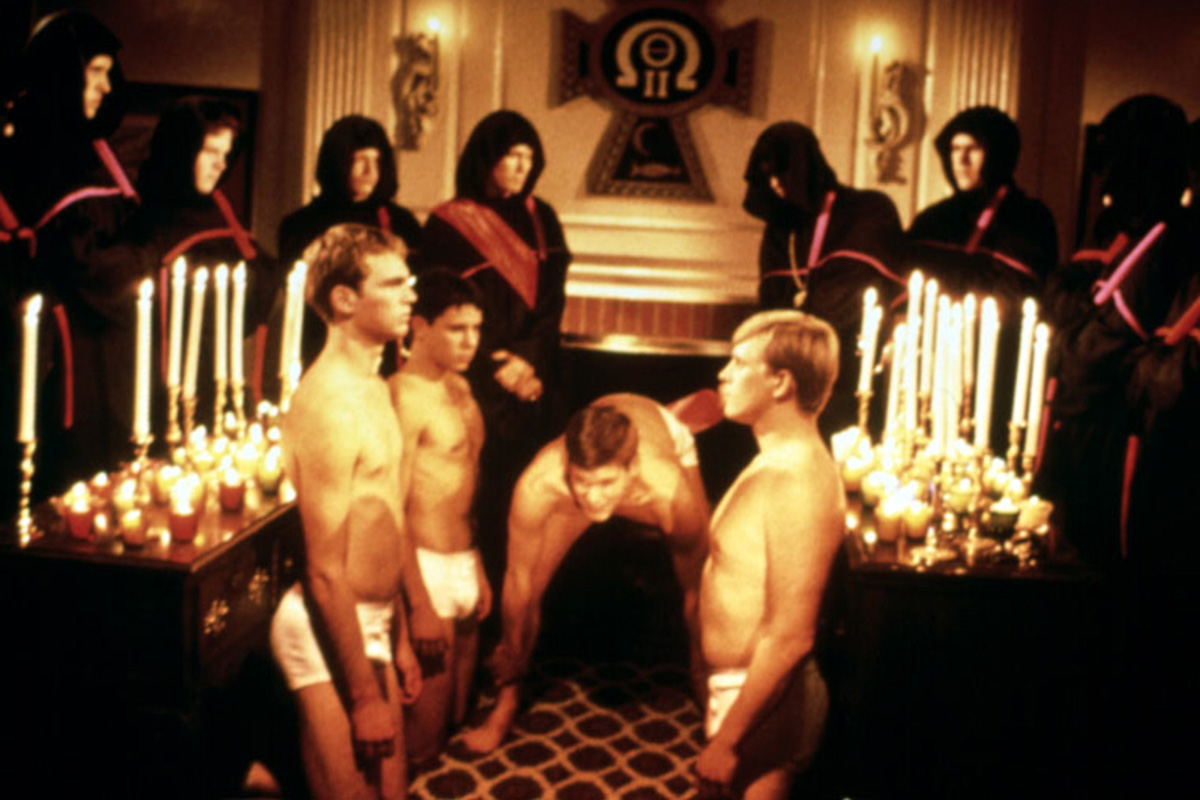
Masonic lodges had a strong influence on early fraternity culture. From them, fraternities inherited a love of symbols, secret mottos, initiation rituals, signs of recognition, solemn ceremonies and the idea of brotherly loyalty. Unlike Freemasonry, however, student fraternities were tied to youth, campus life, friendship, rivalry and the alumni network that followed after graduation.
Phi Beta Kappa and the birth of Greek letters
The first famous Greek-letter student society was Phi Beta Kappa. It was founded on December 5, 1776, at the College of William and Mary in Virginia. Its early meetings took place at Raleigh Tavern in Williamsburg. Phi Beta Kappa established a model that later became recognizable throughout American fraternity culture: Greek letters, a secret motto, rituals, selective membership and the idea of intellectual brotherhood.
It is important to understand, however, that Phi Beta Kappa did not begin as a modern party fraternity. It was a serious student society for debate, oratory, friendship and intellectual exchange. Over time, it became a prestigious academic honor society, while the social, residential and club-like aspects of student life were taken up by other fraternities that emerged in the nineteenth century.
Greek letters became the perfect code. They looked noble, referred to antiquity, philosophy and learning, and at the same time concealed the true meaning of the motto from outsiders. It was a game, a status marker and a way of saying: we belong to a circle that cannot simply be entered from the street.
Initiation rituals also had symbolic meaning. They were meant to mark a transition from one state to another: from outsider to brother, from newcomer to member of a closed circle. Ideally, this was connected to ideas of trial, trust, loyalty and shared memory. In practice, however, this is where one of the darkest sides of fraternity culture emerged: hazing.
Hazing: the dark side of brotherly loyalty
Hazing is often explained as a “test of character,” but in reality it can too easily become humiliation, coercion and a dangerous game of power. In some fraternities, new members were forced to undergo psychologically and physically difficult trials, drink excessive amounts of alcohol, perform pointless tasks or endure degrading rituals. All of this was justified in the name of brotherhood: if you suffered through hardship, you had proved your loyalty to the group.
The problem is that this logic is dangerous. It confuses loyalty with submission, trust with abuse, and tradition with irresponsibility. That is why hazing in the United States has long been the subject of investigations, university bans, lawsuits and public criticism. Many fraternities today officially reject such practices, but the reputational shadow remains strong.
Alcohol is another painful issue. In popular culture, the fraternity house is often shown as an endless party. There is some truth in this: many fraternities did become centres of campus party culture. But this is also the side that has brought them many problems, from complaints by neighbours and universities to tragedies involving binge drinking, injuries and assault.
Still, it would be superficial to reduce fraternities only to drinking and scandal. Their role is more complicated.
Why students join them
For many students, a fraternity is first of all a way to find one’s place in a huge university world. Especially at large American universities, a campus can feel impersonal and intimidating. A fraternity offers a recognizable group, a house, older peers, a social calendar, support, rituals and a sense of belonging.
Fraternities also often organize charity events, athletic competitions, alumni events, professional meetings and mentoring. For a student, this can become a powerful social platform. Alumni help younger members with internships, recommendations, first jobs and connections in business, politics, law, medicine or finance.
The alumni network is one of the main secrets of fraternity longevity. American society values individual achievement, but it also understands the price of connections. A fraternity promises not only friendship for four years, but a network for decades. In this sense, a fraternity is social capital packaged as a student tradition.
Of course, this system invites legitimate criticism. Closed communities can easily reproduce inequality, social selectivity, male and racial hierarchies, privilege and access to opportunities “for our own.” That is why American universities have debated for decades whether fraternities help build community or, on the contrary, preserve old elite barriers under the cover of tradition.
Why fraternities became especially strong in America
America proved to be ideal ground for fraternity culture for several reasons. First, college in the United States became not merely a place to obtain a profession, but a distinct stage of life, almost a rite of passage. Four years on campus are not only about classes, but also dorms, clubs, sports, homecoming, alumni pride and a special university identity.
Second, American society historically developed around associations: churches, clubs, lodges, professional groups, civic organizations and voluntary societies. People formed groups to solve problems, build careers, support one another and influence society. Student fraternities fit perfectly into this culture of voluntary association.
Third, the United States became early on a society of high geographic mobility. A student left home, entered a new city, a new state, a new environment. The fraternity gave him a ready-made social structure and a sense of home. After graduation, the alumni network helped preserve that sense of belonging even when a person moved to another city or began a career elsewhere.
Finally, universities themselves gradually learned to use Greek life as part of the campus ecosystem. Although relations between administrations and fraternities have always been complicated, fraternities became part of university branding, fundraising culture, alumni engagement and campus social life.
Why Russia and Eastern Europe did not develop the same model
Russia and Eastern Europe did not develop the same fraternity culture for several reasons. The first is historical. The university tradition there developed later and differently than in England or the United States. There was no centuries-long continuous culture of residential colleges, closed student clubs and campus autonomy in the American sense.
The second reason is the different structure of elites. In the Russian Empire, the nobility, state service, the military, bureaucracy, court connections, Masonic lodges, literary circles and salons performed many of the functions that university communities partly assumed in the Anglo-American world. Education itself could already be a social elevator, without necessarily requiring a separate fraternity network.
The third reason is political. The authorities in the Russian Empire were suspicious of autonomous student associations, especially if they had a political, secret or opposition character. After the revolution, the Soviet system was even less likely to tolerate closed fraternities with pseudo-Masonic rituals, private hierarchies, independent networks and elite symbolism. Instead, it created its own mass forms of youth organization: Komsomol, student councils, trade-union structures, dormitory communities, job placement systems and ideological collectives.
The fourth reason is the absence of full campus life in the American sense. In many Eastern European countries, the university was historically more a place of study than a separate world where a student lives, socializes, builds an identity and remains emotionally tied to the alma mater for life. Without a strong residential campus, there is simply little soil from which a fraternity house can grow.
Fraternities today: relic or social machine?
Today, American college fraternities occupy a contradictory position. On the one hand, they still retain influence, money, alumni networks and appeal for many students. On the other, they face increasing pressure over hazing, alcohol, sexual misconduct, exclusivity and safety concerns.
Some universities tighten oversight, suspend chapters, introduce new rules or demand greater transparency. Some students, meanwhile, see Greek life as an outdated system that fits poorly with modern values of inclusion, equality and mental health. Yet fraternities are not disappearing. They are too deeply embedded in American university culture and too useful for those who know how to turn membership into connections, status and opportunity.
This is the central paradox. A fraternity can be a caricatured party house, but it can also be a real school of social navigation. It can reproduce toxic hierarchy, but it can also provide support, friendship and access to a strong alumni network. It can be a closed club of privilege, or it can become a student’s first experience of leadership, fundraising, teamwork and responsibility.
That is why college fraternities cannot be understood only through movies. They are not simply drunken parties with Greek letters on the façade. They are an American institution of informal power, ritual belonging and social capital. They emerged where the university became not only a place of education, but also a factory of future connections. And as long as connections, identity and alumni loyalty remain important in American society, fraternity culture will change, be criticized and be reformed - but it is unlikely to disappear completely.