
Deep Purple In Rock: the album that carved hard rock into stone
Some albums simply sell well, enter the charts and become part of a band’s discography. Others make it impossible for the band ever to be the same again. Deep Purple In Rock belongs firmly in the second category. In 1970, Deep Purple did not merely release their fourth studio album. They effectively redefined themselves: out of a group that had been moving between psychedelia, progressive rock, covers and orchestral experiments emerged one of the defining hard rock line-ups of its time.
Deep Purple In Rock was the first studio album by the classic Mark II line-up: Ritchie Blackmore, Ian Gillan, Roger Glover, Jon Lord and Ian Paice. Formally, this line-up had already appeared on Concerto for Group and Orchestra, but In Rock was its true manifesto. The album was released in June 1970 on Harvest in the United Kingdom and Warner Bros. in the United States, and quickly became the band’s breakthrough in Europe.
In America, the record did not have the same impact as some of Deep Purple’s earlier work. At home, however, it became a major event: In Rock reached No. 4 on the UK album chart and remained there for more than a year. The single Black Night, recorded after the main album sessions, reached No. 2 on the UK singles chart and became Deep Purple’s highest-charting British single. Over time, the album would increasingly be recognized as one of the key documents of early hard rock and a forerunner of what would soon be called heavy metal.
How Deep Purple became a different band
By the end of the 1960s, Deep Purple were facing a crisis of direction. Ritchie Blackmore was drawn toward a heavier, more aggressive sound. Jon Lord, by contrast, was fascinated by the fusion of rock and classical music. The first three albums were interesting, but not fully focused: psychedelia, progressive elements, covers, American influences, organ grandeur and the search for a language of their own.
Eventually, the change affected not only the style, but the line-up. Vocalist Rod Evans and bassist Nick Simper left the band. Blackmore felt that Evans sang ballads well, but was not suited to faster, heavier material. Simper was a capable bassist, but seemed connected to an older rock-and-roll school. The band wanted a different force, a different energy and stronger songwriting chemistry.
The new chapter began after Deep Purple heard Ian Gillan singing with Episode Six. His voice - high, powerful, dramatic, capable of moving from a blues phrase to an almost inhuman scream - was exactly what the new music required. Gillan brought with him bassist Roger Glover. At first, Glover did not want to leave Episode Six, but it quickly became clear that his musical thinking, bass weight and songwriting contribution were ideal for the new line-up.
This was the birth of Deep Purple Mark II - the line-up that would record In Rock, Fireball, Machine Head and Made in Japan. But In Rock was the first moment when that chemistry fully caught fire.
From Concerto to In Rock
Before In Rock, Jon Lord had already pushed his classical ambitions to their most visible extreme. In September 1969, Deep Purple performed Concerto for Group and Orchestra at the Royal Albert Hall with the Royal Philharmonic Orchestra conducted by Malcolm Arnold. For its time, this was a daring gesture: a long-haired rock band invading the territory of academic music and trying to combine rock energy with large-scale orchestral form.
Yet for all the boldness of the idea, a fully organic unity was not achieved. The rock and orchestral passages tended more to alternate than to grow into a single whole. The attempt was important, but it also revealed the limit of the previous path. Deep Purple could continue complicating form and searching for fusion with classical music, or they could do the opposite - compress the energy, make the sound heavier and turn virtuosity into impact.
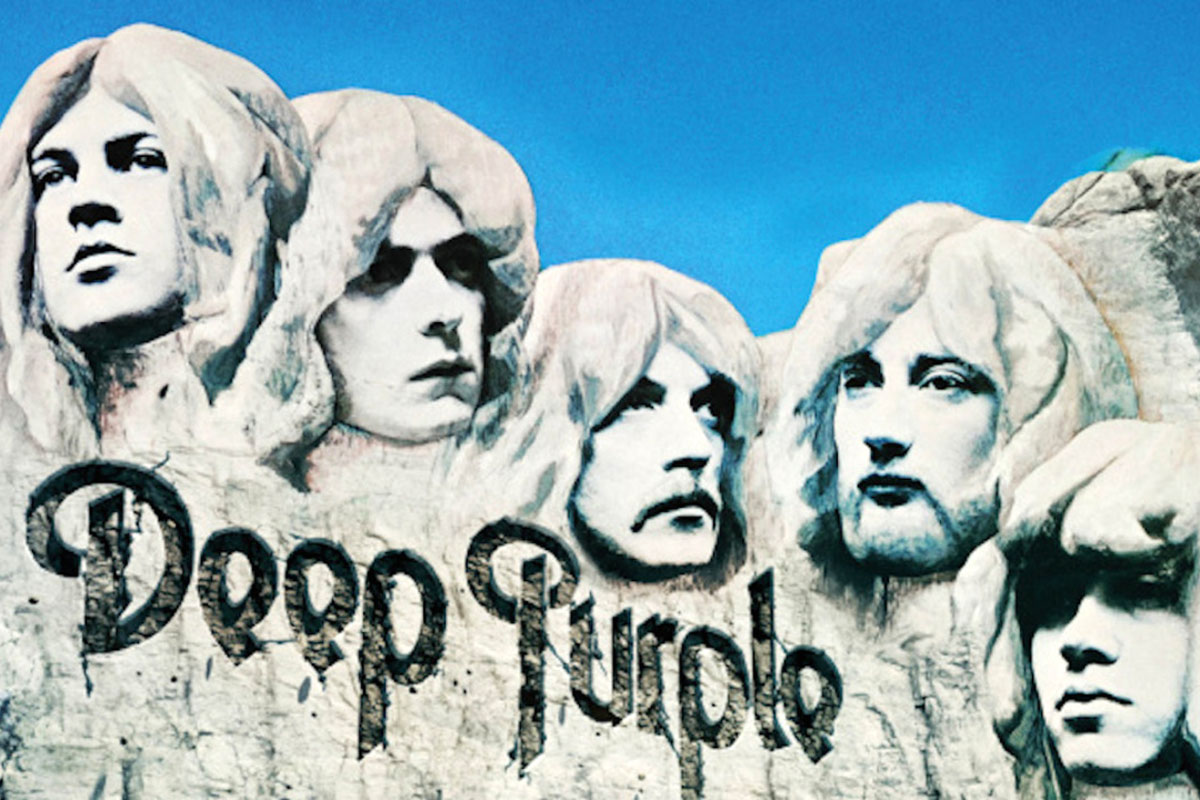
The title In Rock was almost a declaration. After Concerto, the band seemed to be saying: we are not in the orchestra, not in an academic experiment, not in someone else’s system of values. We are in rock. And, through the cover image, quite literally in stone.
The sound that changed everything
The album was recorded between October 1969 and February 1970 at London’s IBC, De Lane Lea and Abbey Road studios, often between live performances. That matters: In Rock does not sound like a sterile studio construction. It sounds like an attempt to capture the live power of a band that already understood how devastating it could be on stage.
Speed King opens the album with near-chaos - an explosion of noise, organ, guitar and rhythmic attack. On the American edition, the intro was cut, which only underlines the difference between how Deep Purple wanted to present themselves and how the market tried to adapt them. Bloodsucker, Flight of the Rat, Into the Fire and Living Wreck all demonstrate density, groove and heavy riff-based writing, but the great monument of the record is Child in Time.
Child in Time became not simply a song, but a dramatic scene. The slow organ introduction, the gradual build, Gillan’s voice moving beyond ordinary rock singing, and the explosive middle section made the composition one of the peaks of early heavy rock. This was music in which blues foundations, European drama, psychedelic tension and almost operatic expression merged into something new.
It was here that Deep Purple finally found the balance between Blackmore and Lord. The guitar no longer fought the organ, and the organ no longer pulled the band back toward academic form. They became two equal power lines. Paice held everything together with flexible but forceful drumming. Glover thickened the sound. Gillan turned songs into dramatic events. This was how Deep Purple became a great hard rock machine.
Black Night: the single the band barely respected
One of the great paradoxes of the In Rock era is that its most commercially successful track was not part of the album itself, but a song recorded at the label’s insistence. At the time, the idea of album-oriented rock was gaining strength among serious bands: a real group thought in albums, not singles. Led Zeppelin’s principled refusal to release singles set the tone, and many musicians regarded single culture as something pop-oriented and slightly degrading.
Deep Purple were not planning to craft a hit. But Harvest wanted a single and sent the band into De Lane Lea with a clear message: do not come back without one. For a long time, nothing useful emerged. The musicians went to a pub, returned to the studio, and the riff for Black Night gradually appeared.
The band themselves treated the song rather lightly, almost as a throwaway. Its riff carried echoes of old rock-and-roll and garage influences, and its structure was simpler and more direct than the material on In Rock. But managers Tony Edwards and John Coletta immediately heard what mattered: Deep Purple had a hit.
They were right. Black Night reached No. 2 on the UK chart and dramatically expanded the band’s audience. In serious rock circles, this could look almost suspicious: a heavy band suddenly appearing in the singles chart. But the times were changing. Black Sabbath with Paranoid and Deep Purple with Black Night showed that heavy music could enter the mass charts without losing its power.
Why In Rock arrived at exactly the right time
Deep Purple In Rock appeared at a moment when audiences were increasingly tired of polished pop aesthetics. The late 1960s and early 1970s became a period when young listeners were looking for louder, more complex, heavier and more “real” music. The live business was changing: instead of older entertainment formats, student unions, clubs, festivals and venues willing to book progressive and underground bands were becoming more important.
Record labels were changing too. Major companies began creating subsidiaries for music that did not fit the old pop model. EMI launched Harvest, associated with Pink Floyd and Deep Purple. Decca created Nova, Pye created Dawn, and Fontana created the legendary Vertigo. These labels released music that today forms a golden archive for vinyl collectors and rock historians.
The new managers and producers understood the language of youth better. They did not always look like traditional office executives, but they sensed where rock was going. Deep Purple were in the right place at the right time: a new line-up, a new sound, a new album and a single that unexpectedly opened the door to mass consciousness.
Roger Glover later remembered that after Black Night and In Rock, the band suddenly seemed to be everywhere: newspapers wrote about them, concerts began to pay off, and audiences grew rapidly. This was the moment Deep Purple transformed from a promising group into one of the leading forces of British and European hard rock.
The stage, destruction and the myth
By 1970, Deep Purple were becoming not only a studio band, but a live legend. Ritchie Blackmore had already mastered the art of stage destruction, inspired in part by The Who: smashed guitars, aggression, fire and physical tension. Asked how he felt about treating his instrument so roughly, Blackmore answered in his usual style: he played the guitar well, and therefore had the right to be rough with it occasionally.
At festivals, Deep Purple sounded like a band that did not merely perform songs, but attacked the space around them. Melody Maker described performances from that period almost like natural disasters: Blackmore destroying guitars, Lord pushing the organ to its limit, and the band creating the impression of uncontrolled force. That was how the early Deep Purple myth formed: virtuosity, volume, danger and almost barbaric energy joined to musical discipline.
It is no coincidence that Arthur Brown, one of the most theatrical figures in British rock of the 1960s, saw in Deep Purple a continuation of the line where psychedelia, heavy organ and dark stage energy turned into a premonition of hard rock. Gillan’s vocal extremity, Lord’s organ power and Blackmore’s guitar fury did indeed continue and radically intensify that tradition.
The cover: Deep Purple in stone and in rock
The cover of In Rock is one of the most successful visual images in classic rock history. The album title contains a play on words: rock means both rock music and stone. On the cover, the faces of the band members replace the presidential heads on Mount Rushmore in South Dakota. The result is a joke, a declaration and a prophecy all at once: Deep Purple seemed to carve their monument into rock history before history had fully confirmed it.
The idea was bold. Mount Rushmore is one of the most recognizable American national symbols, with the stone faces of George Washington, Thomas Jefferson, Theodore Roosevelt and Abraham Lincoln. By 1970, the image was already deeply embedded in popular culture, not least through Alfred Hitchcock’s North by Northwest.
On the cover of Deep Purple in Rock, the faces of the five musicians replaced the presidents through pre-Photoshop design techniques. Today, the image feels almost obvious, but for its time it was witty and ambitious. The band was not merely releasing a record. It was making a claim: we are here to stay.
Legacy
With In Rock, the language of early hard rock came sharply into focus: heavy riffs, powerful Hammond organ, virtuoso guitar, dramatic vocals, long instrumental sections and the sense that rock music could be raw, intelligent, theatrical and monumental at the same time. It was a European answer to rock’s American blues roots: less relaxed groove, more tension, density, classical drama and architectural force.
Deep Purple did not follow the path of full fusion with classical music, as Lord had imagined in Concerto. Instead, they chose to make the rock band itself heavier from within. The organ became not decoration, but a weapon. The guitar became not merely a solo instrument, but a structural force. The voice became not melodic accompaniment, but dramatic explosion. The rhythm section became not background, but engine.
The 1995 anniversary reissue, prepared for the album’s 25th anniversary, added bonus tracks including Black Night, Jam Stew, a new version of Cry Free and remixes of selected tracks. But the essential impact remained unchanged: In Rock still sounds like the moment when a band found itself and helped define an entire genre.
Today, when hard rock has long since become classic, it is easy to forget how risky and raw this music was in 1970. Deep Purple In Rock was not smooth, comfortable or designed for background listening. It was loud, tense, sometimes rough and almost confrontational. That was its strength. Deep Purple did not simply enter rock. They carved themselves into it.