
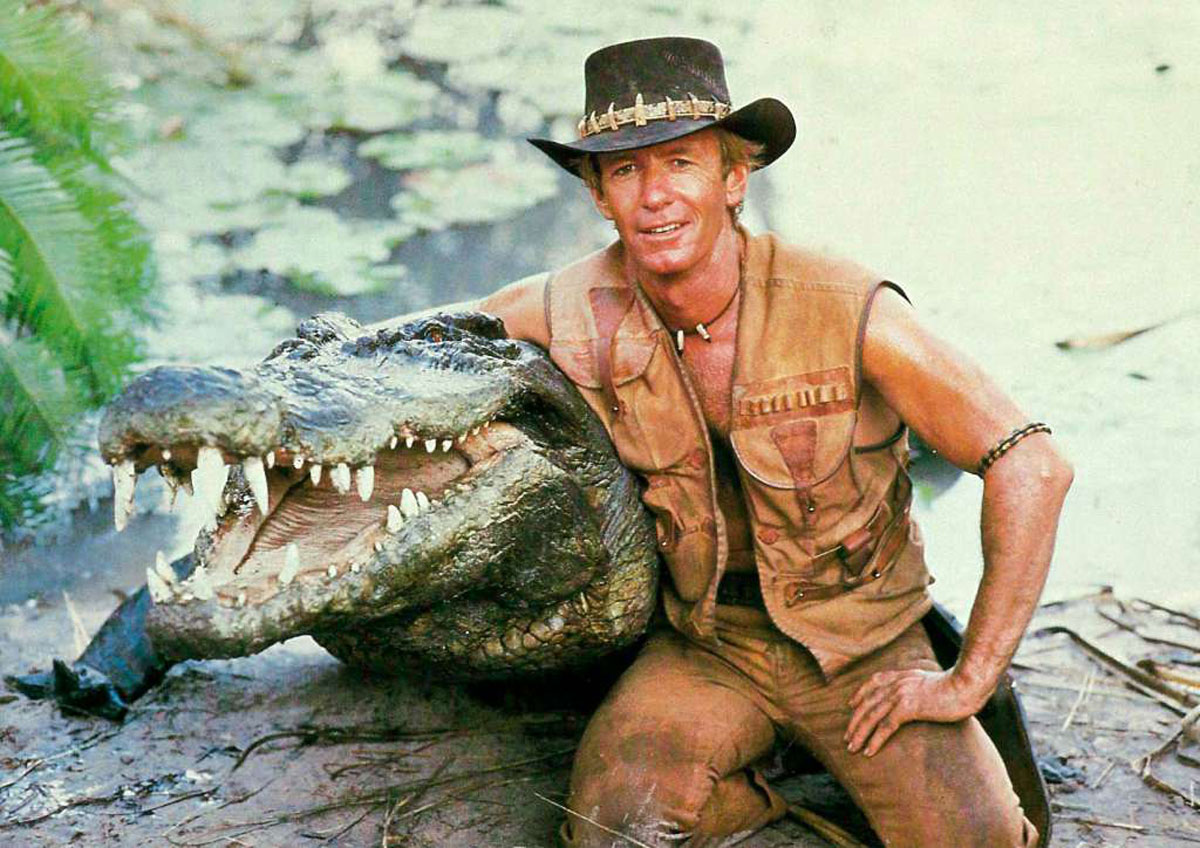
The story of the real Crocodile Dundee
Sometimes cinema creates a myth so convincing that the real person behind it almost disappears in its shadow. That is what happened with Crocodile Dundee, the 1986 film that turned the image of the Australian bushman into a global pop-culture legend. Paul Hogan played Mick Dundee - a man from the wild Australian North who arrives in New York and faces the big city with the same calm confidence with which he once faced crocodiles. Made on a budget of under 10 million dollars, the film became an international hit and earned hundreds of millions. But behind its charming legend stood a far harsher, stranger and more tragic story.
One of the main real-life inspirations for Mick Dundee is widely considered to be Rodney Ansell - an Australian buffalo hunter, tracker and bushman. His life could easily have become a film of its own, though certainly not a comedy. It contained wilderness, extraordinary survival, sudden fame, legal disappointment, the loss of land, drugs, paranoia and an ending that feels less like an adventure story and more like a dark ballad about a man who could not find his way back from his own legend.
Rodney William Ansell was born in Queensland in 1954. As a teenager, he moved into Australia’s Northern Territory - a world of red earth, wet heat, crocodiles, buffalo, rare roads and people accustomed to living far beyond the logic of the city. By the age of 15, he was hunting wild buffalo and selling the meat. For him, the bush was not a romantic image. It was work, habitat and a way of understanding the world.
Fifty-six days in the wild
In May 1977, Ansell went fishing in the area of the Victoria River. With him were two young bull terriers. The trip was supposed to be ordinary, but it would make him famous. His 18-foot motorboat capsized after striking something enormous. Ansell later claimed it had been a whale, though that version sounds highly doubtful. It was far more likely a large crocodile or another violent collision on the water.
Ansell managed to escape and save some of his belongings. He ended up in a small dinghy with one oar, a rifle, a knife, a small amount of canned food, bedding and two puppies, one of which had an injured leg. During the night, the boat was carried away by the current and eventually washed up near the mouth of the Fitzmaurice River, far from where anyone might have searched for him.
He spent the next 56 days in near-total isolation. For the first two days, he had no fresh water. To survive, he hunted wild cattle and buffalo, sometimes drinking animal blood to replace fluid and salts. He caught bees and tried to follow them back to their hives in order to find honey. At night, he slept in trees with his dogs, away from crocodiles. Around him were heat, insects, tides, predators and a vast landscape in which a human being quickly becomes a very small creature.
Ansell had little expectation of being rescued. He had told people he would be away for several months, so no one raised the alarm immediately. And even if they had searched, they would not have looked where he ended up. Rescue came almost by chance: one day, he heard the sound of horse bells and followed it to two Aboriginal stockmen and their white companion. They helped bring him back to people.
Fame that did not bring happiness
The story immediately became a sensation. Newspapers wrote about the man who had survived for more than seven weeks in the crocodile country of the Northern Territory. Ansell wrote a book, To Fight the Wild, and appeared in a documentary of the same name. Later, he was invited on television, including Michael Parkinson’s famous talk show. In the city, he looked almost like a visitor from another world: barefoot, direct, unfamiliar with luxury, a man who understood the bush far better than a hotel room.
It was precisely this combination of natural confidence, innocence before the city and an almost mythological image of the Australian tracker that helped inspire the creators of Crocodile Dundee. Paul Hogan and his co-writers created Mick Dundee as a lighter, comic and more charming version of that kind of figure: wild but noble; simple but wise; funny in the city, yet completely at home in nature.
The film was released in 1986 and became a global phenomenon. It presented Australia to the world as a country of vast spaces, dangerous wildlife, dry humour and people who seemed able to stop a crocodile with one hand and charm New York with the other. But real-life fame gave Rodney Ansell very little. He did not receive a share of the film’s success. Worse still, when he later tried to use the name “Real Crocodile Dundee” for a tourism business, he faced legal threats from the rights holders.
For a man whose biography helped give birth to the legend, that was bitter. The movie earned millions, while the real bushman remained on the outside - recognizable, but not protected by his own fame.
Lost land and a broken man
After his brief rise to fame, Ansell tried to return to the life he understood best: land, cattle, hunting, the Northern Territory. But reality began to collapse. A decline in the buffalo population, problems with the land, invasive weeds and economic hardship damaged his operation. In the 1990s, his farming business came under pressure, and eventually he lost his ranch and had to leave the places to which he was deeply attached.
For an urban person, the loss of property is a financial catastrophe. For Ansell, it was more than that: the loss of a world, a language, a role, an identity. He was a man of the land, and when the land was gone, he began to come apart with it.
Later, Ansell became involved in growing marijuana and using amphetamines. He lived with his partner, Cherie Ann Hewson, near Urapunga, among an Aboriginal community with which he had long-standing ties. Many locals respected him: he knew the language, the customs, the land and was not an ordinary outsider to them. But beyond that respect, his life was becoming increasingly unstable.
A tragic ending
In August 1999, Rodney Ansell’s story ended in a shootout with police in the Northern Territory. Before that, there had been reports of strange and dangerous behaviour, attacks and injured people. During the confrontation, Ansell fatally wounded police Sergeant Glen Huitson. In the exchange of fire that followed, Ansell himself was killed.
After his death, it was found that he had high levels of amphetamines in his system. Later accounts also referred to paranoia, mental disturbance and the destructive effect of drugs. This was no longer the romantic hunter of legend, but a man broken by loss, addiction, isolation and, perhaps, by his own inability to live outside the wild world in which he had once been strong.
At the request of his sons, Ansell was buried according to Aboriginal rites in Arnhem Land. There was something symbolic in that: the man remembered by the world as the inspiration for an Australian screen legend returned in the end not to Hollywood, not to the city and not to a tourist myth, but to the land where he truly belonged.
The man behind the myth
Rodney Ansell’s story matters not simply because he was “the real Crocodile Dundee.” It is deeper than that. It is a story about how cinema can take a harsh life and turn it into a light legend. About how mass culture can make a person into a symbol without necessarily helping the person himself. About how the romance of wild landscapes can hide the very real pain of those who live in such places not on screen, but every day.
Mick Dundee remained in the audience’s memory as a charming hero who moved easily between two worlds: the bush and the metropolis. Rodney Ansell could not make that crossing. He survived crocodiles, heat and hunger, but proved defenceless against fame, the loss of land and his own inner darkness.
That is why his story does not read like a funny footnote to a famous film, but like a real tragedy. Behind the smile of the screen hero stood a man who truly knew how to survive in the wild - but never found a way to survive in the world that turned him into a legend.