
The Green Fairy, bohemia and the most beautiful alcoholic myth
The history of absinthe
Absinthe has always been more than just a strong drink. Across different eras, it has been called a medicine, an artists drink, a dangerous poison, a symbol of decadence, a cause of madness and the forbidden fruit of European bohemia. It was drunk by doctors, soldiers, poets, workers, aristocrats and adventurers. It was blamed for almost every sin of the Belle Époque, banned for decades and then returned to the market - this time as a legend carefully sealed in a bottle.
The exact origin of absinthe is still surrounded by elegant versions and half-myths. The name itself comes from the French absinthe, connected with grand wormwood - Artemisia absinthium. According to one popular version, the drink appeared in the late eighteenth century in Switzerland’s Val-de-Travers region, where the Henriod sisters made herbal tinctures and medicinal mixtures. Another version gives an important role to the French doctor Pierre Ordinaire, who used a wormwood-and-anise elixir as a therapeutic remedy.
At the heart of the drink was the distillation of an alcohol infusion with wormwood, anise, fennel and other herbs. Later, wormwood became the centre of controversy: thujone, a compound found in its essential oil, was long believed to cause unusual visions and madness. Today, that reputation looks far less convincing. Modern science does not support the romantic myth that absinthe was some separate hallucinogenic portal. The more honest explanation is simpler: it was a very strong alcoholic drink that was often consumed too heavily and too quickly.
The commercial success of absinthe began when the recipe passed to entrepreneur Henri Dubied and later to Henri-Louis Pernod. With Pernod, the industrial history of absinthe truly began. What once looked like an herbal remedy quickly became one of the most recognizable alcoholic symbols of Europe.
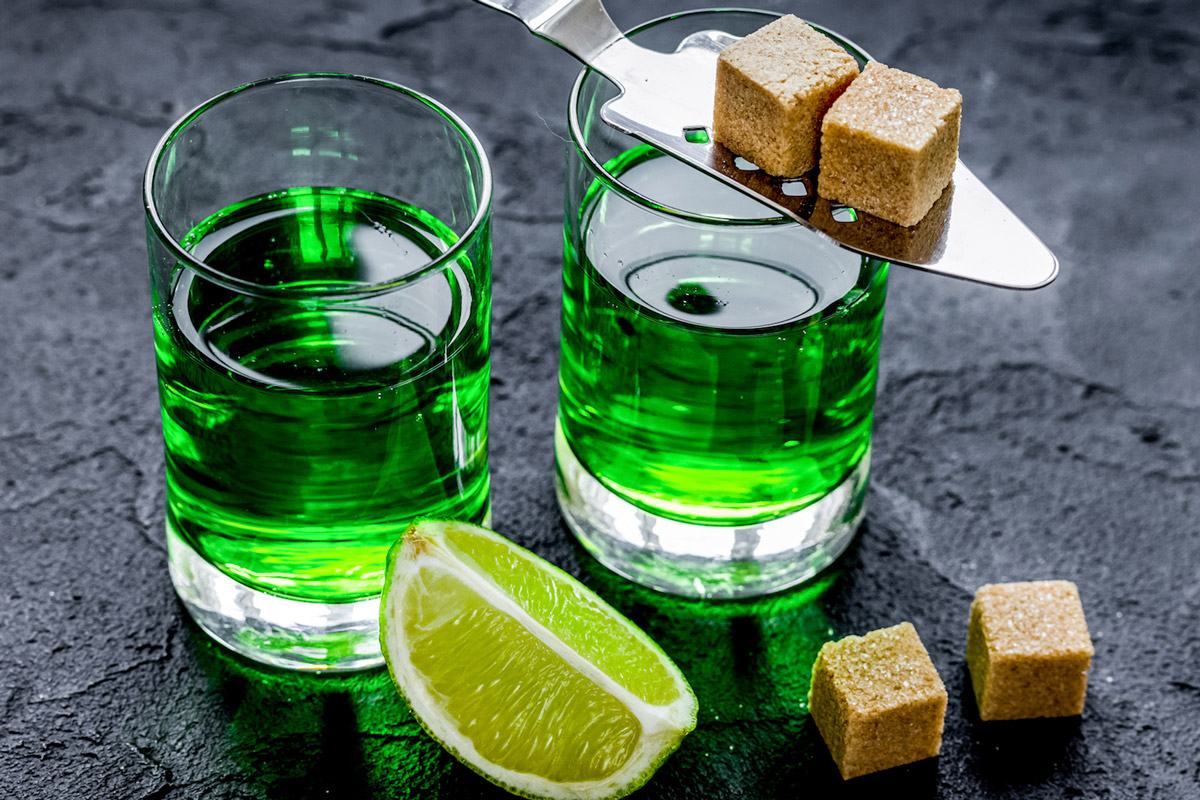
Absinthe is most often associated with an emerald-green colour, although it may also be clear, yellow, brownish or otherwise tinted. The green hue comes from the chlorophyll in herbs, which is sensitive to light; for that reason, absinthe was traditionally bottled in dark glass. It was this colour that gave the drink its most famous nicknames: the Green Fairy and the Green Witch.
The green hour of French bohemia
In the nineteenth century, absinthe experienced a spectacular rise. In France, it began as a drink for people of money and taste: an aperitif for artists, writers, journalists, officers, Parisian dandies and those who wanted to belong to the world of urban refinement. Between five and seven in the evening, cafés and bars entered the famous l’heure verte - the green hour. Absinthe was diluted with cold water poured over sugar on a special spoon, the drink turned cloudy and milky-green, and the ritual became almost a small performance.
Its image quickly entered art. Absinthe appeared in painting, literature, diaries, memoirs and scandalous urban legends. It was associated with Van Gogh, Verlaine, Rimbaud, Baudelaire, Maupassant, Toulouse-Lautrec, Picasso and later Hemingway, among others - figures for whom alcohol was not merely a habit, but part of the myth of creative freedom and self-destruction.
But the Green Fairy had another side. As mass production developed, absinthe became cheaper and more accessible. It left the world of bohemian cafés and reached the tables of workers, soldiers and the poor. While the elite could still turn the drink into a ritual, mass consumption often looked very different: a lot, strong, fast and not always of good quality. Cheap versions could be rough, poorly made and dangerous not because of mystical thujone, but because of the overall alcohol burden and questionable production.
The army also helped spread absinthe. During French colonial campaigns in the nineteenth century, it was issued to soldiers, including as a preventive remedy and for disinfecting water. When soldiers returned home, they brought back a taste for this sharp herbal drink. In this way, absinthe became part of French everyday life - first fashionable, then popular, and eventually increasingly troubling.
The ban: when the myth became stronger than the drink
By the beginning of the twentieth century, absinthe had acquired an almost demonic reputation. It was blamed for hallucinations, madness, crime, moral decline, the destruction of families and the degeneration of society. In reality, behind many tragedies stood not absinthe as a unique chemical threat, but mass alcoholism, poverty, social tension and the very high alcohol content of the drink.
Still, the image had been created: absinthe became a convenient enemy. Wine interests, moral reformers, doctors, politicians and the press gradually transformed the Green Fairy into a symbol of dangerous modern corruption. In the early twentieth century, various countries began banning it. Switzerland, France, the United States and several others introduced restrictions or outright prohibitions, and for many decades absinthe disappeared from legal mass circulation.
But it did not disappear completely. In Spain and some other countries, production never fully stopped. In Switzerland, the tradition went underground: distillers produced clear absinthe blanche, or la Bleue, which was easier to hide. The drink survived its exile not as a fashionable symbol of bohemia, but as a semi-forbidden regional secret.
The return of the Green Fairy
The modern revival of absinthe began in the late twentieth century. In the United Kingdom, where absinthe had never been formally banned in the same way as in France or Switzerland, imported Czech brands appeared in the 1990s. Many connoisseurs considered them rough and far from the historical style, but they brought the word absinthe back into public conversation.
It soon became clear that the market was ready not only for exotic novelty, but also for a serious return of the legend. In the early 2000s, more ambitious brands appeared, aiming to restore the traditional taste of absinthe - complex, herbal, anise-forward, bitter-edged and elegant. Important figures in modern absinthe culture included French researcher Marie-Claude Delahaye, founder of the Absinthe Museum, as well as experts and distillers who tried to separate the real history of the drink from cheap horror stories.
Pop culture also helped. Absinthe once again appeared in conversations about cinema, music, Gothic aesthetics, bohemian decadence and forbidden pleasure. Johnny Depp spoke about his experience with absinthe during the filming of Sleepy Hollow, while Marilyn Manson even launched his own brand, Mansinthe, with a label based on his watercolour self-portrait. The Green Fairy received a new life - no longer as the everyday aperitif of Parisian cafés, but as a stylized cultural object.
What remains of the legend
In the twenty-first century, absinthe is legal in many countries, but its production is regulated. In Europe, limits apply to thujone content, and modern legal products must meet established standards. This matters: today’s absinthe is not a mysterious narcotic elixir from urban legend, but a strong herbal spirit with a controlled composition.
The most persistent myth about absinthe is its supposed hallucinogenic power. For decades, that myth gave the drink its forbidden aura. But studies of historical samples have shown that thujone levels in old absinthe were not nearly as extraordinary as opponents of the drink liked to claim. Most effects attributed to absinthe are far more convincingly explained by high alcohol content and excessive consumption.
That does not make absinthe less interesting. On the contrary, once the cheap mysticism is removed, a more subtle story remains: a drink with a medicinal past, bohemian fame, tragic mass popularity, political prohibition and a dramatic return. Its power is not that it opens a portal to hallucinations, but that it carries within it an entire era - its cafés, artists, anxieties, illusions and taste for beautiful risk.
Absinthe is best understood not as a drink for chasing extreme effects, but as a cultural artifact. It is drunk slowly, diluted with water, while one watches the clear green liquid cloud into an opalescent mist. In that ritual, there is something the modern world increasingly loses: pause, theatre, attention to detail and the sense that a glass can be more than alcohol - it can be a small stage where history, taste and legend meet.