
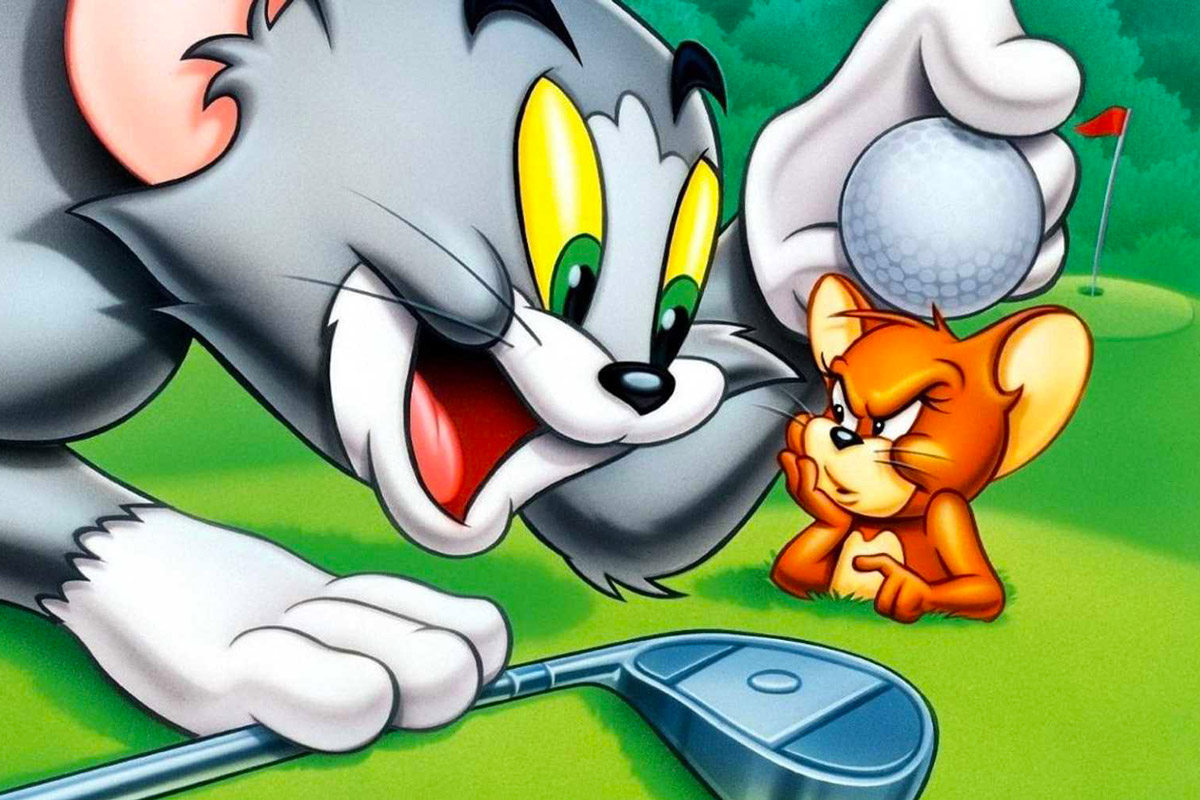
Tom and Jerry: a few facts about the cartoon
That taught the world to laugh
Some cartoons belong to their own time, and some seem to fall outside time altogether. Tom and Jerry belongs to the second category. You can watch it as a child, then as an adult, then show it to your own children - and still understand why a cat, a mouse, a piano, a frying pan, a door, a staircase and one perfectly timed pause can make people laugh without a single explanation. The first short was released in 1940, yet the duo still lives in global culture because its language is almost universal: movement, music, rhythm, pain, revenge, triumph and comedy refined to a jewellers precision.
Tom and Jerry is often perceived as a simple children’s cartoon, but behind its lightness lies an enormous school of animation craft. This is not merely a story about a cat and a mouse. It is a legacy of Hollywood’s golden age, studio rivalry, the influence of silent cinema, virtuosic slapstick, controversial cultural stereotypes and a rare case in which almost silent characters became understandable to audiences around the world.
Tom and Jerry were born from the desire to compete with Disney
In the late 1930s, the animation department at Metro-Goldwyn-Mayer was searching for distinctive characters of its own. Disney already had Mickey Mouse and an entire universe of recognizable figures, while MGM needed to create something just as memorable, but with a different temperament. Animators William Hanna and Joseph Barbera proposed a story about a cat and a mouse who endlessly set traps for one another.
At first glance, the idea did not seem revolutionary: a cat chases a mouse - what could be simpler? But the strength was not in the plot. It was in the execution. The pilot short Puss Gets the Boot was released in 1940 and immediately showed the potential of the duo. It even received an Academy Award nomination, which was a serious achievement for a new pair of characters.
From that moment, MGM understood that it had its own answer to Disney - not a gentle fairy-tale hero, but a dynamic, noisy and mercilessly funny duo built on conflict, speed and brilliant physical comedy.
At first, they were not called Tom and Jerry
In the first cartoon, the cat was called Jasper. The mouse’s name was not spoken in the short itself, although early sources mention names such as Jinx or Pee-Wee. Once it became clear that the characters would continue, the studio decided to give them more memorable names.
That is how Tom and Jerry appeared. Beginning with the second short, The Midnight Snack, the cat became Tom and the mouse became Jerry. The names proved so successful that today it is almost impossible to imagine them any other way. They are simple, easy to remember and instantly create the feeling of a pair - almost like the name of an old comedy team.
Tom and Jerry won seven Oscars
Tom and Jerry did not simply become audience favourites. They became one of the most decorated series in the history of short-form animation. The classic Hanna-Barbera shorts made for MGM won seven Academy Awards in the animated short subject category.
The first Oscar came in 1943 for The Yankee Doodle Mouse. In the years that followed, the series continued to win, proving that slapstick animation could be not only mass entertainment, but also a craft of the highest order. In terms of Academy Awards in this category, Tom and Jerry came close to Disney’s achievements and became a symbol of MGM’s success in building an animation force of global scale.
The spirit of Chaplin and the language of silent film
Tom and Jerry are often compared to the tradition of silent cinema, and the comparison is entirely fair. In the films of Charlie Chaplin, Buster Keaton and other great comedians of the silent era, laughter was built not on dialogue, but on the body, rhythm, the glance, the pause, the fall and the precise timing of disaster. Tom and Jerry carried that logic into animation.
The characters hardly speak, yet the viewer understands everything. Tom arches in pain, Jerry freezes before another trick, the music signals tension, and the editing stretches anticipation to its breaking point. This is physical comedy in its purest form: chase, impact, pause, explosion, sudden defeat and instant return to the game.
That is why the cartoon travelled so easily around the world. It did not need translation. A child in Canada, Italy, Mexico or Japan could understand what was happening without words. This is the magic of Tom and Jerry: comedy built on the universal language of movement.
Tom gradually became almost human
In the early shorts, Tom behaves more like an ordinary cat: he meows, hisses and walks on all fours. But as the series develops, he increasingly acquires human traits. He walks on two legs, makes elaborate plans, plays musical instruments, sings, conducts, courts female cats, teaches, reads, cooks and enters situations that are much closer to human comedy than to the behaviour of a house cat.
Jerry is not just a mouse either. He is small, but strategically almost unbeatable. His strength lies in speed, attention and an absolute understanding of his opponent’s weaknesses. Tom is physically larger, but Jerry is almost always smarter in the moment. This reversal of the expected hierarchy is what makes their conflict so appealing: the weak does not simply run away from the strong, but constantly outplays him.
Why they almost never speak
The near absence of dialogue is not an accident, but one of the main reasons for the cartoon’s longevity. Tom and Jerry do not need long lines because their emotions are conveyed through music, tempo, facial expression, screams, sound effects and perfectly constructed visual logic.
At different times, creators experimented with giving the characters more voice, especially in feature-length versions, but audiences often reacted cautiously. When Tom and Jerry begin to talk too much, the magic changes. They stop being universal figures of pure comedy and become ordinary characters with dialogue. Their strength lies elsewhere - in the fact that they can be understood without words.
Secondary characters in the classic shorts spoke much more often. The most famous example is Mammy Two Shoes, Tom’s owner, whose full face was often kept out of frame. Her voice, accent and manner became part of the early style of the series, but later this very character became the centre of serious controversy.
Mammy Two Shoes and the difficult legacy of old Hollywood
Mammy Two Shoes is one of the most controversial characters in the history of Tom and Jerry. The image of an African American domestic worker speaking with a distinctive accent is now seen as an example of racial stereotyping in old Hollywood. In the mid-twentieth century, such images appeared frequently in film and animation, but over time they came under justified criticism.
Beginning in the 1960s, some older episodes were edited and redubbed for television. In certain versions, Mammy Two Shoes was replaced or her voice was altered in an attempt to soften the racially problematic context. This is an important part of the cartoon’s history: Tom and Jerry remains a great work of animation, but it also reflects the cultural limitations of its time.
Today, these shorts are best watched with historical awareness. Their artistic value is enormous, but that does not remove the need to honestly recognize the stereotypes embedded in popular culture of that era.
The cartoon was often accused of violence
Tom and Jerry has always carried a double reputation. On one hand, it is a classic beloved by millions. On the other, the cartoon is indeed built on an endless sequence of blows, explosions, falls, traps, burns, collisions and destruction. The characters attack one another with such inventiveness that a modern viewer may sometimes wonder how this was ever shown to children.
But in classic slapstick, violence operates according to special rules. It is not realistic, but symbolic. Characters recover instantly, physical pain becomes a graphic sign, and the scene is built not on cruelty for cruelty’s sake, but on rhythm, anticipation and a surprise payoff. This is what links Tom and Jerry to circus clowning and silent film.
Still, the criticism is understandable. Over the years, certain scenes have been edited because of smoking, racial jokes, dangerous behaviour or excessively rough comedy. This again shows how social norms change: what one era considered harmless farce, another begins to examine much more carefully.
Tom and Jerry appeared alongside live actors
Even during Hollywood’s golden age, Tom and Jerry moved beyond ordinary animated shorts. In 1945, Jerry appeared in the musical Anchors Aweigh, dancing with Gene Kelly. For its time, this was an impressive scene in which a live actor interacted with an animated character as if they were truly sharing the same space.
In 1953, Tom and Jerry appeared in Dangerous When Wet with Esther Williams. These scenes were not just charming inserts, but demonstrations of MGM’s technical ambition: the studio showed that animation could exist organically inside a major Hollywood film.
The feature film proved how difficult it is to change the formula
The first feature-length animated film, Tom and Jerry: The Movie, was released in 1992. It showed just how fragile the original formula was. In the film, the characters spoke extensively and effectively became allies, which many viewers felt violated the very nature of the duo.
The problem was not only the story. Tom and Jerry work best as short musical-visual comedy, where conflict unfolds with mechanical precision. Stretching that formula into a feature film is difficult: if you keep only the chase, the audience becomes tired; if you give the characters dialogue and dramatic plot, their special magic disappears.
That is why the classic Hanna-Barbera shorts still feel stronger than many later continuations. Everything in them is perfectly assembled: tempo, music, drawing, pause, violence without realism and comedy without unnecessary words.
Why Tom and Jerry still work
The secret of Tom and Jerry is not only nostalgia. Nostalgia helps, but it does not explain why the cartoon continues to live for new generations. Its strength lies in precision. Every good short is built like a small machine for laughter: setup, desire, obstacle, trap, mistake, explosion, reversal and final irony.
Tom and Jerry has almost no morality in the conventional sense. Good does not always win, the guilty are not always punished, the strong are not always wrong and the weak are not always innocent. Sometimes Jerry is cruel, sometimes Tom inspires sympathy, sometimes both behave terribly, and that is exactly why their conflict remains so alive. It is not a lesson in behaviour, but a comedy about the eternal clash of cunning, desire, irritation, jealousy, hunger, pride and stubbornness.
There is something surprisingly adult in this. Tom and Jerry make children laugh because everything is physically clear. But adults see something else: an endless battle for territory, status, love, food, peace and the right not to be defeated. Perhaps that is why a cat and mouse invented in 1940 for a short studio cartoon still feel alive. They have not become outdated because their conflict is too simple to disappear and too precisely made to become boring.