
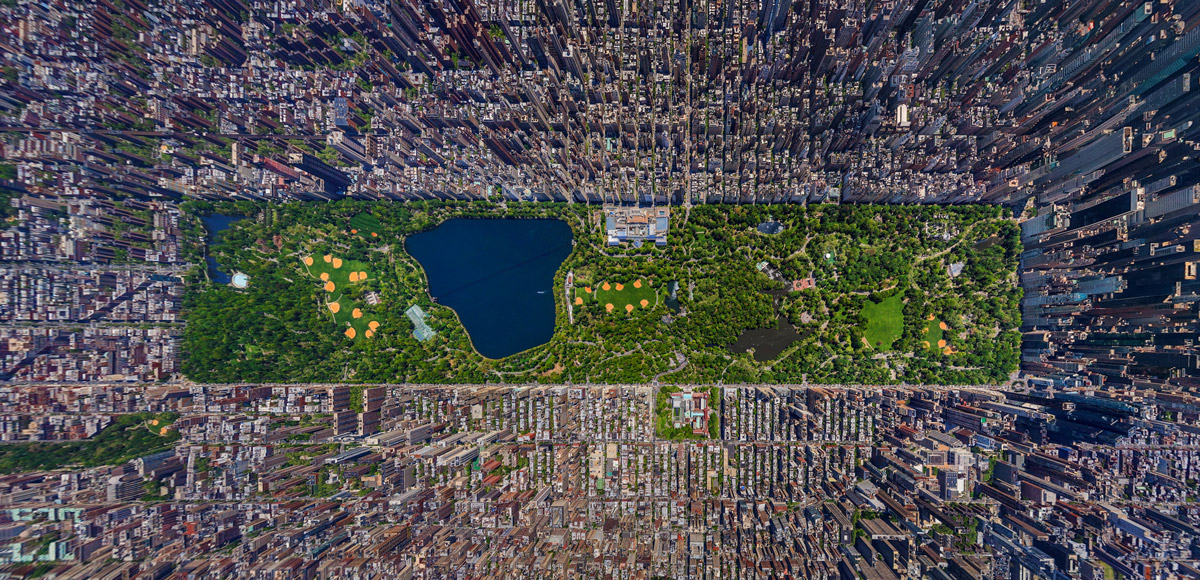
What you did not know about Central Park
Central Park is one of those rare urban landscapes that long ago stopped being merely a place on a map. It is smaller than several other parks in New York City, it is not the oldest park in America, and even its own designers did not always consider it their most perfect creation. Yet Central Park became the most recognizable image of an urban park in the world: a green rectangle in the middle of Manhattan, where the noise of the metropolis suddenly recedes, skyscrapers become a frame for trees, and a carefully manufactured landscape feels almost eternal.
The paradox of Central Park is that it looks natural, although it is almost entirely man-made. Its hills, lawns, ponds, paths, bridges, wooded corners and picturesque views were not simply “preserved” in the middle of the city. They were designed, excavated, filled, planted and built. This is not a piece of wilderness that somehow survived among stone and glass. It is one of the most ambitious urban illusions of the nineteenth century - artificial nature created so that millions of people could feel a little freer inside a growing industrial city.
The park is located in Manhattan between 59th and 110th Streets, from Fifth Avenue to Eighth Avenue, which along the park is also known as Central Park West. It is about 4 kilometres long, roughly 800 metres wide, and covers 843 acres, or about 3.4 square kilometres. By global park standards, that is not a record. But in cultural influence, Central Park has long belonged to its own category. It appears in film, literature, photography, advertising, fashion and the personal memory of millions of people for whom New York without Central Park would be an entirely different city.
A park created not by nature, but by an idea
By the middle of the nineteenth century, New York was growing at extraordinary speed. From the 1820s to the 1850s, the city’s population multiplied, and Manhattan was becoming one of the country’s major financial and industrial centres. The city was growing richer, denser, louder and dirtier. Streets were filled with carriages, commerce, workshops, people, animals, smells, dust and disease. Public space where residents could simply breathe, walk and see greenery was desperately lacking.
European capitals already had large public parks open to different classes of society. In New York, however, access to well-kept gardens and green spaces often depended on money, status and membership in the right circles. The idea of a large public park was therefore not only aesthetic, but social. Central Park was conceived as a space where the city could see itself as more civilized, more equal and more modern.
In 1857, Frederick Law Olmsted and Calvert Vaux won the design competition with their Greensward Plan. Their idea was inspired by the English landscape tradition: winding paths, open meadows, scenic water, gentle hills, wooded areas and carefully composed views that were meant to appear natural. Unlike formal French gardens with straight axes, grand flower beds and palace-like symmetry, Central Park was meant to feel free, democratic and natural.
But behind this “naturalness” was precise calculation. Olmsted and Vaux understood that a park in the centre of a major city should not simply decorate Manhattan. It should heal it: providing air, light, movement, social mixing and emotional pause. This was a new urban philosophy - nature as necessary infrastructure, not a luxury for the few.
Democracy written into the landscape
One of the strongest ideas behind Central Park was that it should be accessible to everyone. In the middle of the nineteenth century, that sounded far more radical than it does today. The city was divided by class, ethnicity and wealth, but the park was meant to be a place where different New Yorkers could, at least for a time, share the same public space.
This idea is visible even in the plan. Pedestrian paths, carriage drives, walking routes and service roads were designed so that different flows could coexist without destroying the sense of calm. The Central Mall - one of the few straight avenues in the park - leads to Bethesda Terrace and was conceived as a broad public promenade, a place for meetings, walks, performances and watching city life unfold.
It is also symbolic that the park entrances were given names not after kings, military victories or politicians, but after professions and groups of ordinary people: Scholars, Artists, Artisans, Merchants, Farmers, Hunters, Miners, Woodmen, Engineers, Inventors, Warriors and others. It was a gesture of respect toward society as a whole - toward those who build the city, work in it, create its culture and sustain its everyday life.
Invisible engineering
Central Park is often seen as a romantic landscape, but it was also an engineering breakthrough. One of its smartest solutions was the system of transverse roads crossing the park from east to west below the main park level. They allowed city traffic to pass through Manhattan without breaking the illusion of parkland. Cars still use these transverses today, while a visitor walking through the park often barely notices their existence.
The system of bridges and arches was just as important. Central Park was built with dozens of bridges, each with its own design, material and character: stone, brick, cast iron, wood and rusticated schist. They did more than connect routes. They separated different kinds of movement: pedestrians, carriages, riders and, later, cars and cyclists. For the middle of the nineteenth century, this was remarkably modern thinking about urban logistics.
Bethesda Terrace became one of the most expressive examples of this approach. Here, space works on several levels: people, traffic, views, stairs, arches, the fountain and water all come together in a complex but easily understood composition. It is not merely a beautiful point in the park, but an architectural node where the whole idea of Central Park becomes visible: nature, city and movement should not interfere with one another, but be carefully staged.
The cost of creating beauty
The history of Central Park was not idyllic. The site of the future park was not empty. It contained farms, small settlements, industrial uses and homes. The best-known community was Seneca Village, a predominantly African American settlement where many residents owned property. In the 1850s, the city used eminent domain to clear the land for the park. People were displaced, homes were demolished, and the history of Seneca Village was largely forgotten for a long time.
Today, this is one of the most important and honest turns in the conversation about Central Park. The park did become a great public space, but its creation had a human cost. Understanding this does not diminish the park’s significance; it deepens it. Like many great urban projects, Central Park is both a symbol of progress and a reminder of whose voices progress has often pushed aside.
Construction began in 1858 and continued for many years. Workers moved enormous amounts of earth, rock and topsoil, drained marshes, blasted out rock formations, created bodies of water, built bridges and roads, and planted trees, shrubs and vines. According to the Central Park Conservancy, nearly 5 million cubic yards of stone, earth and topsoil were moved during construction, 36 bridges and arches were built, and about 500,000 trees, shrubs and vines were planted.
What now feels like a natural landscape was the result of physical labour, engineering and artistic will. Central Park was literally built by hand.
Places everyone knows
Central Park is not one attraction, but many worlds. Bethesda Terrace and Bethesda Fountain form one of the park’s most ceremonial spaces, where architecture, water and perspective gather into an almost theatrical scene. The Mall, lined with tall American elms, remains one of New York’s most beautiful promenades. Bow Bridge is one of the city’s most romantic bridges, familiar from countless films and photographs.
Belvedere Castle looks like a fairytale tower above the landscape, although it was originally created as a decorative architectural feature. The Ramble is a wilder, more tangled part of the park beloved by birdwatchers. The Great Lawn has become a vast outdoor living room where people sunbathe, read, play, picnic and attend concerts. Strawberry Fields, dedicated to John Lennon, has long been a place of memory, music and quiet pilgrimage.
Central Park Zoo, Conservatory Garden, Delacorte Theater, Loeb Boathouse, Jacqueline Kennedy Onassis Reservoir, Sheep Meadow, Harlem Meer - each of these places has its own character. That is why the park cannot be understood in a single route. It must be assembled gradually, like a city within the city.
Decline and return
After its opening, Central Park was not always kept in perfect condition. At various times, it suffered from lack of funding, political interference, poor maintenance and rising crime. By the late nineteenth century, the park’s fate was affected by the political machine known as Tammany Hall, and after the death of Calvert Vaux in 1895, one of the strongest defenders of the original vision was gone.
In the twentieth century, the park passed through different eras. Under Robert Moses, appointed in the 1930s, Central Park received new sports fields, renewed infrastructure and a more active recreational role. The park became not only a place for walking, but for sports, games and mass recreation. Yet in the 1960s and 1970s, a lack of funding, litter, graffiti, crime and broader urban tension again pushed it into severe decline.
By the 1970s, Central Park no longer matched its image. Lawns were worn out, buildings were deteriorating, bridges were aging, and many areas felt unsafe. For a city experiencing its own economic and social crisis, the park became a mirror of New York’s exhaustion.
The turning point came in 1980 with the creation of the Central Park Conservancy, a private nonprofit organization that began working with the city to restore the park. Its approach was revolutionary not simply because the park was repaired, but because it began to be cared for systematically. Landscape restoration, bridge repair, plantings, lawn care, safety, volunteer programs, fundraising and long-term planning gradually returned Central Park to its status.
Today, Central Park remains the property of the City of New York, but the Conservancy plays a key role in its daily care and management through an agreement with NYC Parks. It is one of the best-known examples of public-private partnership in the urban environment: the park remains a public space, but its quality is supported in large part by private donations, professional management and a vast number of people who consider it part of their lives.
Why Central Park still matters
Today, Central Park receives tens of millions of visitors each year. It contains more than 80 kilometres of walking paths, dozens of bridges and arches, lawns, wooded areas, sports fields, open-air theatres, playgrounds, bodies of water and places where, for a few minutes, one can forget that one of the densest and most expensive cities in the world surrounds it.
But the park’s real significance is not in the numbers. Central Park matters because it proved that nature in a city is not decoration, but necessity. The park became a model for countless urban spaces around the world and changed the very idea of what a metropolis could be. It showed that city life should not consist only of work, movement, commerce and density. It must also leave room for shade, water, silence, accidental walks, children’s play, solitude, encounters and shared air.
In that sense, Central Park is still modern. Perhaps even more modern than it was in the nineteenth century. The denser cities become and the more expensive space becomes, the more important such places are. Central Park reminds us that the true luxury of a metropolis is not only penthouses with views and restaurants with waiting lists, but the ability to step out of the city’s stone rhythm and find oneself among trees, where birds, footsteps, music, laughter and wind can still be heard.
Central Park is not the largest, not the oldest and not the only great park in America. But it became the most influential. Because it does not merely decorate New York. It explains it. In a city of ambition, speed and verticality, it remains a horizontal pause - a space where the metropolis suddenly becomes human.