
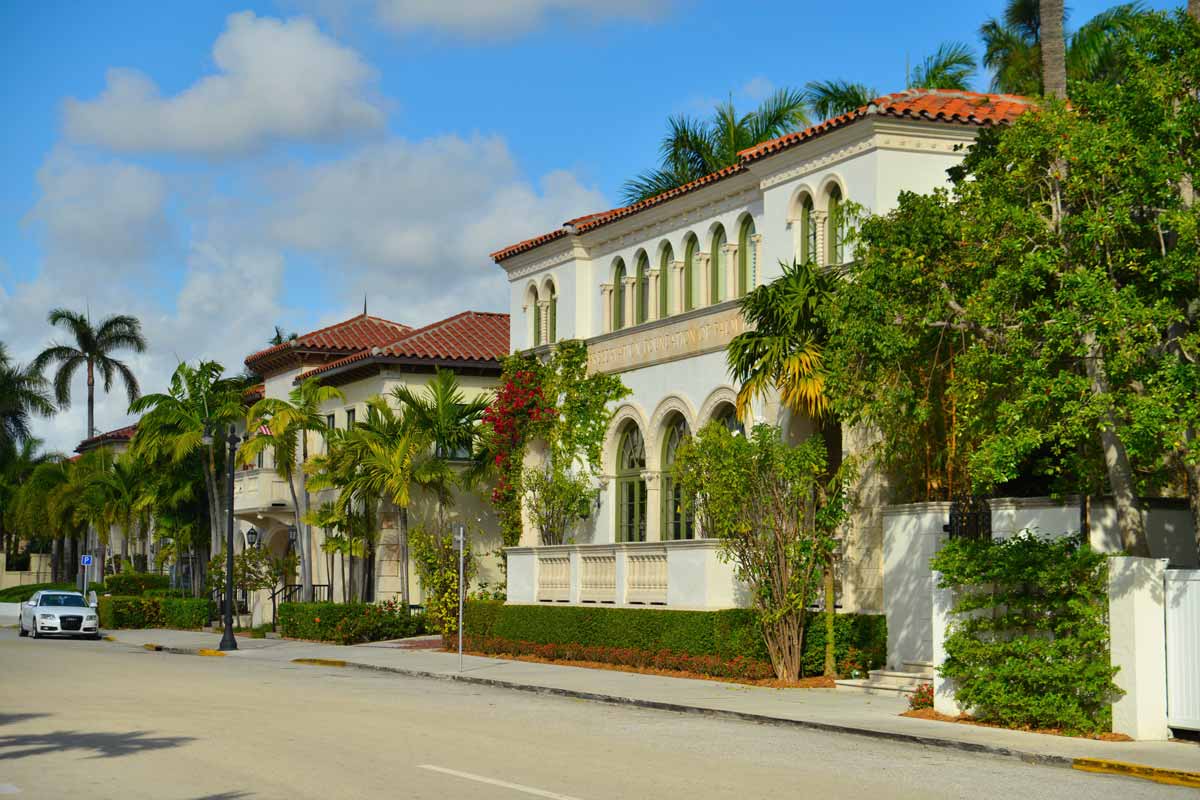
From oil to palm trees: the birth of luxury Florida
Palm Beach
Today, Palm Beach feels as if it has always existed: oceanfront villas behind hedges, hotels with marble lobbies, golf clubs, private charity dinners, white trousers in winter, quiet money and an almost theatrical certainty that luxury does not need to explain itself. For the residents of the northeastern United States, Florida has long been more than a resort. It has become a seasonal alternative to life itself: when Toronto and New York have grey skies, wet snow and early darkness, the South promises sun, terraces, palms and another version of who you might be.
But that dream did not appear by itself. It was not “found” on a map. It was built.
At the end of the nineteenth century, Florida was not yet the brand it would later become. The southern part of the Atlantic coast was difficult to reach, sparsely populated and inconvenient for wealthy northern tourists. The climate was beautiful, but climate alone is not enough to create a luxury destination. You need roads, hotels, electricity, docks, advertising, service, a legend - and someone who understands that wealthy people do not simply buy a place. They buy the confidence that the place already belongs to their world.
That man was Henry Morrison Flagler - co-founder of Standard Oil, partner of John D. Rockefeller, one of the architects of Gilded Age American capitalism and perhaps the principal builder of modern eastern Florida. He is often called the man who “invented modern Florida.” It sounds grand, but in Flagler’s case it is hardly an exaggeration.
He created what today might be called a vertically integrated luxury platform. Only instead of an app, an ecosystem and a subscription, he had a railroad, hotels, land, ports, newspapers, utilities and an unerring understanding of the psychology of the wealthy client.
Flagler came to Florida not as a romantic, but as an industrialist. He had already made his fortune in oil and understood the power of logistics better than most. At Standard Oil, success was built not only on the product, but on control of transportation, distribution, rates and access to markets. In Florida, he applied the same logic to the dream of escape.
First, he saw the problem. The northern elite had money, time and the desire to leave winter behind. But southern Florida was not ready to receive them at the level to which they were accustomed. You cannot sell a luxury season in a place that is hard to reach. You cannot keep wealthy guests without a hotel that confirms their status. You cannot create a resort without a sense of safety, beauty and belonging.
Flagler understood that if people were to come, he had to build not one hotel, but an entire route of desire.
In the 1880s, he began in St. Augustine, where he built the grand Ponce de León Hotel and invested in railroad infrastructure. But the true scale of his ambition became clear later, as he moved south along the Atlantic coast. In his project, the railroad was not merely a way to transport passengers. It was the spine of a new economy. Wherever rails appeared, stations followed, along with jobs, warehouses, farms, hotels, landowners, tourists and speculators. A place that yesterday seemed distant and almost empty suddenly became accessible.
That is how the story of Palm Beach as a luxury myth began.
In the early 1890s, Flagler turned his attention to the Lake Worth area. It was a place of extraordinary natural potential: a narrow strip of land between lagoon and ocean, a mild climate, water, light and tropical vegetation. But potential is not yet a resort. To turn a place into a symbol, three things were required: bring the right people there, house them in the right hotel and persuade them that they had become the first participants in a new privileged ritual.
In 1894, the Hotel Royal Poinciana opened. It was not merely a hotel, but a declaration. The enormous wooden building on the shore of Lake Worth would become one of the largest resort hotels of its time. Its scale was astonishing: hundreds, and later more than a thousand rooms, long corridors, a vast staff, its own infrastructure, shops, services and social life. A guest did not enter a hotel. A guest entered a seasonal city for the rich.
This is essential to understand. Palm Beach was not born as a beach resort in the modern democratic sense. It was born as a winter stage for the American elite. In northern cities, wealth already had its addresses - New York, Newport, Boston, Philadelphia. Flagler offered them a new seasonal address: a place where one could not merely wait out the winter, but confirm one’s status among equals.
The Royal Poinciana faced the lagoon, but wealthy guests soon wanted to be closer to the ocean. Flagler reacted immediately. In 1896, he opened the Palm Beach Inn on the ocean side. Guests began asking for rooms “near the breakers.” That is how the name The Breakers was born - one of the most famous names in American hotel history.
Today, The Breakers is perceived as a legend in its own right, but its origins belong to the same strategy. Flagler was not creating one property. He was creating a system. The Royal Poinciana offered scale, society and a seasonal capital. The Breakers offered ocean, air and more intimate luxury. The railroad delivered the guests. West Palm Beach, across the water, became the working, commercial and service side of this new reality.
Thus a social geography began to take shape, and much of it remains recognizable: the island as a showcase of wealth, the mainland as the city that sustains that showcase. In this model, one can already see the future of Florida: resort and service, privilege and labour, beauty and infrastructure, sun and money.
Flagler was brilliant precisely because he understood that luxury is not only architecture. Luxury is the absence of friction. The wealthy guest should not have to think about how to get there, where to stay, where to dine, what to do, how to send luggage, where to meet acquaintances, how to continue a familiar way of life in a new climate. Everything should already be solved.
And Flagler solved it.
He built railroads, hotels, docks, power plants, water systems, newspapers, churches and city streets. He understood that a luxury destination cannot rest on one beautiful idea. Behind it must stand dull, expensive, technical infrastructure. That is what turns nature into a resort, and a resort into an economy.
In this sense, Flagler was a predecessor of modern developers who sell not square feet, but lifestyle. Only his scale was almost imperial. He was not simply building a hotel by the ocean. He was changing the map.
When the railroad reached West Palm Beach, and then Miami, southern Florida ceased to be a distant edge. In 1896, Miami received a railroad connection and began its transformation from a small settlement into a future metropolis. Later, Flagler went even farther - to Key West. His Over-Sea Railroad, completed in 1912, became one of the most ambitious engineering projects of its time: a railway across water, islands, storms and doubt. Economically, the project was debatable, but symbolically it was flawless. Flagler wanted to prove that in America, rails could run almost to the edge of imagination.
Of course, this story cannot be told as a postcard without shadows. The Gilded Age was a time of enormous fortunes, fierce competition, monopolies, social inequality and almost unlimited power of capital. Standard Oil, where Flagler made his fortune, became a symbol of corporate power that the American state would later try to restrain through antitrust law. Flagler’s Florida was not built in a vacuum either. Before the luxury hotels, there were local communities, natural ecosystems, workers, Black residents, migrants and service staff without whom none of this beauty could have functioned.
Palm Beach was, from the beginning, not only a dream, but a hierarchy.
And yet it is precisely this duality that makes Flagler’s story so interesting for a modern reader. He was not simply “a rich man who built hotels.” He was a man who understood the mechanism by which territory becomes desire. Today, cities, brands, developers, travel companies, luxury groups and governments do the same. They sell climate, safety, status, lifestyle, tax appeal, cultural codes and proximity to “one’s own kind.” Flagler was doing it more than a century before Instagram, global real estate marketing and the language of destination branding.
He understood that a place becomes expensive not when it is beautiful. Beautiful places are common. A place becomes expensive when beauty is joined by access, infrastructure, social confirmation and story.
Palm Beach became exactly that kind of place. Its luxury rested not only on the ocean, but on legend: the “right” people came here, the “right” season appeared here, the “right” hotels were built here, the “right” distance from ordinary life emerged here. Wealth loves not merely comfort, but separation. Flagler gave it separation with a railroad timetable.
Whitehall, his own residence in Palm Beach, became another symbol of the era. The enormous house on Lake Worth, built as a gift for his young wife, did not look like a modest winter villa, but like a declaration: Flagler was not merely investing in Palm Beach; he was writing himself into its social mythology. When the creator of a resort lives there, he confirms the value of his own product.
There was a subtle marketing logic in this. Flagler did not tell the northern elite, “go there.” He told them, “I am already there.”
For today’s Russian-speaking audience in Canada, this story is especially easy to read through the experience of northern winter. We understand perfectly why the South is sold not only as geography, but as psychological liberation. Sun in January is not merely weather. It is status, health, mood, social capital and sometimes the illusion of a new life. In this sense, Flagler did not simply build Palm Beach. He commercialized the northerner’s dream of escaping winter.
But his main lesson is broader than tourism.
Flagler showed that great transformations rarely happen because of one element. A hotel does not create a resort. A road does not create a city. Climate does not create an economy. A system does. If you connect transportation, capital, land, service, architecture, advertising and a precise understanding of the audience, you can create a new centre of attraction where yesterday there was a periphery.
That is why his story still feels modern. Today, billionaires build space companies, artificial islands, new cities, technology campuses and luxury resorts in deserts. But the logic is largely the same: first infrastructure, then status, then mass desire. Flagler was one of the first Americans to apply this principle to an entire region.
He died in 1913, a year after the completion of the railway to Key West. By then, Florida had already changed irreversibly. Palm Beach had become the winter salon of wealthy America. Miami had received the impulse that would help turn it into a city of the future. The state’s east coast had been connected by rail. Tourism and agriculture had gained a foundation that would shape Florida’s economy for decades to come.
Of course, the region’s history after Flagler was complicated: hurricanes, land booms and busts, the Great Depression, fires, rebuilding, new waves of migration, Cuban influence, retirement communities, skyscrapers, gated communities and climate risks. But the original gesture remained: Florida could be not only developed, but reimagined - and that imagination could be sold to those willing to pay for it.
Palm Beach today is not a museum of Flagler, though his trace is everywhere. It is a living symbol of how capital can create not only buildings, but habits. Wealthy people gained a season. America gained a new southern ritual. Florida gained a luxury legend that continues to function more than a century later.
And if we look honestly, Flagler’s most important product was not the Royal Poinciana, not The Breakers and not even the Florida East Coast Railway.
He built the confidence that winter could be cancelled - if you had a ticket, luggage and the right address by the ocean.