
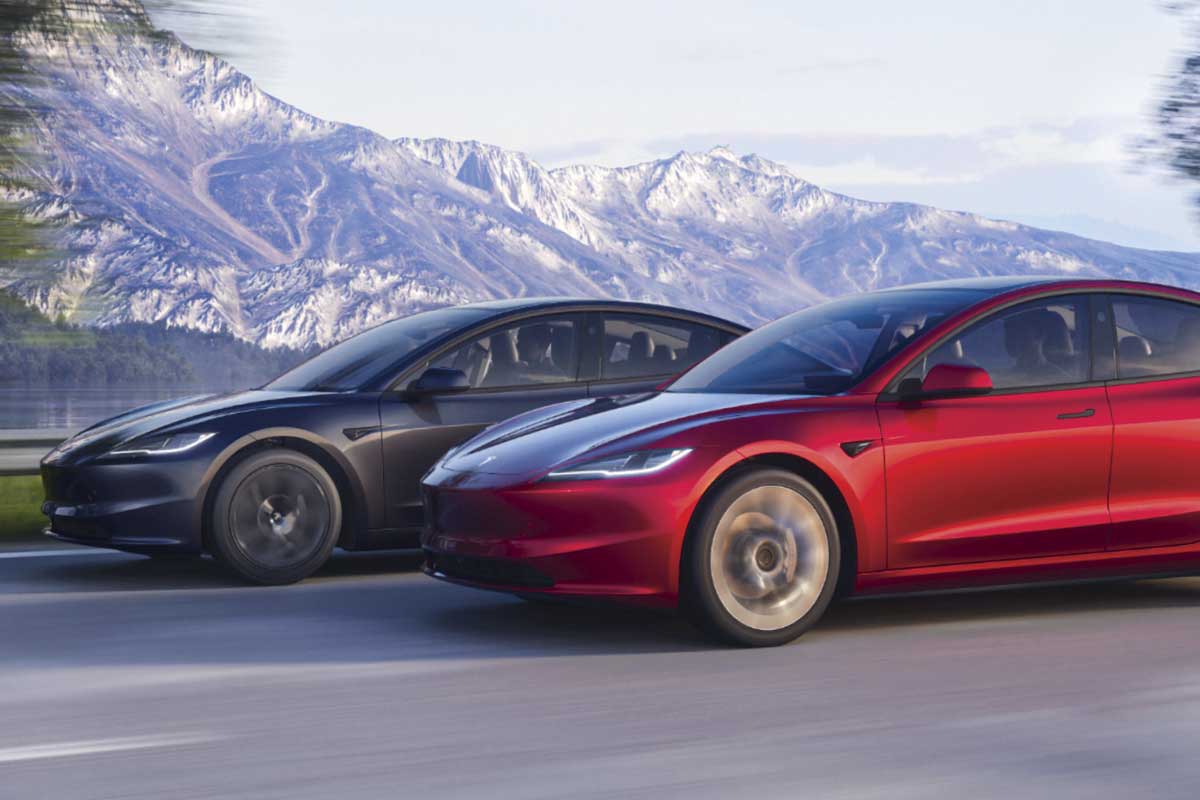
Tesla Model 3 Highland
Updated design and unexpected features
The Tesla Model 3 had long been ready for a major update. Since its launch in 2017, it had changed gradually: Tesla has never been fond of traditional model cycles with a clearly defined mid-cycle facelift every few years. Instead, the company has preferred to introduce constant small improvements to production, software and equipment. But the Model 3 update known as Highland became more than another round of incremental changes. It was, in effect, a serious reworking of one of the most important electric cars of the past decade.
For the Tesla Model 3, this is more than fresh headlights and a new bumper. The car received a more mature design, a quieter and better-finished cabin, a new rear screen, improved aerodynamics, increased range and noticeably more comfortable tuning. Tesla stated that roughly half of the car’s components were changed as part of the update. And it shows: the Model 3 has not become a different car in concept, but it has become a much more grown-up one in execution.
Exterior changes: front end, headlights and a new character
The most visible change is the redesigned front end. The updated Model 3 keeps its recognizable silhouette, but now looks lower, cleaner and more contemporary. The earlier slightly bulging nose, which many criticized on the original Model 3, is gone. The front bumper is smoother, the headlights are slimmer and sharper, and the entire face of the car has a more athletic and composed expression.
The rear also receives noticeable changes. Instead of the previous T logo in the centre, the car now carries TESLA lettering. The taillights look cleaner and more stretched, helping the car appear wider and more premium. This is not a revolutionary design, but it is exactly the kind of visual maturity the Model 3 had needed for a long time.
The colour palette also introduced a richer Ultra Red finish, replacing the previous multi-coat red in several markets. Already used on other Tesla models, it looks deeper, more modern and more expensive, especially against the cleaner lines of the updated body.
More efficiency means more range
One of the main improvements in the updated Model 3 is higher efficiency. Under the European WLTP cycle, versions fitted with 18-inch aerodynamic wheels showed noticeably increased range: around 554 km for the rear-wheel-drive version and up to 678 km for the Long Range. These figures were roughly 11–12% better than before, although for North America, EPA ratings matter more than WLTP numbers, since they are usually stricter and closer to local real-world use.
The increased range is not only about the battery, but about overall efficiency. The redesigned front end guides air more smoothly around the car, and the drag coefficient was reduced to approximately Cd 0.219 — one of the best figures among Tesla production cars. On highways, where aerodynamics play an especially important role, this directly helps reduce energy consumption.
The wheels were also revised. New aerodynamic covers help balance appearance and efficiency. Many owners prefer a more open wheel design, but aerodynamic elements provide additional range. Tesla tried to make them look cleaner, so that saving energy would not feel like a forced sacrifice of design.
Performance remains one of the Model 3’s strengths. The updated Long Range AWD accelerates to 100 km/h in about 4.4 seconds, while the rear-wheel-drive version does it in about 6.1 seconds. For a mainstream sedan, these are still very quick numbers, especially considering the instant response of the electric motor.
Interior: more quietness, comfort and a more premium feeling
The biggest changes in the Model 3 are not only outside, but inside. The early Model 3 was often praised for its minimalism, but criticized for noise, firmness and the overly simple feel of some materials. In the updated version, Tesla clearly tried to make the car feel more mature and more premium.
The cabin now includes a new 8-inch rear touchscreen, allowing second-row passengers to control climate and entertainment functions. For families and rear-seat passengers, this is a meaningful practical improvement: the Model 3 is no longer a car where almost all attention is focused on the driver and front passenger.
The front seats are more comfortable and now add ventilation to heating. In hot weather, this is a major improvement, and the ability to cool the cabin in advance through the Tesla app makes daily use more pleasant. The rear seats also receive updated perforated upholstery and heating, but not ventilation.
One of the most controversial changes is the removal of the stalks on the steering column. As in the larger Model S and Model X, turn signals are now controlled by buttons on the steering wheel, while gear selection has moved to the screen. Tesla is betting on software logic and minimalism, but not every driver will find this approach convenient. For some, it is a clean and modern interface; for others, it unnecessarily complicates familiar actions.
In terms of quietness, however, the update is an unquestionable step forward. Improved aerodynamics, acoustic glass, new seals and revised materials noticeably reduce cabin noise. This had previously been one of the Model 3’s weaker points compared with traditional premium sedans.
The multimedia experience has also improved. In higher trims, the audio system now has up to 17 speakers instead of the previous 14, microphones have been upgraded, and Wi-Fi and Bluetooth performance are more stable. A new customizable ambient LED lighting system adds visual depth and makes the interior feel less austere.
The rear trunk is slightly larger as well, increasing from around 561 to 594 litres. For a car many people use as a family daily driver, such details matter in real life.
More than an ordinary facelift
According to early impressions from owners and journalists, the updated Model 3 does not feel simply like the old car with a new face. The most important improvements are tied to everyday experience: a quieter cabin, smoother ride, better materials, more comfortable seats, a more modern digital environment and more attention to passengers.
The exterior refresh was expected, but the extent of the reworking in structure, sound insulation, suspension, interior and user interface turned out to be deeper than many anticipated. Of course, replacing a large number of components in a car always carries some risk of early production issues. Historically, Tesla has not always been flawless in build quality, especially during the early stages of new versions. But the company has significantly improved its manufacturing processes over the years, and the Model 3 remains one of the brand’s most proven platforms.
The main result of the update is simple: the Model 3 has grown up. It keeps the qualities people liked — efficiency, speed, software flexibility, a strong charging ecosystem and minimalist character. But now it adds quietness, comfort, a more premium feel and a design that no longer looks like Tesla’s first mass-market experiment, but like a mature electric car entering a new stage.