
How the United States was at war with Canada
Although the United States and Canada are allies today, their relationship was not always peaceful. The southern neighbour twice tried to change the fate of Britain’s northern possessions by force. The first attempt came in 1775, during the American War of Independence, when the Continental Army invaded Quebec in the hope of bringing the French-speaking population onto its side in the struggle against Britain. The attempt failed. The second came during the War of 1812, when the United States moved against Canada, seeing the British colonies as a military target, a political bargaining chip and, perhaps, a future territorial prize. That invasion failed as well.
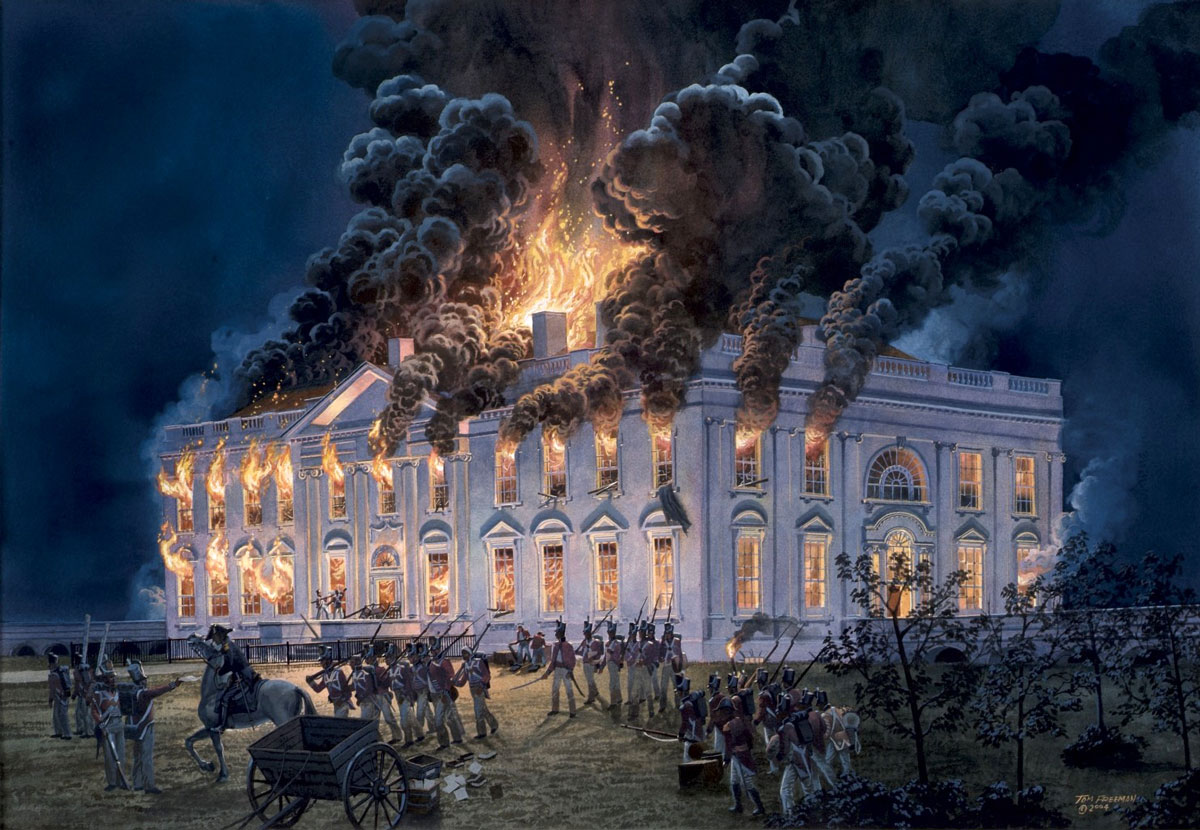
This is the story of the War of 1812 — not Napoleon’s European war, but another conflict that became one of the strangest and most contradictory wars in nineteenth-century North America. In the United States it has often been called the “Second War of Independence,” although there was no literal second conquest of independence. It was more a war for honour, trade rights, border security, continental influence and the young republic’s right to see itself as an independent power. At the same time, the war gave the United States new national symbols, new heroes and severe humiliations — including the capture of Washington by British troops and the burning of the White House and the Capitol.
In the long run, the Indigenous peoples of North America suffered more than anyone. For many Indigenous nations, the War of 1812 was not merely an episode between Washington and London, but part of a much longer struggle for land, autonomy and survival. The British used alliances with Indigenous peoples against American expansion, while Americans viewed resistance on the western frontier as a threat to their future growth. After the war, pressure on Indigenous nations only intensified, and in 1830 the United States passed the Indian Removal Act, one of the most tragic symbols of forced removal policy.
Why the war began
Formally, the causes of the war were connected with maritime trade and the confrontation between Britain and France during the Napoleonic Wars. The British Empire, fighting Napoleon, tried to control trade with Europe and imposed restrictions that affected American ships. France responded with its own measures. The young United States, claiming the right to neutral trade and freedom of navigation, found itself caught between two giants.
Americans were especially angered by Britain’s Orders in Council, the search of merchant vessels, the seizure of cargo and the practice of impressment — the forced removal of sailors from American ships into the British navy on the grounds that they were British subjects. President Thomas Jefferson’s attempt to answer with economic pressure, the Embargo Act of 1807, hurt American merchants more than anyone else and became deeply unpopular at home.
But the war had another, more territorial cause: Canada. British possessions were close, and Britain was occupied with the fight against Napoleon. For American war hawks, this looked like a historic opportunity. Some spoke of defending trade and national honour. Others emphasized border security and the struggle against British influence among Indigenous nations. Still others saw Canada as a possible territorial prize, or at least as a useful bargaining tool against London.
Look north, the supporters of war argued. There are British colonies, loyalists, French-speaking Quebec, the Great Lakes and lands that look like a natural extension of American space. From the west, they claimed, came the threat of Indigenous confederacies supported by the British. To the south remained Spanish Florida. The young republic was already beginning to think in terms of continental expansion, although the phrase Manifest Destiny still lay decades in the future.
The decision for war came in June 1812. The irony of history is that around the same time, Britain had already begun changing its policy toward American trade. But news crossed the Atlantic slowly. On June 18, 1812, the United States declared war on Great Britain.
An unprepared war
The United States was poorly prepared for war. Its regular army was small, weakly trained and not always well led. State militias often had little desire to participate in offensive operations beyond their own territories. The navy was limited, although individual American ships and captains would soon prove themselves remarkably capable. The main strategic objective became Canada.
On paper, the American plan looked simple: strike in several directions, capture key positions in Upper and Lower Canada, force Britain to negotiate and perhaps alter the balance of power in North America. In practice, everything proved far more difficult. Militia units were reluctant to cross the border, commanders made mistakes, logistics were weak, and Canadian loyalists, British regulars and allied Indigenous forces offered far stronger resistance than Washington expected.
In 1812, American invasions of Canada failed. One of the most painful defeats came at Detroit, where American general William Hull surrendered the city to the British and their allies. Attempts to advance along the Niagara frontier and toward Montreal also failed to produce a decisive success.
In 1813, the Americans achieved some victories, especially on the Great Lakes. Commodore Oliver Hazard Perry’s victory on Lake Erie became an important moment in the war and allowed the Americans to regain their position in the northwest. But overall, the dream of a quick and easy campaign against Canada collapsed. The war dragged on.
York, Washington and the logic of retaliation
In the spring of 1813, American troops captured York — the future Toronto and then the capital of Upper Canada. During the raid, important buildings were destroyed and burned, including parliamentary structures. For the British and Canadian colonists, this became a painful symbol of American aggression. Later, such actions were often cited as moral justification for the retaliatory strike against Washington.
After Napoleon’s fall in 1814, Britain was able to send more forces to North America. A war that had previously been a secondary theatre for London suddenly became a chance to punish the former colony and improve Britain’s position before peace negotiations.
In the summer of 1814, British forces landed in the Chesapeake Bay region and marched on Washington. American defence proved weak. On August 24, 1814, at the Battle of Bladensburg, American troops and militia were quickly routed. The defeat would later be called one of the most humiliating episodes in American military history.
That same day, British troops entered Washington. The government fled. First Lady Dolley Madison managed to remove important documents and the famous portrait of George Washington from the White House. The British burned the White House, the Capitol and several other government buildings. These were British troops, not “Canadian soldiers,” although that myth still appears occasionally in Canadian and American popular culture.
The symbolic power of the strike was enormous. The young republic, which had expected to seize British Canada, saw its own capital in flames. For the British, this was retaliation for American actions in Upper Canada. For Americans, it was a humiliation that had to be transformed as quickly as possible into a story of endurance and renewal.
Baltimore and the birth of an anthem
After Washington, the British moved toward Baltimore, one of the most important American ports. This time, resistance was much stronger. In September 1814, the British fleet bombarded Fort McHenry, which guarded the entrance to the harbour. In the morning after the bombardment, the American flag still flew above the fort.
The sight inspired lawyer Francis Scott Key, who had watched the attack, to write the poem Defence of Fort M’Henry. The words were later set to the melody of a British song and became known as The Star-Spangled Banner. It became the official national anthem of the United States only in 1931, but its origin is directly tied to the War of 1812 and the defence of Baltimore.
In this way, a war full of chaos, errors and defeats gave America one of its central national symbols. The paradox of history is that the symbol was born not from a victorious offensive, but from a night of fear, siege and one question: would the flag still be there in the morning?
The Great Lakes and the war at sea
If American success on land was uneven, individual victories at sea and on the Great Lakes acquired enormous symbolic importance. The Battle of Lake Erie in September 1813 was one such moment. After his victory, Perry sent the famous message: “We have met the enemy and they are ours.” The phrase entered American military memory.
The frigate USS Constitution also became one of the symbols of the war. Its victories over British ships made a strong impression on the American public. The ship earned the nickname Old Ironsides and remains one of the most famous historic vessels in the United States.
Against the background of general strategic uncertainty, such naval successes mattered greatly to national morale. They proved that the young republic could challenge the world’s strongest navy, at least in individual engagements. For a country that had only recently been a British colony, that mattered almost as much as the formal outcome of the war.
Plattsburgh and the saved road to New York
In the autumn of 1814, the British launched a major northern offensive along Lake Champlain, threatening New York. The British army advanced from Canada, but its success depended on control of the lake. In September 1814, near Plattsburgh, an American flotilla defeated the British squadron.
The defeat on the water made further advance risky. The British commander feared for his communications and decided to retreat to Canada. Another campaign that could have sharply changed the course of the war ended without a strategic breakthrough.
The Treaty of Ghent and the battle after peace
By the end of 1814, both sides were tired of the war. Britain needed to focus on the European balance of power after Napoleon, while the United States faced military setbacks, economic pressure and internal discontent. In New England, where the war was especially unpopular, Federalists gathered at the Hartford Convention, later remembered as a dangerous sign of regional fracture.
On December 24, 1814, the Treaty of Ghent was signed. It essentially returned the parties to the prewar status quo: no territorial gains, no indemnities and no final settlement of the issues that had led to war. But news from Europe travelled slowly, so one of the war’s most famous battles took place after peace had already been signed.
On January 8, 1815, near New Orleans, American forces under Andrew Jackson defeated the British army of General Edward Pakenham. The British suffered heavy losses, Pakenham was mortally wounded, and American casualties were comparatively light. Militarily, the battle could no longer change the terms of peace. Psychologically, however, it changed a great deal.
For Americans, New Orleans became not merely a victory, but the beautiful ending the war had lacked after Washington, Bladensburg and failed campaigns against Canada. Andrew Jackson became a national hero and later the seventh president of the United States. The memory of the war gradually rearranged itself: defeats receded, while Baltimore, Perry, Old Ironsides and New Orleans moved to the foreground.
Who truly lost
The Treaty of Ghent did not resolve most of the issues that had caused the war. British impressment effectively lost relevance after the end of the Napoleonic Wars. Territorial borders remained unchanged. The United States did not take Canada, Britain did not break American independence, and both sides could claim they had preserved their honour.
But for Indigenous nations, the consequences were far more severe. Their hope for a buffer territory between the United States and British Canada disappeared. In signing peace, the British could no longer, or would no longer, effectively protect their Indigenous allies. American expansion westward resumed with new force. In this sense, the true losers of the war were not Washington or London, but the Indigenous peoples whose political and territorial autonomy came under even greater pressure after 1815.
Article IX of the Treaty of Ghent formally promised to end hostilities with Indigenous peoples and restore the rights and possessions they had enjoyed before the war. In practice, that wording proved weak and almost powerless against further American expansion. Within the next generation, removal policy, treaty pressure and military force would radically alter the map of North America.
A war turned into myth
The phrase “Second War of Independence” is attractive, but debatable. American independence already existed by 1812. Britain was not trying to return the former colonies to direct rule. Psychologically, however, the war did become a final separation from the image of the former mother country. The young republic could tell itself: we endured once again.
The war became an important part of American mythmaking. From it came The Star-Spangled Banner, the hero of New Orleans Andrew Jackson, the legend of Old Ironsides and the image of a country able to withstand the blow of a great empire. During the War of 1812 era, the figure of Uncle Sam also gained strength, linked to the legend of meat packer Samuel Wilson, who supplied the army with barrels marked U.S. Over time, that image became the personification of the United States.
And yet the War of 1812 remains inconvenient for a simple heroic legend. The United States began it expecting an easy campaign against Canada, but failed to achieve that goal. Britain burned the American capital, but did not impose a humiliating peace. Canada strengthened its sense of separateness from the United States. Indigenous peoples lost the most. And the result for the major participants was a status quo that every side learned to tell as victory.
That is why the War of 1812 remains so interesting. It is not a story with one simple winner and one simple loser. It is a war of ambition, errors, symbols and memory. It showed that North America was no longer merely an extension of Europe, but had not yet become the continent we know today.